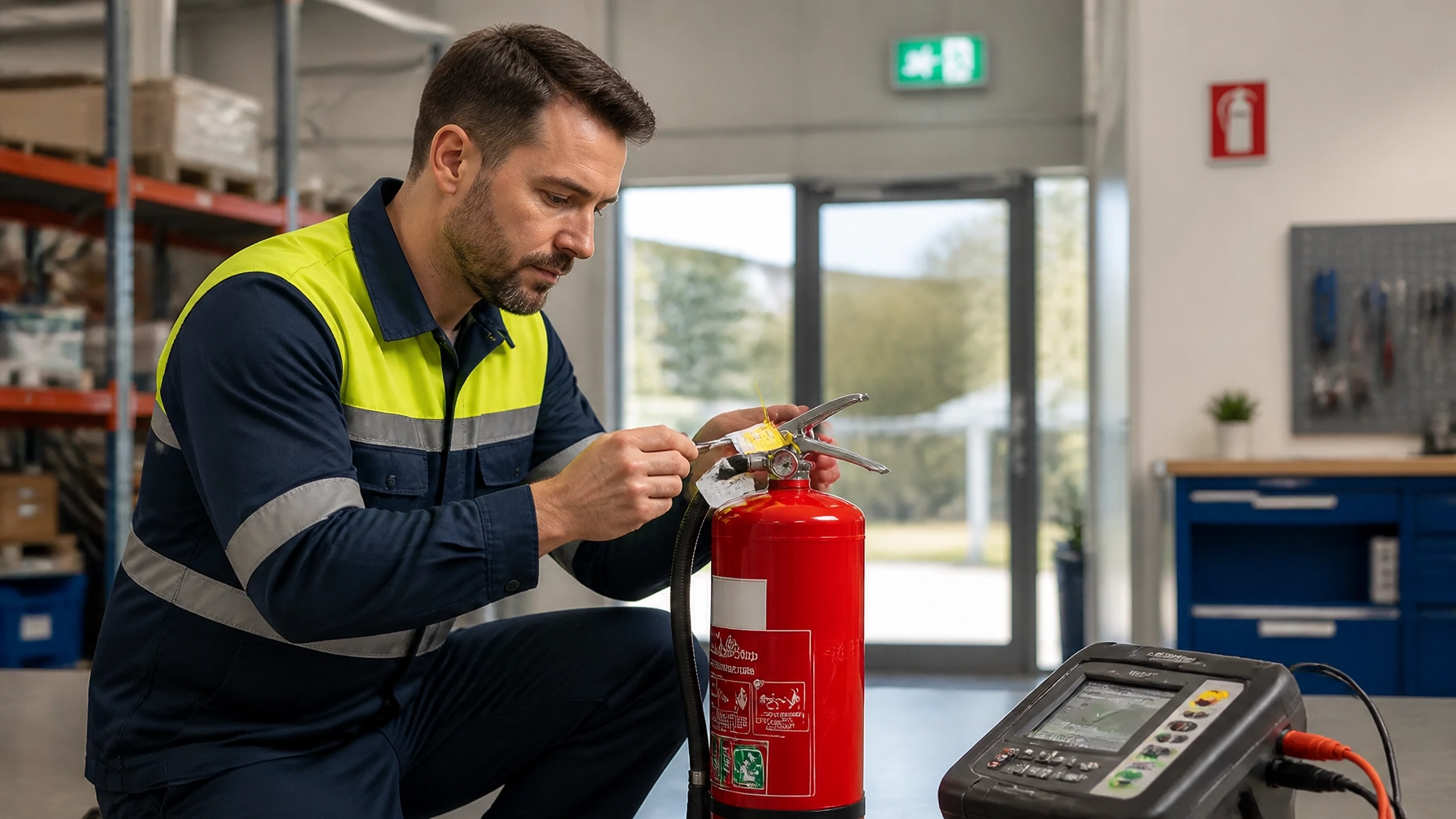
Capalaba is one of Brisbane’s Southside and Redlands Coast’s most significant retail, commercial and light-industrial hubs. Businesses operating around Capalaba Central, Capalaba Business Park, Old Cleveland Road and Redland Bay Road rely on portable electrical equipment, machinery, fire protection systems and emergency lighting every day.
That operating environment creates an ongoing compliance obligation. Retail stores, offices, warehouses, workshops, factories and construction worksites must identify hazards, maintain safety equipment and retain evidence that inspections and testing have been completed.
This article is part of the Brisbane Suburban Safety Compliance Series. It explains how local businesses can arrange test and tag Capalaba, RCD testing, fire extinguisher servicing and exit light testing through one coordinated provider: and save 40% when eligible electrical and fire services are bundled together.
Why Is Electrical Safety Compliance Important in Capalaba?
What risks are common in Capalaba workplaces?
Capalaba’s mixed commercial environment means that electrical equipment may be exposed to frequent movement, extended use, dust, moisture, heat, mechanical impact and changing work conditions.
Typical equipment includes:
- 240V portable appliances
- Three-phase equipment
- Power boards and extension leads
- Portable power tools
- Refrigeration and kitchen equipment
- Warehouse chargers and cleaning equipment
- Office computers, printers and kitchen appliances
- Construction tools and temporary electrical equipment
- Portable and fixed RCDs
A damaged lead, cracked plug, failed earth connection or overloaded power board can create an electric shock, fire or equipment-failure risk.
Queensland businesses must manage electrical risks under the Electrical Safety Act 2002 and the Electrical Safety Regulation 2013.
“A person conducting a business or undertaking at a workplace must manage risks to health and safety associated with electrical risks at the workplace.”
Test and tag is therefore not merely a labelling exercise. It is one component of a systematic electrical risk-management process.
What Does Test and Tag Capalaba Involve?
Electrical test and tag is the structured inspection and testing of in-service electrical equipment. The process is performed with reference to AS/NZS 3760:2022, the recognised Standard for the in-service safety inspection and testing of electrical equipment and RCDs.

Standards Australia explains that AS/NZS 3760:2022 provides guidance relating to visual inspection, electrical testing, test intervals, tagging, recordkeeping and technician competency. Read the Standards Australia overview of AS/NZS 3760:2022.
How is the process completed?
A competent technician should follow a consistent process:
-
Identify the equipment
Each item is recorded using a plant number, asset number, serial number, location or another reliable reference. -
Conduct a visual inspection
Cords, plugs, casings, switches, strain reliefs and connections are examined for damage, overheating, contamination, exposed conductors and unauthorised modification. -
Complete the appropriate electrical tests
Depending on the equipment, testing may include earth continuity, insulation resistance, polarity, leakage current and functional checks. -
Assess the result
Equipment that fails should be isolated, identified and removed from service until repaired, replaced or otherwise managed through the business’s defect-control procedure. -
Apply a durable compliance tag
Passed equipment receives a tag showing relevant test information and the next scheduled date. ABC Test Tag & Fire also provides QR-coded tags to improve asset traceability. -
Issue digital records
Digital compliance certificates and reports provide accessible evidence for workplace reviews, landlord requirements, insurance documentation, client audits and regulatory enquiries.
How Does AS/NZS 3760 Apply to Different Capalaba Businesses?
There is no single testing interval that is suitable for every workplace. The appropriate schedule depends on the equipment, environment, frequency of use, likelihood of damage and consequences of failure.
| Capalaba workplace | Typical equipment and conditions | Compliance consideration |
|---|---|---|
| Retail stores and shopping-centre tenancies | Point-of-sale equipment, appliances, leads and portable displays | Generally lower risk, but equipment remains subject to inspection and applicable requirements |
| Offices and professional premises | Computers, monitors, printers, kitchen appliances and extension leads | Risk-based scheduling should reflect how equipment is used |
| Warehouses and logistics areas | Chargers, portable tools, cleaning equipment and extension leads | Movement, impact and loading-area conditions may require more frequent testing |
| Workshops and light-industrial premises | Grinders, drills, machinery accessories and three-phase equipment | Dust, vibration, mechanical damage and intensive use increase risk |
| Construction worksites | Temporary power, portable tools, leads and portable RCDs | High-risk conditions generally require a more frequent inspection and testing regime |
These categories are general guidance only. A documented risk assessment should be used to confirm the program for each site.
Do not apply a low-risk office schedule to equipment used in a workshop, warehouse loading area or construction environment.
What Is Included in RCD Testing in Capalaba?
Residual Current Devices, commonly known as safety switches, are designed to disconnect electrical supply when they detect an imbalance in current. They are an important protection measure, but an RCD must be tested to confirm that it operates correctly.
RCD testing may include:
- Push-button functional testing
- Instrument testing of trip time and performance
- Testing of fixed safety switches
- Testing of portable RCDs
- Identification of defective or overdue devices
- Recording of results and next scheduled test dates
A push-button test confirms that the test mechanism operates. It does not provide the same level of information as an instrument test that measures trip performance.
Queensland requirements and testing intervals vary according to the workplace, equipment and RCD type. Businesses should establish their schedule with reference to AS/NZS 3760, current Queensland legislation and the actual site risk profile.
If an RCD fails, do not continue using the affected equipment or circuit without appropriate investigation. Arrange rectification through a suitably licensed electrical contractor where fixed electrical installation work is required.
For further information, read ABC Test Tag & Fire’s AS/NZS 3760 guide for Brisbane workplaces and RCD testing frequency guide.
Why Is Fire Extinguisher Testing Required in Capalaba?
Retail premises, warehouses, workshops and light-industrial businesses may contain combustible packaging, stock, cooking equipment, vehicles, batteries, electrical machinery, chemicals or other fire hazards.
Fire extinguishers and fire blankets must remain:
- Suitable for the hazards present
- Clearly visible and accessible
- Correctly positioned
- Free from damage and obstruction
- Within the required service period
- Properly recorded in the site’s fire safety documentation
ABC Test Tag & Fire conducts six-monthly routine fire extinguisher and fire blanket servicing in accordance with AS1851:2012.
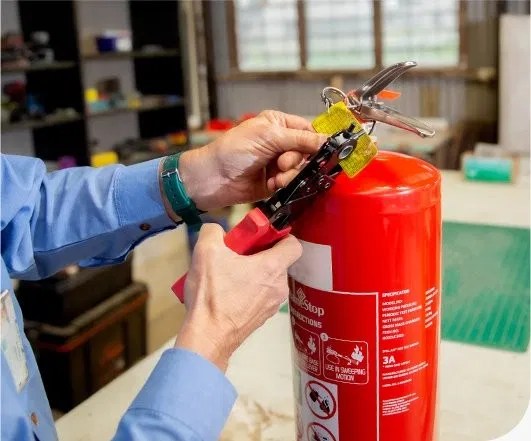
Businesses searching for fire extinguisher test and tag Capalaba should note that fire equipment servicing is separate from electrical test and tag. Electrical equipment is tested under AS/NZS 3760, while fire extinguishers and blankets are serviced with reference to AS1851:2012 and applicable Queensland fire safety requirements.
The service may identify:
- Missing or damaged safety seals
- Incorrect placement
- Obstructed access
- Corrosion or physical deterioration
- Pressure or charge issues where applicable
- Expired or incomplete service records
- Equipment that is unsuitable for the identified hazard
ABC Test Tag & Fire can also supply replacement extinguishers, fire blankets and other safety equipment where additional or replacement protection is required.
How Does Exit Light Testing Support Emergency Preparedness?
During a power failure or emergency, workers, customers, contractors and visitors must be able to identify escape routes and exits.
ABC Test Tag & Fire provides exit light testing and sales in accordance with AS/NZS 2293, the recognised Standard covering emergency escape lighting and exit signs.

Testing may identify:
- Failed lamps or LED modules
- Battery deterioration
- Damaged fittings, housings or diffusers
- Poor visibility of exit signs
- Inadequate illumination along escape paths
- Fittings that do not operate during simulated power failure
- Obstructed or poorly identified exit routes
The testing schedule should reflect the building, system design and applicable requirements. Keep all exit paths clear. Record defects and arrange rectification without delay.
How Can Capalaba Businesses Save 40%?
Many businesses require several compliance services during the same maintenance cycle. Arranging electrical test and tag, RCD testing, fire equipment servicing and exit light testing separately can create duplicated travel, multiple appointments and fragmented reporting.
ABC Test Tag & Fire’s bundled service coordinates these requirements through one locally owned and fully insured provider.
An eligible bundled booking may include:
| Service | Compliance focus | Documentation or outcome |
|---|---|---|
| Electrical test and tag | AS/NZS 3760 and Queensland electrical safety requirements | Durable tags and digital compliance records |
| RCD testing | Safety-switch operation and scheduled testing | Recorded test results and defect identification |
| Fire extinguisher servicing | AS1851:2012 routine servicing | Service tags and digital certificates |
| Fire blanket servicing | Fire equipment condition and readiness | Inspection records and replacement advice |
| Exit light testing | AS/NZS 2293 emergency escape lighting requirements | Test results and rectification recommendations |
| Safety equipment sales | Replacement or additional workplace protection | Suitable extinguishers, blankets and related products |
By combining eligible electrical and fire safety services, Capalaba businesses can save 40% on the bundled service, subject to the number of assets, site conditions and final quotation.
Additional benefits include:
- Fast, hassle-free digital reporting
- QR-coded equipment tags
- One coordinated service appointment
- Reduced administration
- A locally owned service provider
- Fully insured technicians
- The opportunity to earn Qantas points on eligible services, subject to current program terms
Capalaba Workplace Safety Compliance Checklist
Before your next scheduled inspection, confirm the following:
- Portable and connectable electrical equipment has been identified.
- Warehouse, workshop, retail and office risks have been considered separately.
- Electrical equipment is tested and tagged under the applicable AS/NZS 3760 requirements.
- Fixed and portable RCDs are tested at the required intervals.
- Failed equipment is isolated and removed from service.
- Fire extinguishers and blankets are serviced under AS1851:2012.
- Fire equipment remains visible, accessible and correctly positioned.
- Exit signs and emergency lighting are tested under AS/NZS 2293.
- Digital compliance certificates are stored centrally.
- Defects are assigned to a responsible person for rectification.
- The next service is scheduled before the due date.
- Bundled service savings have been considered.
Book Electrical and Fire Safety Compliance in Capalaba
A systematic compliance program helps Capalaba businesses manage electrical, fire and emergency-evacuation risks while maintaining reliable documentation.
ABC Test Tag & Fire services Capalaba, Brisbane, Ipswich, the Gold Coast and surrounding suburbs. To arrange test and tag Capalaba, electrical safety compliance Capalaba, RCD testing, fire extinguisher servicing or exit light testing, call:
Book your electrical and fire services together and ask how your business can access the 40% bundled discount, QR-coded tags, digital compliance certificates and Qantas points on eligible services.