For Queensland homeowners, the countdown to a significant regulatory shift is well underway. By 1 January 2027, every owner-occupied residence in the state must comply with updated smoke alarm legislation. While this deadline may seem distant, the complexity of the requirements and the potential for a last-minute surge in demand for qualified installers mean that proactive planning is essential.
Failure to meet these standards is not merely a matter of non-compliance with the Fire and Emergency Services Act 1990; it is a fundamental risk to life and property. Research consistently indicates that photoelectric, interconnected smoke alarms provide the earliest possible warning of smouldering fires, which are most common in residential settings during sleeping hours.
What Are the Core Regulatory Requirements for 2027?
The upcoming mandate necessitates a transition to a higher standard of fire detection technology. To achieve electrical safety compliance in Brisbane and across Queensland, homeowners must ensure their systems meet three primary criteria:
- Photoelectric Sensors Only: All alarms must be photoelectric. Older ionisation alarms, which detect invisible particles from flaming fires but are slower to respond to smouldering domestic fires, will no longer be permitted. All devices must comply with AS 3786-2014.
- Mandatory Interconnection: When one alarm detects smoke, every alarm in the dwelling must sound. This "all-in-one-in" system ensures that occupants are alerted regardless of their location relative to the fire. Interconnection can be achieved via physical wiring or wireless radio frequency.
- Specific Power Sources: Alarms must be either hard-wired to the 240V mains power supply (with a battery backup) or powered by a non-removable, 10-year lithium battery.
Where Must Smoke Alarms Be Installed?
A common point of failure for homeowners is the incorrect placement of devices. The legislation is prescriptive regarding the systematic distribution of alarms within a dwelling. By 2027, you must have alarms installed in the following locations:
- Every Bedroom: Detection must occur at the source of a potential fire within sleeping quarters.
- Connecting Hallways: Any hallway that connects bedrooms to the rest of the dwelling must be equipped with an alarm.
- Every Storey: Regardless of whether a level contains bedrooms (including multi-purpose areas or enclosed garages), at least one alarm must be installed on each storey.
Caption: Ensuring all alarms are interconnected is a legal requirement under the new QLD legislation.
Critical Mistakes: How Homeowners Risk Non-Compliance
Even with the best intentions, many property owners fall into technical traps that compromise both safety and legal standing. Avoiding these pitfalls is the first step toward total compliance.
1. Assuming "Grandfathered" Compliance
A prevalent misconception is that because a home was compliant when purchased or built, it remains so indefinitely. The 2027 deadline removes "grandfathering" provisions for owner-occupiers. If your alarms are not interconnected or are ionisation-based, your home will be non-compliant as of January 1, 2027.
2. Purchasing Incompatible Hardware
The market is saturated with "budget" smoke alarms that may carry a generic certification but fail to meet the rigorous AS 3786-2014 standard required in Queensland. Furthermore, purchasing standalone battery alarms that lack interconnection capabilities is a wasted investment, as they will not satisfy the legislative requirements.
3. Attempting DIY 240V Installations
In Queensland, any work involving 240V mains power, including the installation of hard-wired smoke alarms, must be performed by a licensed electrical contractor. Attempting this yourself is not only a breach of electrical safety laws but may also void your home insurance policy in the event of a fire.
4. Incorrect Positioning Relative to Environmental Factors
Alarms placed too close to air conditioning vents, ceiling fans, or bathroom doors are prone to "dead air" pockets or nuisance tripping. Professional smoke alarms installation ensures that sensors are placed in locations where airflow is optimal for detection but shielded from steam or excessive dust.
The Systematic Process for Achieving Compliance
Achieving total compliance requires more than just a trip to the hardware store. It involves a strategic assessment of your home’s layout and electrical infrastructure.
| Step | Action | Description |
|---|---|---|
| 1 | Audit | Conduct a visual inspection of all existing alarms. Check the manufacture date (usually on the back) and sensor type. |
| 2 | Mapping | Identify every bedroom and storey. Determine if a hallway exists or if alarms need to be placed in transitional areas. |
| 3 | Selection | Choose high-quality photoelectric alarms. Decide between 240V hard-wired or 10-year wireless lithium models based on ease of installation and current wiring. |
| 4 | Installation | Engage a professional to install and interconnect the units, ensuring they meet the spacing requirements of AS 1670.6. |
| 5 | Certification | Retain your compliance certificate and invoices as proof for insurers and future property sales. |
Why Professional Installation is Non-Negotiable
While the hardware itself is critical, the installation is where most compliance issues arise. Our technicians at ABC Test Tag & Fire provide a comprehensive solution that mitigates risk for Brisbane and Ipswich homeowners.
We don't just "fit" alarms; we design a safety system. This includes verifying signal strength for wireless interconnections and ensuring that hard-wired units are integrated into your home's circuitry without compromising existing electrical loads.
Bundling Your Safety Services
Many homeowners overlook the opportunity to combine their smoke alarm upgrades with other essential safety checks. By bundling services such as RCD (Safety Switch) testing or a general electrical safety audit, clients can frequently save between 20% and 40% on their total compliance costs.
Furthermore, as a locally owned and fully insured provider, we offer a unique incentive: you can earn Qantas Points on all smoke alarm installation and fire safety services. It is an effective way to turn a mandatory compliance expense into a personal benefit.
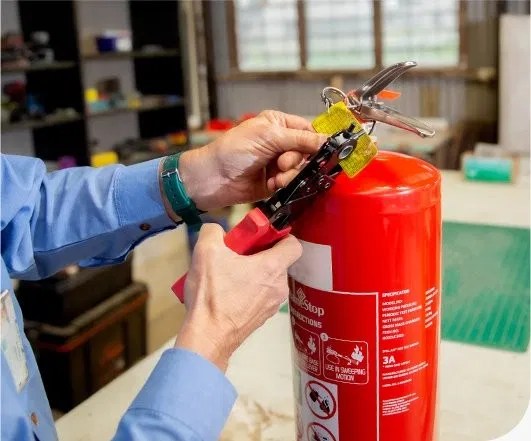
Caption: Professional installation ensures your home meets AS 3786-2014 standards and maintains your insurance validity.
Frequently Asked Questions
What happens if I don't comply by 2027?
Beyond the obvious safety risks, non-compliance can lead to substantial fines. More importantly, many insurance providers are updating their PDS (Product Disclosure Statements) to reflect that homes must meet current state legislation to be covered for fire damage.
How do I know if my current alarms are photoelectric?
Look for a "P" or the word "Photoelectric" on the alarm body. If the alarm has a small radiation symbol on the back, it is an ionisation model and must be replaced.
Can I mix 240V and 10-year battery alarms?
Yes, provided they are all interconnected and of the same brand/series to ensure communication compatibility. Often, a "hybrid" approach is most cost-effective for multi-storey homes.
Secure Your Compliance with ABC Test Tag & Fire
The 2027 deadline is a hard cutoff. As the date approaches, the availability of licensed technicians will decrease while costs for hardware may fluctuate due to high demand. By acting now, you ensure your family’s safety and avoid the stress of last-minute regulatory scrambling.
ABC Test Tag & Fire is dedicated to making smoke alarms and general electrical safety compliance in Brisbane simple, fast, and cost-effective. We provide digital compliance certificates immediately upon completion, giving you the documentation you need for peace of mind.
Contact us today to schedule your smoke alarm audit or installation and start earning Qantas Points on your home safety.