Nudgee workplaces operate within a strategically located Brisbane employment and transport area, with businesses positioned near Nudgee Road, the Gateway Motorway and routes connecting commercial, airport and port-related operations. Warehouses, logistics facilities, transport depots, workshops, trade premises, offices and commercial sites all depend on electrical equipment and fire safety systems that must remain safe, accessible and properly documented.
For these businesses, workplace safety compliance is not limited to placing a test tag on an appliance. It requires a systematic process covering electrical inspection, RCD testing, fire equipment servicing, emergency egress, defect management and reliable digital records.
ABC Test Tag & Fire provides coordinated test and tag Nudgee, electrical safety compliance, RCD testing, fire extinguisher testing and exit light testing for businesses across Brisbane, Ipswich and the Gold Coast.
Why Is Workplace Safety Compliance Important in Nudgee?
What electrical and fire risks should Nudgee businesses assess?
Equipment used in logistics, transport and workshop environments may be:
- Moved frequently between work areas
- Exposed to dust, moisture, impact, vibration or chemicals
- Used outdoors or near loading and unloading areas
- Connected and disconnected repeatedly
- Subject to damage from vehicles, pallets, tools or machinery
- Shared by employees, contractors and visitors
- Operated continuously during production or dispatch activities
These conditions can accelerate deterioration of plugs, cords, power boards, portable tools and three-phase equipment. A damaged lead, ineffective earth connection or defective RCD may create an electric shock, fire or operational hazard.
Queensland businesses and PCBUs must manage risks associated with electrical equipment under the Electrical Safety Act 2002, the Electrical Safety Regulation 2013 and applicable workplace health and safety duties.
“A person conducting a business or undertaking at a workplace must manage risks to health and safety associated with electrical risks at the workplace.”
A documented inspection and maintenance program helps demonstrate that electrical and fire risks are being identified, controlled and reviewed.
What Does Test and Tag Nudgee Involve?
Electrical test and tag is conducted under the recognised framework of AS/NZS 3760:2022 : In-service safety inspection and testing of electrical equipment and RCDs.
ABC Test Tag & Fire can inspect and test:
- 240V electrical equipment
- Three-phase equipment and cord sets
- Portable power tools
- Extension leads and power boards
- Office and kitchen appliances
- Workshop and warehouse equipment
- Portable lighting
- Relevant low-voltage equipment
- Fixed and portable RCDs
The testing interval should be based on equipment use, environment, damage exposure, previous failure history and the applicable Queensland requirements. Industrial and construction environments generally require more frequent attention than controlled, low-risk office areas.
How Is Electrical Equipment Inspected and Tested?
A competent technician follows a structured process.
-
Asset identification
Equipment is recorded against an asset number, serial number, location or other identifier. -
Visual inspection
The technician checks the plug, cord, casing, switches, strain relief and accessories for visible defects, contamination, overheating, unauthorised modification and mechanical damage. -
Instrument testing
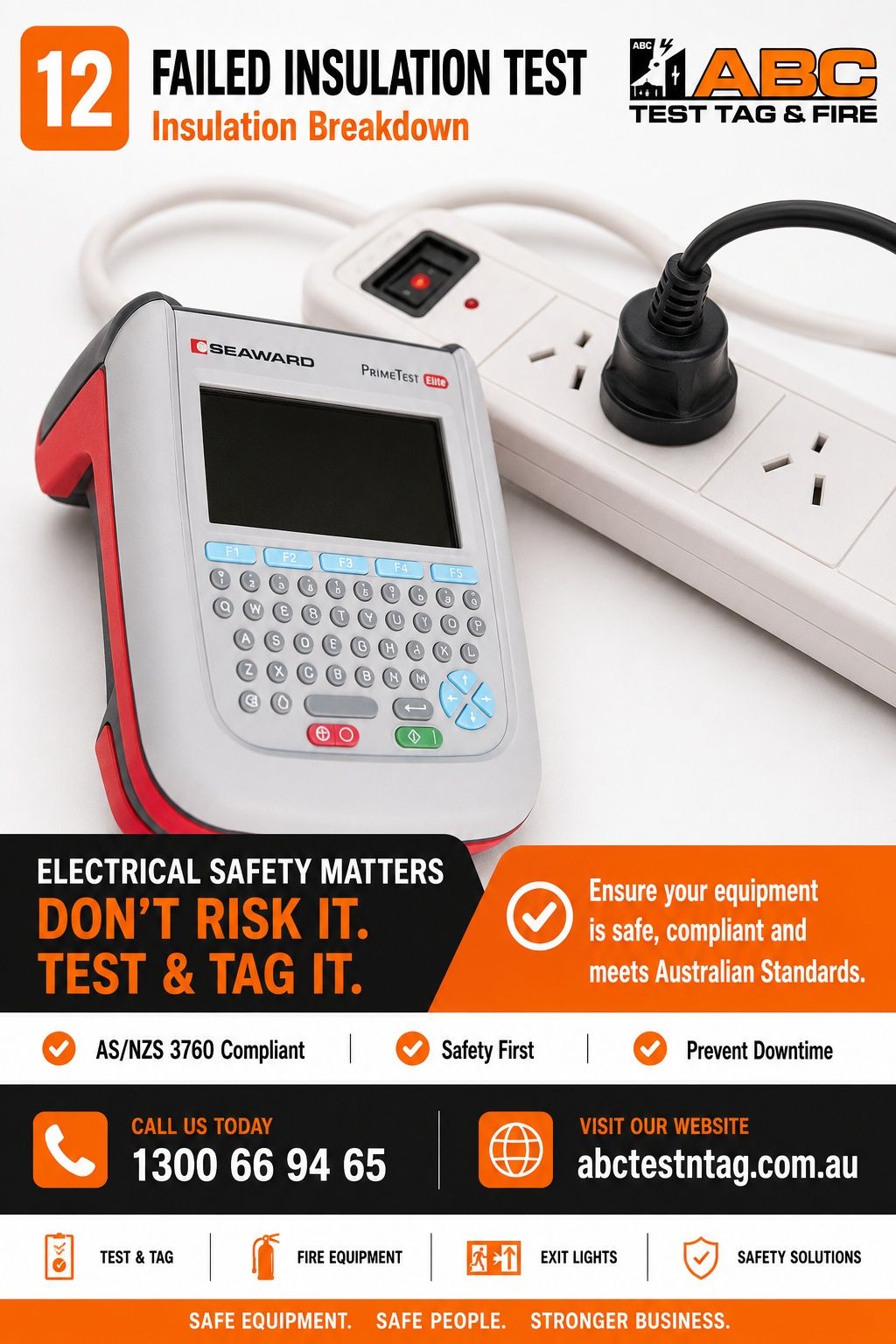
Appropriate calibrated equipment is used for relevant tests, which may include earth continuity, insulation resistance, polarity, leakage current and functional checks. -
Result assessment
Equipment that does not meet the applicable requirements is identified as failed and removed from service. -
Tagging
Passed items receive durable tags displaying relevant test information and the next due date. ABC also provides QR-coded tags linked to digital compliance records. -
Reporting
Digital compliance certificates and test records identify results, defects, corrective actions and upcoming due dates.
Visual inspection is essential. Instrument testing alone cannot identify every physical defect.
What Happens When Equipment Fails?
A failed appliance, lead, power board or tool must not remain available for use. It should be:
- Disconnected where safe to do so
- Clearly marked as Danger : Out of Service
- Physically isolated from serviceable equipment
- Recorded in the defect register
- Repaired, replaced or disposed of appropriately
Do not remove an out-of-service tag and return equipment to use without confirming that the defect has been rectified and the item has passed the required inspection and testing process.
Repairs, modifications, fixed wiring work and switchboard work must be completed by an appropriately licensed electrical contractor. Test and tag does not replace licensed electrical installation or repair work.
How Does RCD Testing Support Electrical Safety?
Residual Current Devices, commonly called safety switches, are designed to disconnect supply when they detect an imbalance in electrical current. They are an important protective control, but their presence does not prove that they are operating correctly.
RCD testing may include:
- Push-button functional testing
- Instrument testing of trip time and operating current
- Fixed safety switch testing
- Portable RCD testing
- Identification of defective devices
- Documentation of test results and corrective actions
The appropriate frequency depends on the type of work and workplace conditions. For example, Queensland guidance identifies more frequent testing requirements for construction and higher-risk environments than for general office work. Refer to the WorkSafe Queensland testing and tagging guidance and obtain advice based on the actual site risk profile.
For additional information, read ABC’s RCD testing Brisbane compliance guide.
What Fire Safety Services Do Nudgee Businesses Require?
Warehouses, workshops, transport premises and trade facilities may contain electrical equipment, packaging, fuels, oils, machinery, charging stations and other combustible materials. Fire equipment must remain suitable, accessible and serviceable.
ABC Test Tag & Fire provides:
- Six-monthly routine servicing of fire extinguishers
- Six-monthly routine servicing of fire blankets
- Inspection of condition, accessibility, seals and service indicators
- Replacement and sale of fire extinguishers
- Sale of fire blankets and other safety equipment
- Service documentation and compliance records
Routine fire equipment servicing is performed with reference to AS1851:2012 and the applicable building and fire safety requirements.
Fire equipment must not be obstructed by stock, pallets, vehicles, shelving or temporary materials. A correctly serviced extinguisher that cannot be reached quickly is not an effective control.
See ABC’s AS1851 compliance guide for Brisbane commercial buildings for further information.

How Does Exit Light Testing Protect Emergency Egress?
Emergency lighting and exit signs help workers and visitors identify evacuation routes when normal lighting is interrupted. This is particularly important in warehouses, commercial buildings, workshops and premises with large floor areas, internal passageways or multiple exit routes.
ABC Test Tag & Fire provides exit light testing and sales in accordance with AS/NZS 2293. Testing can identify:
- Failed lamps or LED modules
- Battery deterioration
- Damaged fittings or diffusers
- Poor visibility of exit signs
- Obstructed or incorrectly positioned signs
- Emergency fittings that fail during simulated power loss
The required testing frequency depends on the building classification, approvals and applicable Queensland requirements. ABC can help coordinate scheduled testing, including annual service arrangements, while identifying where more frequent routine checks may apply.

Keep emergency exits, corridors, stairways and exit signs unobstructed. Correct defects promptly and retain evidence of testing and rectification.
What Should a Nudgee Compliance Program Include?
| Compliance area | Relevant reference | Practical control |
|---|---|---|
| Electrical equipment | AS/NZS 3760:2022 | Visual inspection, appropriate instrument testing, tagging and records |
| RCDs and safety switches | AS/NZS 3760:2022 and Queensland requirements | Push-button and competent-person instrument testing at applicable intervals |
| Fire extinguishers and blankets | AS1851:2012 | Six-monthly routine service, accessibility checks and service records |
| Emergency lighting and exit signs | AS/NZS 2293 and applicable fire safety requirements | Functional and discharge testing, defect rectification and logbook records |
| Defect management | WHS and electrical safety duties | Immediate isolation, out-of-service identification and corrective action |
| Compliance evidence | Site management requirements | QR-coded tags, digital certificates, registers and scheduled reviews |
The standards provide technical guidance, but the PCBU remains responsible for ensuring that risks are managed and that competent people are engaged for inspection, testing and maintenance.
Nudgee Workplace Safety Compliance Checklist
- Identify all 240V, three-phase and relevant low-voltage equipment.
- Separate warehouse, workshop, transport, outdoor and office equipment by risk.
- Confirm the applicable AS/NZS 3760:2022 testing intervals.
- Test fixed and portable RCDs at the required frequency.
- Isolate failed electrical equipment immediately.
- Maintain clear access to fire extinguishers and fire blankets.
- Arrange six-monthly fire equipment servicing where applicable.
- Test emergency lighting and exit signs under the applicable AS/NZS 2293 requirements.
- Store digital certificates and inspection records centrally.
- Assign responsibility for correcting identified defects.
- Schedule the next inspection before the current due date.
- Review the program after incidents, equipment changes or changes in workplace conditions.
How Can Nudgee Businesses Save Up to 40%?
ABC Test Tag & Fire can coordinate electrical test and tag, RCD testing, fire equipment servicing and exit light testing through one locally owned and fully insured provider.
Bundling services may provide:
- Up to 40% bundled savings, depending on the services, asset numbers and site requirements
- Reduced contractor coordination
- Fewer separate site visits
- QR-coded equipment tags
- Fast digital reporting
- Digital compliance certificates
- Brisbane, Ipswich and Gold Coast coverage
- Eligibility to earn QANTAS Business Rewards points on applicable services, subject to program terms
With ABC Test Tag & Fire, the more services you book, the more you save.
The exact saving depends on the scope of work. A site-specific quotation is required.
Book Test and Tag and Fire Safety Services in Nudgee
A compliant Nudgee workplace requires more than an overdue tag replacement. It requires risk-based inspection, competent testing, effective defect isolation, accessible fire equipment, reliable emergency egress and traceable records.
To arrange test and tag Nudgee, electrical safety compliance, RCD testing, fire extinguisher testing or exit light testing, contact ABC Test Tag & Fire:
1300 66 94 65
ABC Test Tag & Fire supports workplaces across Brisbane, Ipswich and the Gold Coast with practical, documented and coordinated safety compliance services.
Frequently Asked Questions About Nudgee Workplace Safety Compliance
How often should electrical equipment be tested and tagged in Nudgee?
The interval depends on the equipment, workplace environment, frequency of use, exposure to damage and applicable Queensland requirements. Warehouses, workshops, transport sites and construction environments generally require more frequent testing than low-risk office areas.
Does test and tag include RCD testing?
Yes. RCD testing can be included for fixed and portable safety switches. Testing may involve a push-button function check and instrument testing of trip performance by a competent person.
What happens if an appliance fails testing?
The equipment should be isolated, marked as out of service, recorded and repaired, replaced or disposed of. It must not be returned to use until the defect has been appropriately rectified.
How often should fire extinguishers and fire blankets be serviced?
ABC Test Tag & Fire provides six-monthly routine servicing in accordance with AS1851:2012, subject to the applicable equipment, building and regulatory requirements.
Are exit signs and emergency lights included?
Yes. ABC provides exit light testing and sales in accordance with AS/NZS 2293. The required frequency should be confirmed against the building’s classification, approvals and applicable Queensland obligations.
Can ABC combine all compliance services in one visit?
In many cases, electrical test and tag, RCD testing, fire equipment servicing and exit light testing can be coordinated. Combining services may reduce administration and provide up to 40% bundled savings.
Can businesses earn QANTAS points?
Eligible customers may earn QANTAS Business Rewards points on applicable services, subject to QANTAS Business Rewards terms and conditions.