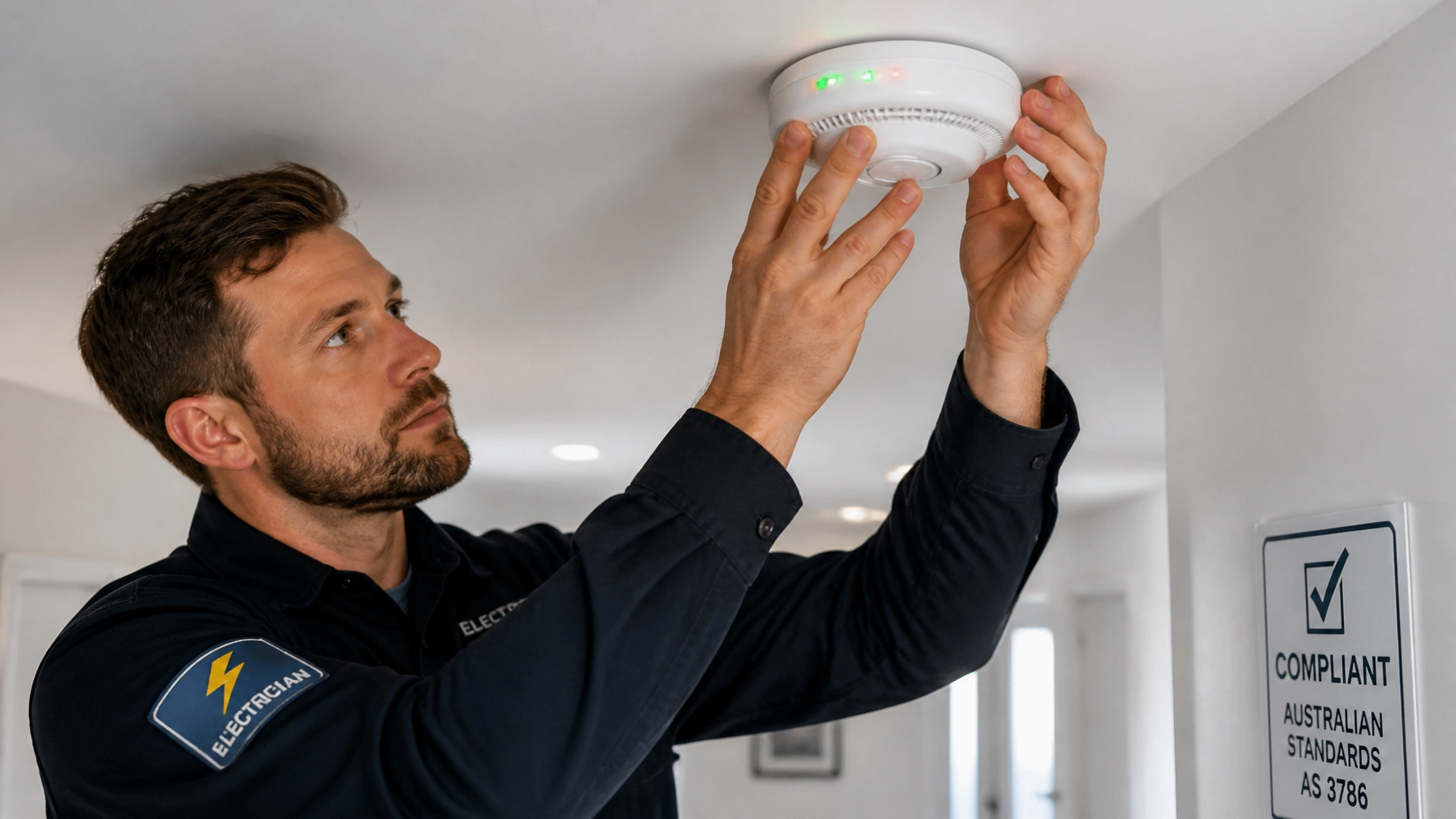
For property managers and strata committees across Queensland, the regulatory landscape regarding fire safety is undergoing its most significant shift in a generation. While the initial milestones for rental properties in 2022 provided a preliminary framework, the final, non-negotiable deadline of 1 January 2027 is rapidly approaching. By this date, every residential dwelling in Queensland: including every individual lot within a strata scheme: must be equipped with interconnected photoelectric smoke alarms that meet the rigorous AS3786:2014 standard.
Failure to achieve compliance is not merely a technical oversight; it is a significant legal liability. As an industry leader in electrical safety compliance in Brisbane, ABC Test Tag & Fire provides this comprehensive guide to ensure your portfolio remains protected and legally sound.
What is the AS3786:2014 Standard?
The Australian Standard AS3786:2014 specifies the requirements, test methods, and performance criteria for smoke alarms using scattered light, transmitted light, or ionization. Under current Queensland legislation (the Fire and Emergency Services Act 1990), all new and replacement smoke alarms must adhere to this specific version of the standard.
Why is photoelectric technology mandatory?
The legislation explicitly mandates photoelectric smoke alarms. Unlike older ionization models, which detect invisible particles from "fast-flaming" fires, photoelectric alarms are designed to detect "smouldering" fires: the type most common in residential settings, often caused by overloaded electrical circuits or discarded smoking materials. Photoelectric sensors react significantly faster to thick, visible smoke, providing residents with critical additional minutes to evacuate.

The Critical Mandate: Interconnection and Location
The "interconnection" requirement is the cornerstone of the new safety laws. In a compliant system, if one alarm is triggered (for instance, in a kitchen or a downstairs garage), every other alarm in the dwelling must sound simultaneously. This ensures that a resident sleeping in a distant bedroom is alerted immediately, regardless of where the fire starts.
Where must smoke alarms be installed?
To meet the 2027 "Smart Strata" requirements, alarms must be installed in the following locations within every dwelling:
- Every bedroom: Ensuring maximum protection for sleeping occupants.
- Connecting hallways: Specifically those that connect bedrooms to the rest of the dwelling.
- Every storey: In multi-level townhouses or apartments, at least one alarm must be present on every level, even if there are no bedrooms on that level.
These alarms must either be hardwired to the 240V mains power (with a battery backup) or powered by a non-removable 10-year lithium battery. Given the complexity of strata wiring, many committees are opting for wireless interconnection technology to bridge the gap between units without invasive electrical work.
Why Property Managers and Strata Committees Must Act Now
While January 2027 may seem distant, the scale of upgrading large-scale strata schemes requires meticulous planning. Waiting until the final quarter of 2026 will inevitably result in supply chain shortages, increased labor costs, and a lack of available licensed technicians.
How does non-compliance affect legal liability?
Property managers have a fiduciary duty to ensure that the properties they oversee are safe and compliant with state laws. If a fire occurs in a non-compliant unit, the consequences are severe:
- Insurance Invalidation: Many insurers are updating their PDS (Product Disclosure Statements) to exclude coverage for fire damage in properties that do not meet the latest smoke alarm standards.
- Litigation: In the event of injury or death, property managers and bodies corporate can be held legally liable for negligence.
- Statutory Penalties: The Queensland Fire and Emergency Services (QFES) has the authority to issue significant fines for non-compliance.
Systematic adherence to these regulations is no longer optional; it is a fundamental component of risk mitigation. For more insights on how to avoid these risks, read our article on why insurance won't cover safety mistakes.

How ABC Test Tag & Fire Facilitates Compliance
Navigating the transition to interconnected systems requires technical expertise. ABC Test Tag & Fire offers a streamlined, "one-stop" solution for smoke alarms installation and ongoing maintenance.
Bundling Services for Efficiency
One of our primary USPs is our ability to bundle multiple compliance services. By combining smoke alarm testing with our standard test and tag services, RCD testing, and fire extinguisher inspections, clients can save between 20% and 40% on total compliance costs. This is particularly beneficial for body corporates managing large common areas alongside individual lots.
Professional Digital Reporting
We eliminate the administrative burden of paper records. Our technicians provide fast, digital compliance reports and certificates that are archived securely. These records are essential for demonstrating "due diligence" to insurers and regulatory bodies.
Locally Owned and Fully Insured
We are a locally owned provider serving all suburbs in Brisbane, Ipswich, and the Gold Coast. Our status as a fully insured provider gives property managers peace of mind, knowing that all installations are performed to the highest professional standards.
Earn Rewards for Compliance
Unique to our service, clients can earn Qantas Business Rewards points on every dollar spent. Maintaining workplace and residential safety now provides a tangible return on investment for your business.

Summary of Compliance Steps
| Action Item | Technical Requirement | Responsibility |
|---|---|---|
| Verify Alarm Type | Must be Photoelectric (AS3786:2014) | Property Manager / Owner |
| Confirm Interconnection | All alarms must sound when one is triggered | Licensed Technician |
| Check Locations | Bedrooms, hallways, and every level | Licensed Technician |
| Annual Testing | Functional test and cleaning required | ABC Test Tag & Fire |
| Replacement | Alarms must be replaced every 10 years | ABC Test Tag & Fire |
Conclusion: Securing Your Assets Today
The "Smart Strata" deadline is not a suggestion; it is a legislated certainty. As we move toward 2027, the pressure on property managers to deliver compliant living environments will only intensify. By partnering with ABC Test Tag & Fire, you ensure that your residential portfolios in Brisbane, Ipswich, and the Gold Coast meet the highest safety standards while optimizing your compliance budget through service bundling.
Do not wait for the deadline to arrive. Ensure your properties are protected, your liability is mitigated, and your tenants are safe.
Contact ABC Test Tag & Fire today for a comprehensive quote on smoke alarm installation and compliance auditing.

Leave a Reply