Meta description: Prepare your Brisbane or Ipswich workplace for spring, wet weather and holiday operations with an electrical, fire and emergency-lighting compliance checklist.
Primary keyword: workplace safety compliance Brisbane
Secondary keywords: spring safety checklist Brisbane, workplace electrical safety Ipswich, test and tag Brisbane, fire safety checklist Brisbane, emergency lighting testing Brisbane
Spring is an appropriate time for Brisbane and Ipswich businesses to review workplace safety controls before storm activity, heavy rain, increased outdoor work and the later holiday operating period create new risks.
A seasonal review does not mean every electrical appliance, fire extinguisher or emergency light automatically requires testing solely because spring has arrived. Instead, changed conditions and work activities should trigger a documented risk review. Businesses must confirm whether inspections, testing, servicing or corrective action are required under applicable legislation, standards, manufacturer instructions and their own risk-management system.
This practical spring safety checklist Brisbane businesses can use covers electrical equipment, fire protection, emergency lighting, contractors, temporary staff, shutdowns and compliance records.
“So far as is reasonably practicable” : Queensland’s Work Health and Safety Act 2011 establishes the standard for managing workplace health and safety risks.
Queensland Work Health and Safety Act 2011
Why should seasonal conditions trigger a workplace safety review?
Spring and the wet-weather period can change how a workplace operates. Outdoor electrical equipment may be exposed to moisture, temporary leads may be installed for events or maintenance, storage areas may be rearranged, and contractors or temporary staff may be unfamiliar with evacuation procedures.
Review the following before conditions change:
- Increased rain, humidity, storm activity and water ingress
- Outdoor construction, landscaping, cleaning or maintenance work
- Temporary power supplies, extension leads and portable RCDs
- Altered warehouse, shop, office or worksite storage arrangements
- Reduced staffing, holiday shutdowns and restart procedures
- New contractors, labour-hire personnel or seasonal workers
- Blocked fire equipment, exit routes or emergency lighting
- Equipment that has been stored, relocated, modified or returned to service
The objective is simple: identify changed hazards, verify controls and retain evidence of the decisions made.
What legal and technical framework applies?
Queensland businesses should distinguish between legislation and Australian Standards.
The Electrical Safety Act 2002 and Electrical Safety Regulation 2013 establish enforceable electrical safety duties in Queensland. The Work Health and Safety Act 2011 and WHS Regulation 2011 establish broader duties for PCBUs, officers and workers.
Australian Standards provide technical methods and benchmarks, including:
- AS/NZS 3760:2022 : in-service safety inspection and testing of electrical equipment.
- AS1851:2012 : routine service of fire protection systems and equipment.
- AS/NZS 2293 : emergency escape lighting and exit signs.
A standard is not automatically legislation merely because it exists. However, it may be referenced by legislation, a building requirement, a contract, an insurer or a workplace safety procedure. Businesses should therefore assess the standard alongside the applicable legal duties and site-specific risks.
WorkSafe Queensland also explains that test-and-tag requirements apply to specified equipment and work environments at defined intervals; test and tag is not a universal automatic requirement for every item in every office.
Spring electrical safety checklist for Brisbane and Ipswich workplaces
Use this checklist for offices, factories, warehouses, shops and construction worksites.
1. Inspect leads, plugs, power boards and extension equipment
Check every item that may have been exposed to movement, moisture, heat, chemicals or physical damage:
- Frayed, crushed or cut extension leads
- Cracked plugs, sockets or appliance casings
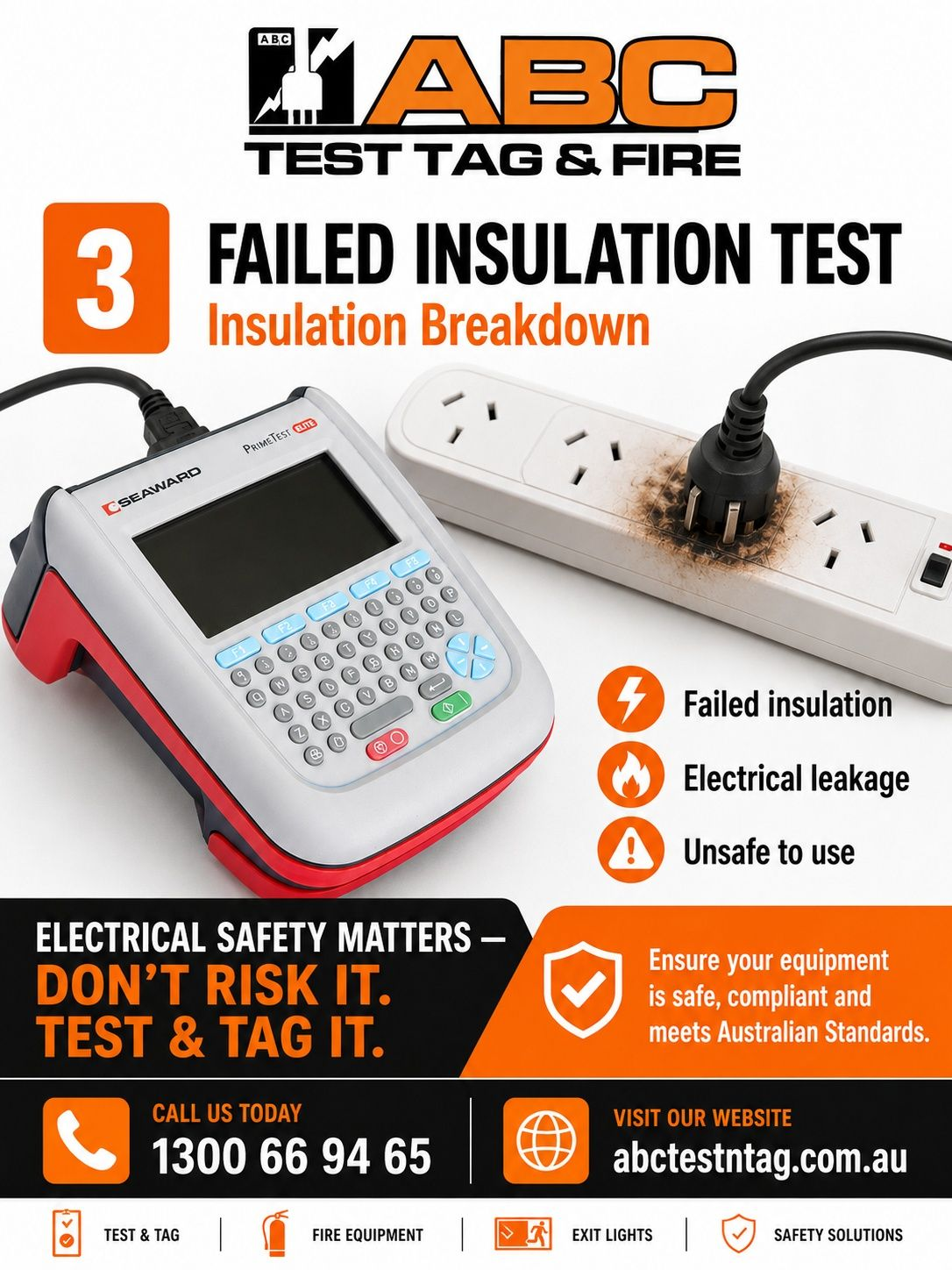
- Burn marks, discolouration, melted plastic or unusual odours
- Overloaded double adaptors and power boards
- Leads running through doorways, wet areas or vehicle paths
- Temporary outdoor equipment without suitable environmental protection
- Unauthorised repairs, taped insulation or missing strain relief
Remove failed equipment from service immediately. Do not rely on a visual pass where electrical testing is required.
2. Review test and tag records
Confirm that the equipment register identifies:
- Asset or equipment description
- Location and responsible department
- Inspection and test date
- Next review or test date where applicable
- Pass, fail, repair or disposal status
- The competent person who performed the work
ABC Test Tag & Fire provides electrical test and tag and RCD testing in Brisbane for 240V, 3-phase and low-voltage equipment, with durable QR-coded tags and digital compliance certificates.

3. Test RCDs and safety switches
Review both fixed and portable RCD arrangements. User push-button tests and instrument-based operating-time tests are different controls and should not be confused.
Construction, manufacturing and other higher-risk environments may have specific testing requirements under Queensland’s electrical safety framework. Portable RCDs used on construction worksites also require particularly frequent user checks under applicable guidance.
Document:
- The RCD identification and location
- Push-button test results
- Competent-person trip-time and current-test results
- Defects, isolation and rectification
- Any changes to the work environment or equipment
4. Review moisture and outdoor equipment controls
Before the wet-weather period:
- Confirm equipment is suitable for the environment in which it is used.
- Keep plugs, connections and power boards away from pooled water.
- Stop using damaged equipment immediately.
- Use appropriate RCD protection.
- Establish when outdoor electrical work must stop during storms, flooding or heavy rain.
- Ensure only licensed electrical workers undertake electrical installation or fixed-wiring work.
This is central to workplace electrical safety Ipswich and Brisbane operations, particularly for construction sites, workshops, warehouses and businesses with outdoor plant.
Fire safety checklist: equipment, access and storage
A fire extinguisher that cannot be reached is not an effective control. Spring cleaning and storage changes frequently create this problem.
Check that:
- Extinguishers, fire blankets, hose reels and hydrants are visible and accessible.
- Stock, cartons, displays and tools have not been placed in front of fire equipment.
- Equipment is correctly mounted and has not been damaged or relocated.
- Fire signage is visible from normal approach paths.
- Extinguisher types remain suitable for the hazards present.
- Fire equipment tags and service records are current.
- Fire doors, exits and evacuation paths are not wedged open or obstructed.
ABC Test Tag & Fire provides fire extinguisher testing and service in Brisbane, including six-monthly routine testing of extinguishers and blankets in accordance with the company’s AS1851:2012 service program, as well as fire extinguisher and fire blanket sales.
Businesses should confirm the applicable maintenance schedule for each item, building and occupancy type rather than assuming that every fire protection asset has the same interval.

Emergency lighting and evacuation routes: what should be reviewed?
Emergency escape lighting and exit signs support safe movement when normal lighting fails. Before spring storms and holiday shutdowns, inspect:
- Illuminated exit signs at exits and changes of direction
- Emergency luminaires in corridors, stairs, ramps and open areas
- Battery or system fault indicators
- Obstructions caused by new shelving, stock or temporary partitions
- Evacuation diagrams and assembly-point information
- Access to final exits and fire-isolated paths
Routine testing should follow the applicable requirements of AS/NZS 2293, the building’s fire safety obligations, the installed system and the risk assessment. Do not assume that seasonal timing alone creates a new mandatory interval.
ABC provides exit light and emergency lighting testing and sales for Brisbane workplaces, helping businesses identify failed batteries, non-illuminating signs and other defects before an emergency occurs.

What should businesses do before shutdown and restart?
Holiday closures create a predictable control gap. Establish a written shutdown and restart procedure.
Before shutdown
- Remove damaged electrical equipment from service.
- Isolate non-essential equipment where appropriate.
- Secure outdoor plant, tools, materials and temporary structures.
- Confirm fire equipment and exits remain accessible.
- Record outstanding defects and assign responsibility.
- Communicate emergency contacts and storm-response arrangements.
Before restart
- Inspect areas for water ingress, pest damage and electrical deterioration.
- Check switchboards for visible damage, moisture or access obstruction. Do not open or repair them unless authorised and qualified.
- Confirm emergency lights and exit signs are operational.
- Verify contractors and temporary staff have completed induction.
- Review evacuation arrangements and assembly points.
- Reconcile test, service and repair records.
Seasonal workplace-risk table
| Seasonal risk | Possible consequence | Practical control | Evidence to retain |
|---|---|---|---|
| Wet extension leads or power boards | Shock, fire or equipment damage | Remove from wet areas; use suitable protection and RCDs | Inspection and test records |
| Blocked extinguisher or exit | Delayed emergency response | Maintain clear access zones and inspect storage changes | Photos, checklists and defect close-out |
| Temporary staff unfamiliar with procedures | Incorrect response during an emergency | Induction, toolbox talks and evacuation briefing | Attendance records |
| Storm-damaged equipment | Electrical failure or injury | Pre-use inspection and competent testing | Asset register and service report |
| Holiday shutdown | Undetected fault or water damage | Written shutdown and restart process | Signed shutdown/restart checklist |
| New contractor activity | Uncontrolled interface risks | Verify licences, SWMS and site induction | Contractor records |
Why bundle electrical, fire and emergency-lighting services?
A seasonal compliance reset is more efficient when related inspections are coordinated. ABC Test Tag & Fire provides:
- Electrical test and tag for 240V, 3-phase and low-voltage equipment
- Fixed and portable RCD testing
- QR-coded compliance tags
- Digital compliance certificates and fast reporting
- Fire extinguisher and fire blanket testing and sales
- Fire hose reel and related fire service support where applicable
- Exit and emergency-lighting testing and sales
- Coverage across Brisbane, Ipswich, Gold Coast and surrounding suburbs
The team is locally owned and fully insured. Bundling services can save clients up to 20–40%. The more services you book, the more you save. Eligible customers may also earn QANTAS Business Rewards points, subject to applicable terms and conditions.

FAQs about spring workplace safety compliance
Does every workplace item need test and tag each spring?
No. Testing requirements depend on the equipment, work environment, applicable Queensland requirements, risk assessment and relevant standard. Spring should trigger a review, not an automatic assumption about every testing interval.
Is AS/NZS 3760:2022 the same as Queensland legislation?
No. AS/NZS 3760:2022 is a technical standard for in-service inspection and testing. Queensland legislation establishes legal duties and may reference standards or impose specific requirements for certain equipment and workplaces.
How often should fire extinguishers be serviced?
The applicable schedule depends on the extinguisher, building, occupancy, fire safety obligations and maintenance program. ABC’s service offering includes six-monthly routine testing in accordance with AS1851:2012. Obtain professional advice where the building or fire system has additional requirements.
Should emergency lights be tested only before storm season?
No. Testing should follow the applicable AS/NZS 2293 requirements, building obligations, system specifications and risk controls. Storm season is an appropriate time to review records, access, faults and evacuation routes.
How can we arrange a bundled compliance inspection?
Contact ABC Test Tag & Fire on 1300 66 94 65 to discuss electrical test and tag, RCD testing, fire equipment servicing, emergency-lighting testing and digital compliance reporting across Brisbane, Ipswich and the Gold Coast.
Start your seasonal compliance reset
Do not wait until wet weather, a holiday restart or an audit exposes an unresolved defect. Arrange a documented review of your electrical equipment, RCDs, fire protection systems, emergency lighting, access routes and records.
Call 1300 66 94 65 or visit ABC Test Tag & Fire to request a practical, bundled compliance service.