For businesses operating in Sumner, Brisbane, workplace safety compliance requires a coordinated and documented approach. Warehouses, distribution centres, manufacturing facilities, trade businesses, offices and commercial premises may all use electrical equipment, portable appliances, fire extinguishers, fire blankets and emergency lighting: often across large or mixed-use sites.
The location’s connection to the Centenary Highway and Western Freeway also makes efficient site access and minimal operational disruption important considerations when arranging compliance services.
ABC Test Tag & Fire provides an integrated service covering:
- Electrical test and tag for 240V, three-phase and low-voltage equipment
- RCD and safety-switch testing
- Fire extinguisher and fire blanket servicing
- Fire safety equipment sales
- Exit-light and emergency-light testing
- Emergency and exit-light sales
- QR-coded compliance tags
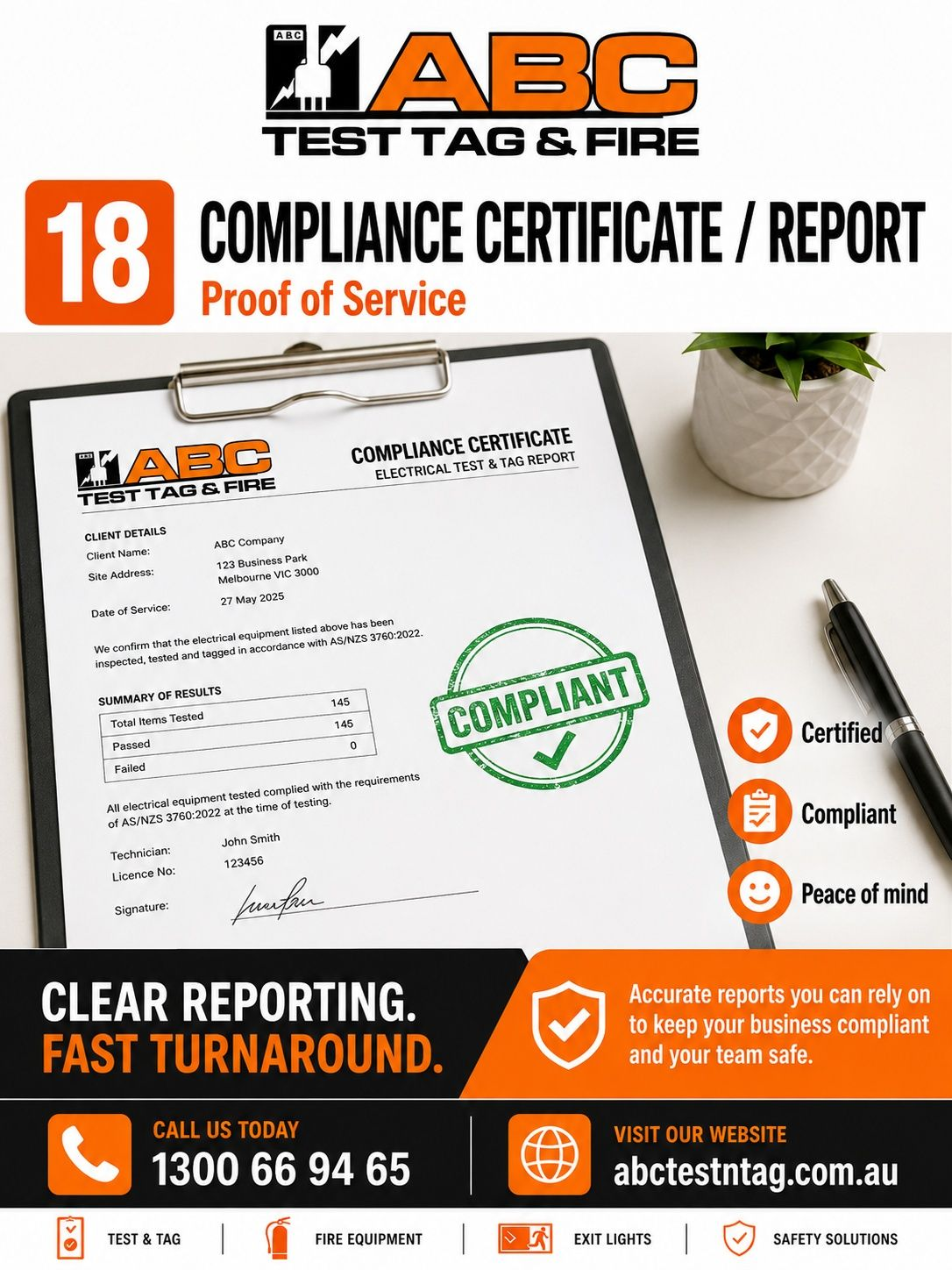
- Digital compliance certificates and reporting
Businesses can also reduce administration and service costs by combining requirements. The more services you book, the more you save, with bundled savings of up to 40%, subject to the scope of work and quotation.
What Does Workplace Safety Compliance Require in Sumner?
Queensland workplace safety obligations are established by legislation, including the Electrical Safety Act 2002 (Qld), the Electrical Safety Regulation 2013 (Qld) and the Work Health and Safety Act 2011 (Qld). These laws require businesses to manage electrical and workplace risks so far as is reasonably practicable.
Australian Standards provide technical frameworks for inspection, testing, maintenance and record keeping. They are not legislation by themselves, but they are important references for demonstrating that a systematic and competent safety process is in place.
The Queensland Government states:
“As an employer you must regularly inspect and test specified electrical equipment and safety switches in your workplace.”
Queensland Government guidance on testing and tagging also confirms that testing requirements differ according to the type of work being performed.
For Sumner businesses, the correct compliance program should therefore consider:
- The nature of the workplace
- The environment in which equipment is used
- Whether equipment is exposed to dust, moisture, vibration, heat or mechanical damage
- Whether the site includes construction, manufacturing, warehousing or office activities
- Whether fixed or portable RCDs protect electrical circuits
- The condition, accessibility and service history of fire equipment
- Whether emergency egress routes are clearly illuminated
How Does Electrical Test and Tag Work?
Electrical test and tag is a systematic process involving visual inspection, electrical testing, recording and identification.
The process generally includes:
-
Asset identification
Electrical appliances, extension leads, power boards, portable tools and other relevant equipment are identified and recorded. -
Visual inspection
The technician checks plugs, cords, insulation, casings, switches, strain relief, pins and other components for damage, wear, contamination or unsafe modification. -
Electrical testing
Appropriate tests are performed using calibrated test instruments. Depending on the equipment, this may include earth continuity, insulation resistance, polarity and leakage-related tests. -
Pass or fail determination
Results are assessed against the applicable requirements, equipment type and workplace environment. -
Tagging and reporting
Equipment that passes is fitted with a durable tag showing relevant testing information. ABC Test Tag & Fire can also provide QR-coded tags and digital compliance records. -
Isolation of failed equipment
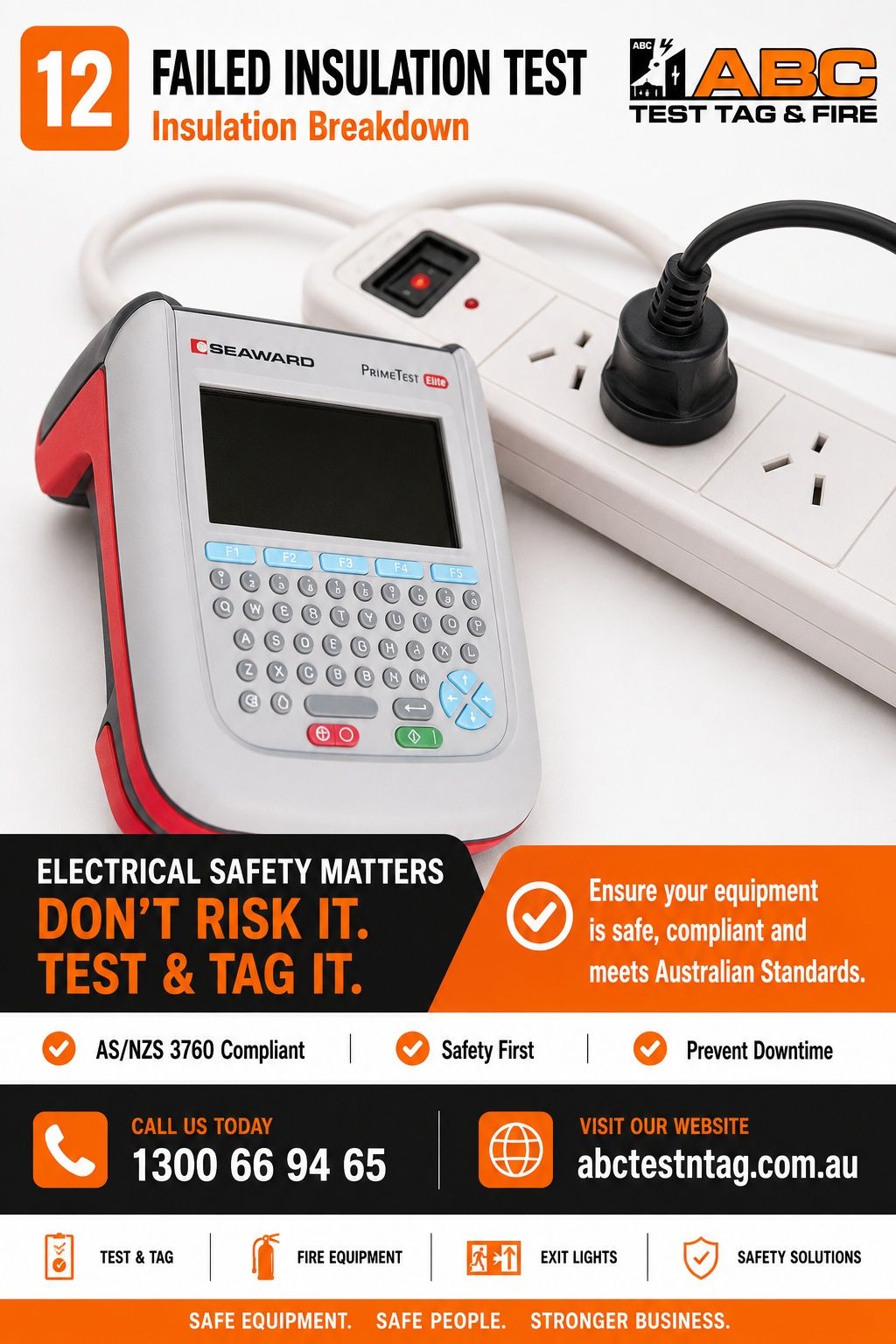
Equipment that fails inspection or testing must not remain available for use. It should be isolated, clearly marked and repaired, replaced or safely disposed of by an appropriately qualified person.
Why Must Failed Equipment Be Removed from Service?
A test tag is not a guarantee that equipment will remain safe indefinitely. It records the condition of the item at the time of testing. Equipment may subsequently be damaged by forklifts, production activities, vehicle movements, dropped loads, moisture or incorrect use.
If a cord has exposed conductors, a plug is damaged or insulation resistance is inadequate, the equipment must be removed from service. Do not continue using it because it was previously tagged.
How Often Should Sumner Workplaces Arrange Test and Tag?
Testing intervals are determined by work type, environmental risk and the applicable Queensland requirements. The following table provides general examples only. A site-specific assessment is required before confirming a testing schedule.
| Workplace or equipment environment | Typical testing consideration |
|---|---|
| Construction work | Higher-risk equipment may require testing at intervals of up to three months, with additional requirements under AS/NZS 3012 |
| Manufacturing and workshops | Equipment may require six- or twelve-monthly testing depending on construction, use and risk |
| Warehouses and trade businesses | Consider exposure to movement, impact, dust, temporary leads and portable tools |
| Office environments | Lower-risk equipment may have longer intervals, but damaged items must still be removed immediately |
| Harsh or hostile environments | Shorter intervals may be appropriate where equipment is exposed to moisture, vibration, chemicals, heat or dust |
| Mixed-use premises | Different areas may require different intervals under a documented risk-based program |
ABC Test Tag & Fire’s electrical test and tag service follows the principles of AS/NZS 3760:2022, the standard covering in-service safety inspection and testing of electrical equipment and RCDs.
What Is Included in RCD Testing?
Residual Current Devices, commonly called safety switches, are designed to disconnect electrical supply when they detect a leakage of current to earth. They are an important risk-control measure, but they must be tested to confirm that they operate correctly.
RCD testing may include:
- Identification of fixed and portable RCDs
- Visual inspection of the device and surrounding installation
- Functional push-button testing where applicable
- Instrument testing of trip current and trip time by a competent person
- Recording of results and defects
- Recommendations for repair or further electrical investigation
RCD testing schedules depend on the type of work. For example, construction, manufacturing, office and service environments may have different requirements for user push-button checks and competent-person instrument testing.
Users must not assume that pressing the test button replaces instrument testing. The two processes serve different purposes.
Businesses should also make sure staff understand how to report an RCD that trips unexpectedly. Do not repeatedly reset a safety switch without investigating the cause.
For further information, see the RCD testing Brisbane compliance guide.
How Are Fire Extinguishers and Fire Blankets Serviced?
Fire extinguishers and fire blankets must remain visible, accessible and suitable for the hazards present at the site. A fire extinguisher obstructed by stock, damaged by impact or lacking a service record may not provide reliable protection when required.
ABC Test Tag & Fire provides routine servicing and sales of fire safety equipment, including:
- Portable fire extinguishers
- Fire blankets
- Replacement safety equipment
- Service tags and maintenance records
- Identification of damaged, discharged or unsuitable equipment
Routine servicing is undertaken with reference to AS1851:2012, which provides a framework for routine service of fire protection systems and equipment. ABC’s standard offering includes six-monthly routine testing of fire extinguishers and fire blankets, with additional servicing, replacement or testing requirements identified according to equipment type and condition.
A workplace fire equipment inspection should consider:
- Whether the extinguisher is the correct type for the nearby hazard
- Whether access is unobstructed
- Whether the cylinder, hose, pin, seal and gauge appear serviceable
- Whether signage remains visible
- Whether the fire blanket container and blanket are undamaged
- Whether service records are current
- Whether defective equipment requires replacement or further action

Why Are Exit Lights and Emergency Lights Important?
Emergency escape lighting and exit signs support safe movement from a workplace if normal lighting fails. They are particularly important in warehouses, offices, workshops and commercial premises where occupants may be unfamiliar with the layout or where storage, partitions and machinery can affect visibility.
ABC Test Tag & Fire provides testing and sales for:
- Illuminated exit signs
- Emergency light fittings
- Replacement emergency-light units
- Battery-backed lighting systems
Testing is performed with reference to AS/NZS 2293, which addresses emergency escape lighting and exit signs. The service process may identify:
- Failed lamps or LEDs
- Battery deterioration
- Inoperative charging indicators
- Poor sign visibility
- Damaged fittings
- Obstructed egress paths
- Missing or incorrectly positioned equipment

Keep exit routes clear. Store stock and equipment away from emergency doors, signs, corridors and designated paths of travel.
Sumner Workplace Compliance Checklist
Use this checklist before arranging a compliance visit:
- Identify all areas requiring electrical inspection.
- Locate portable appliances, tools, power boards and extension leads.
- Confirm whether the premises includes manufacturing, construction or high-risk work.
- Identify fixed and portable RCDs.
- Review the date of the last RCD instrument test.
- Remove visibly damaged electrical equipment from service.
- Confirm fire extinguishers and fire blankets are accessible.
- Check that fire equipment is suitable for the surrounding hazards.
- Ensure exit signs and emergency lights are visible.
- Keep egress routes clear of stock, pallets and machinery.
- Consolidate previous compliance reports and service records.
- Schedule electrical, fire and emergency-light services together where practical.
What Are the Benefits of Bundling Compliance Services?
Managing each service through separate contractors can result in duplicated site visits, fragmented records and missed renewal dates. Coordinating electrical, fire and emergency-light services provides a more efficient compliance process.
ABC Test Tag & Fire offers:
- Up to 40% bundled savings when eligible services are combined
- QR-coded tags for easier asset identification
- Digital compliance certificates and fast reporting
- A locally owned and fully insured service
- Coverage across Brisbane, Ipswich and the Gold Coast
- The opportunity to earn QANTAS Business Rewards points, subject to applicable terms and conditions
- A single point of contact for multiple workplace safety requirements
The more services you book, the more you save. Savings depend on the number of assets, site requirements and services included in the quotation.
Frequently Asked Questions About Sumner Compliance
Is test and tag legally required for every appliance in an office?
Not necessarily. Queensland requirements depend on the type of work, equipment and workplace environment. However, employers must manage electrical risks, inspect equipment and ensure it is safe. A documented test and tag program may assist in demonstrating that reasonably practicable controls are in place.
Can a warehouse use the same testing interval as an office?
A warehouse may have different risks, particularly where equipment is exposed to impact, dust, movement, forklifts or temporary power arrangements. The appropriate interval must be assessed according to the work and environment.
What happens when electrical equipment fails?
The equipment should be removed from service, clearly identified and prevented from being used. Repair must be undertaken by an appropriately licensed person where electrical work is required.
Does fire extinguisher servicing include equipment sales?
Yes. ABC Test Tag & Fire provides fire extinguisher and fire blanket servicing, along with sales and replacement options where equipment is defective, unsuitable or beyond economical service.
Can electrical, fire and exit-light testing be arranged together?
Yes. Coordinating services can reduce disruption, simplify records and provide access to eligible bundled savings.
How do I arrange a Sumner compliance service?
Contact ABC Test Tag & Fire on 1300 66 94 65 to discuss your site, asset numbers, workplace activities and required service combination.
Arrange Sumner Test and Tag and Fire Compliance
Do not wait for an incident, audit or failed inspection to identify gaps in your safety program. Arrange a structured assessment of your electrical equipment, RCDs, fire equipment and emergency lighting.
Contact ABC Test Tag & Fire on 1300 66 94 65 for a quotation covering Sumner and surrounding Brisbane workplaces.