Why is Fire Safety Compliance Essential for Brisbane Workplaces?
In the current regulatory landscape of 2026, workplace safety is not merely a recommendation; it is a stringent legal obligation. For businesses operating across Brisbane, Ipswich, and Logan, maintaining a safe environment is a critical component of risk mitigation and operational continuity. Failure to adhere to established fire safety standards can result in catastrophic consequences, ranging from severe property damage and loss of life to significant legal penalties and the voiding of insurance policies.
The cornerstone of fire safety in Australian commercial environments is AS1851:2012, the Australian Standard for the "Routine service of fire protection systems and equipment." This standard dictates a systematic process for the inspection, testing, and maintenance of fire protection assets to ensure they function as intended during an emergency. For Brisbane business owners, understanding and implementing these requirements is the primary defense against fire-related risks and regulatory non-compliance.
What is AS1851:2012 and How Does it Apply to Your Business?
AS1851:2012 provides a comprehensive framework for the ongoing maintenance of fire protection equipment. In Queensland, this standard is mandated by the Building Fire Safety Regulation 2008 and Ministerial Specification MP 6.1. These legislative instruments require that all fire safety installations in Class 2 through Class 9 buildings: which include offices, factories, retail shops, and warehouses: must be serviced in accordance with the standard.
The primary objective of AS1851:2012 is to ensure that "fire protection systems and equipment are capable of performing to the design standard to which they were installed." This involves a rigorous schedule of routine services performed by a competent person. At ABC Test Tag & Fire, our technicians are fully insured and trained to execute these services with precision, ensuring your business remains compliant with QLD laws.
How does the legislation affect your liability?
Under the Work Health and Safety Act 2011, persons conducting a business or undertaking (PCBUs) have a primary duty of care to ensure the health and safety of workers. Non-compliance with AS1851:2012 is often viewed as a breach of this duty. By maintaining a rigorous fire extinguisher test and tag schedule, you demonstrate a proactive approach to safety, which is essential during workplace audits or insurance assessments.
Understanding the 6-Monthly Routine Service Schedule
The frequency of service is perhaps the most misunderstood aspect of fire safety. While many businesses assume an annual check is sufficient, AS1851:2012 specifies that the majority of portable fire equipment requires a 6-monthly routine service.
What occurs during a 6-monthly inspection?
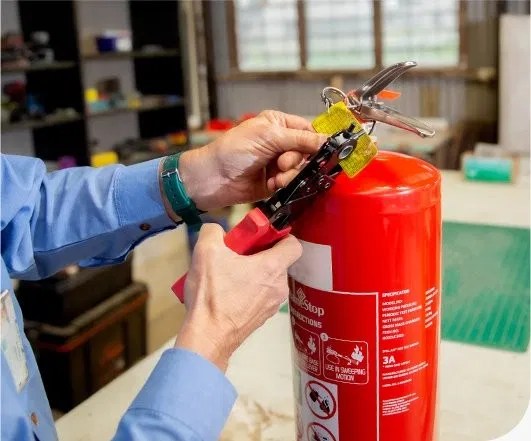
The 6-monthly service, often referred to as a "Level 1" service, is a thorough assessment of the equipment's readiness. The systematic process includes:
- Accessibility Assessment: Ensuring the extinguisher is not obstructed and is mounted at the correct height with clear signage.
- Physical Integrity Check: Inspecting the cylinder for corrosion, dents, or damage that could compromise pressure.
- Pressure Gauge Verification: Confirming the needle is within the operable "green" zone.
- Anti-Tamper Seal Inspection: Verifying that the safety pin and seal are intact, indicating the unit has not been discharged.
- Weight Verification: Weighing the unit to ensure the extinguishing agent matches the manufacturer’s specifications.
The Annual and 5-Yearly Requirements
While 6-monthly checks are the baseline, the standard mandates more intensive testing at longer intervals:
- Annual Service: Includes all 6-monthly tasks plus a detailed inspection of the discharge hose and nozzle for blockages or perishing.
- 5-Yearly Hydrostatic Testing: Every five years, extinguishers must be discharged, internally inspected, and pressure-tested (hydrostatic test) to ensure cylinder integrity. In many cases, for smaller units, replacement is more cost-effective than testing, a decision our technicians can help you navigate.
Fire Extinguisher Selection: Matching Equipment to Your Environment
Selecting the appropriate fire extinguisher is as critical as the testing itself. Different Brisbane business environments face unique risks, categorized as "Classes of Fire." Using the wrong agent (e.g., water on an electrical fire) can exacerbate the danger.
Office vs. Warehouse Requirements
A modern Brisbane office has vastly different risk profiles compared to a heavy-duty warehouse in Ipswich or a construction site in Logan.
| Feature | Office Environment | Warehouse / Industrial |
|---|---|---|
| Primary Risks | Electrical (Class E), Paper/Wood (Class A) | Chemical, Fuel (Class B), Large Electrical |
| Recommended Type | CO2 (Carbon Dioxide): Leaves no residue, safe for computers. | ABE Dry Powder: Versatile for multi-class fires. |
| Secondary Type | Water or Foam: For general waste paper and fabric risks. | High-Capacity ABE or Foam: For liquid spills and machinery. |
| Placement | Near server rooms, exits, and kitchenettes. | Near hazardous storage and loading docks. |
For a detailed breakdown of costs associated with these services, refer to our Test and Tag Pricing Guide.
The Role of Fire Blankets in Kitchen and Industrial Risks
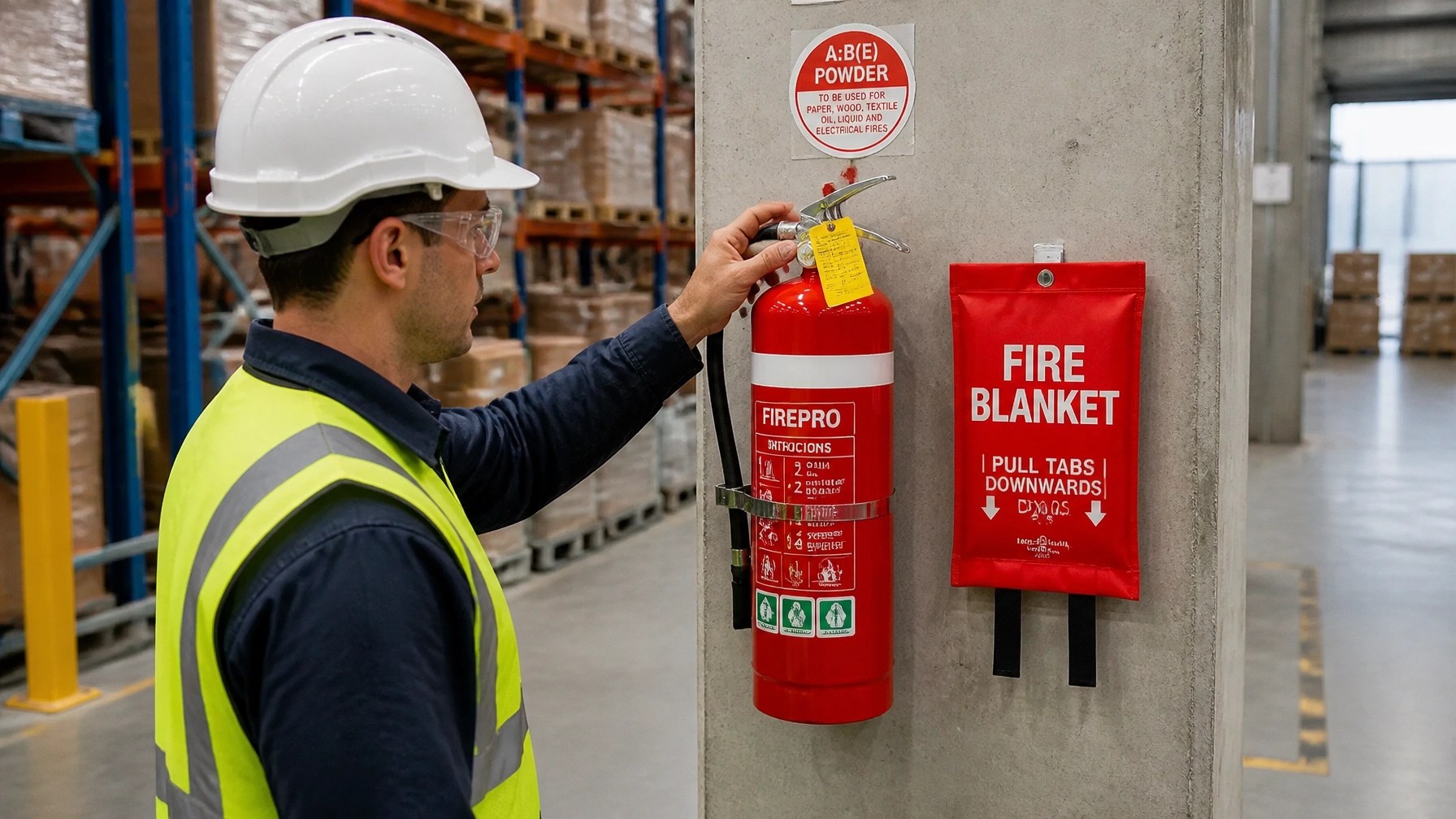
Fire blankets are an often-overlooked component of workplace safety compliance in Brisbane. These are vital for Class F (cooking oils/fats) and Class A fires in confined spaces.
AS1851:2012 requires that fire blankets be inspected every 6 months. Technicians check for:
- Contamination: Any oil or grease on the blanket significantly reduces its effectiveness.
- Container Integrity: Ensuring the blanket can be deployed quickly without snagging.
- Correct Signage: Proper identification as per Australian standards.
In office kitchenettes or cafe environments, a fire blanket is the first line of defense against small stove-top incidents, providing a "smothering" action that extinguishers might otherwise disrupt with high-pressure discharge.
Achieving Cost-Efficiency: The Strategic Benefit of Bundling
A primary concern for many Brisbane businesses is the perceived cost of compliance. However, managing fire safety and electrical safety as separate entities often leads to redundant call-out fees and administrative overhead.
At ABC Test Tag & Fire, we provide a specialized bundling strategy that allows businesses to save between 20% and 40% on their total compliance costs. By coordinating fire extinguisher test and tag with electrical RCD testing and exit light inspections, we minimize workplace disruption and maximize cost-efficiency.
Why choose a bundled service?
- Single Point of Contact: Simplify your safety management with one provider.
- Reduced Call-out Fees: Eliminate multiple visit costs.
- Comprehensive Reporting: Receive all digital certificates in one unified package.
- Qantas Points: As a unique USP, our clients can earn Qantas Points on their safety services, adding tangible value to a mandatory business expense.
Digital Compliance: Managing Your Records in the 2026 Regulatory Landscape
The days of paper logbooks that fade or get lost are over. In 2026, digital record-keeping is the gold standard for workplace safety compliance in Brisbane. Modern compliance requires immediate access to data during a QFES (Queensland Fire and Emergency Services) inspection.
Our technicians utilize a systematic process to generate QR-coded tags for every asset. This allows for:
- Instant Identification: Scan a tag to see the service history.
- Automated Reminders: We track your 6-monthly cycles so you never miss a deadline.
- Cloud-Based Certificates: Receive high-resolution, digital compliance certificates immediately after service completion.
This "hassle-free" approach ensures that your documentation is always audit-ready, providing peace of mind and protecting your business from the "compliance gap."
Conclusion: Securing Your Brisbane Business
Fire safety is a continuous commitment, not a one-time event. Adherence to AS1851:2012 through regular 6-monthly testing is the only way to ensure your fire extinguishers in Brisbane remain operational and your business stays within the law. From the offices of the CBD to the warehouses of Ipswich and Logan, ABC Test Tag & Fire is your local partner in regulatory excellence.
Are you certain your fire equipment is compliant? Do not wait for an emergency or a surprise inspection to find out. Contact our team today to discuss a bundled safety solution tailored to your specific environment.
Ensure your workplace is safe, compliant, and ready for 2026.