For commercial and industrial business owners in Queensland, workplace safety is not merely a moral obligation; it is a rigorous legal mandate. As of 2026, the regulatory landscape regarding electrical and fire safety has become increasingly stringent, demanding a systematic process for risk mitigation and asset management. Failure to adhere to these standards exposes an organisation to significant legal liabilities, including substantial fines under the Work Health and Safety Act 2011 (Qld) and potential criminal negligence charges.
How can a business navigate the complexities of multiple Australian Standards while maintaining operational efficiency? This guide provides an authoritative breakdown of the essential compliance requirements for Queensland workplaces, focusing on the integration of Electrical Test & Tag, Fire Safety, and Exit Light testing.
What are the Core Legal Requirements in Queensland?
Workplace safety in Queensland is governed by a robust framework of legislation designed to ensure the highest levels of protection for employees and the public. The primary legislative instruments include:
- Work Health and Safety Act 2011 (Qld): Establishes the primary duty of care for persons conducting a business or undertaking (PCBUs).
- Electrical Safety Act 2002 and Electrical Safety Regulation 2013: Dictates the specific requirements for the management of electrical risks and the testing of equipment.
- Fire and Emergency Services Act 1990: Outlines the mandatory maintenance of fire safety installations.
To demonstrate compliance with these Acts, businesses must adhere to specific Australian Standards. These standards serve as the "benchmark" for what is considered a safe and compliant workplace.
Electrical Compliance: What is AS/NZS 3760:2022?
The AS/NZS 3760:2022 is the primary standard for the safety inspection and testing of electrical equipment. In a commercial or industrial setting, any device that "plugs in" to a 240V or 415V power supply must undergo regular inspection.
The Systematic Testing Process
Electrical compliance is not a "one-off" event but a continuous cycle of risk assessment. The process involves:
- Visual Inspection: Identifying external damage to cords, plugs, and casings.
- Electrical Testing: Using a Portable Appliance Tester (PAT) to measure earth continuity, insulation resistance, and polarity.
- Digital Documentation: Recording results in a compliance register to provide an audit trail for regulators.
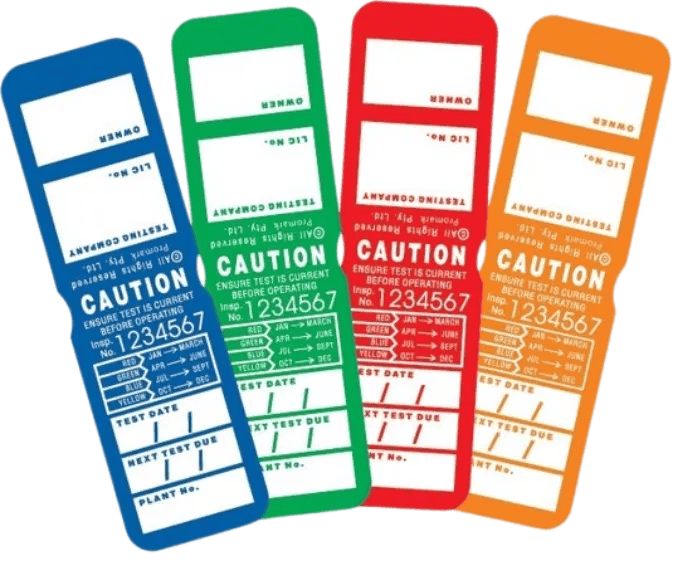
- Tagging: Applying a durable, QR-coded tag to the asset, indicating the date of the test and the date the next test is due.
Recommended Testing Intervals
The frequency of testing depends on the environment and the risk of damage to the equipment. According to WorkSafe Queensland, the following intervals generally apply:
| Environment | Equipment Type | Test Interval |
|---|---|---|
| Construction/Demolition | All portable equipment | 3 Months |
| Factories/Warehouses | Production equipment | 6 Months |
| Commercial/Industrial | General workplace tools | 12 Months |
| Offices/Low-Risk | Static office equipment | 5 Years |
For more detailed information on local requirements, refer to our guide on electrical test and tag services in Ipswich.
Fire Safety: How Does AS 1851:2012 Protect Your Site?
Fire safety compliance in Queensland is primarily dictated by AS 1851:2012, which governs the routine servicing of fire protection systems and equipment. For commercial and industrial facilities, the integrity of fire extinguishers and fire blankets is non-negotiable.
6-Monthly Routine Servicing
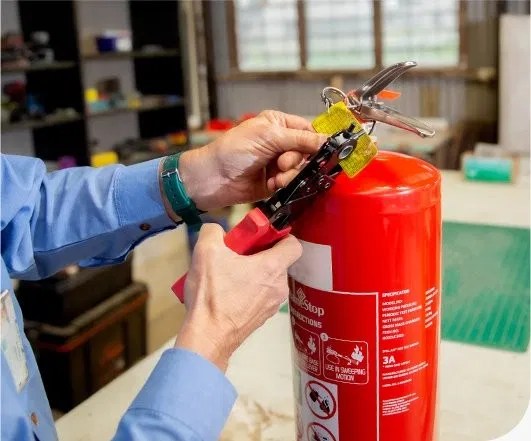
The standard requires that portable fire extinguishers and fire blankets be inspected every six months. This service includes:
- Pressure Gauge Check: Ensuring the extinguisher is fully charged and functional.
- Seal and Pin Inspection: Confirming the safety mechanism has not been tampered with.
- Physical Condition: Checking for corrosion, nozzle blockages, or signage issues.
- Weight Verification: Confirming the contents have not leaked.
Why is Record-Keeping Critical?
In the event of a fire, the Queensland Fire and Emergency Services (QFES) will demand evidence that all fire safety installations were maintained in accordance with AS 1851. Maintaining a digital logbook or compliance certificate is the only way to prove your business has met its statutory obligations. You can learn more about these requirements through our fire safety compliance services.
Emergency Exit Lighting: What is AS/NZS 2293?
In the event of a power failure or fire emergency, the ability of staff and visitors to evacuate safely is dependent on the functionality of emergency and exit lighting. AS/NZS 2293 sets the standard for the design, installation, and testing of these systems.
Mandatory Discharge Testing
While exit lights remain lit via mains power, they must contain a battery backup that operates for at least 90 minutes during a power loss.
- 6-Monthly Testing: A manual discharge test is performed to simulate a power failure. Any unit that fails to remain illuminated for the full 90 minutes must be repaired or replaced.
- Asset Register: Every exit light must be uniquely identified and tracked in a compliance report.
Failure to maintain these systems is one of the most common points of failure in building fire safety audits. Detailed explanations of these procedures can be found in our exit light testing services overview.
The Strategic Advantage: Bundling and Automation
For larger commercial and industrial clients, managing multiple contractors for electrical, fire, and lighting safety is inefficient and increases the risk of "compliance gaps." ABC Test Tag & Fire offers a systematic approach to workplace safety that prioritises cost-efficiency and administrative ease.
How Can You Save 20-40% on Compliance?
By bundling Electrical Test & Tag, Fire Service, and Exit Light testing into a single visit, businesses can significantly reduce their overheads.
- Reduced Call-out Fees: One technician, one visit, multiple services.
- Bundling Discounts: Our pricing model offers substantial savings for comprehensive site audits. Check our pricing guide for a full breakdown.
- Digital Reporting: All results are delivered via a high-speed digital portal, allowing for instant retrieval during audits.
- Qantas Points: As a unique benefit, commercial clients can earn Qantas Points on all eligible compliance services, adding further value to the mandatory safety spend.
Conclusion: Mitigating Risk with Professional Oversight
Workplace safety compliance is not a task to be delegated to untrained staff or managed through an ad-hoc process. The legal and financial risks are too high. To take your business to the next level of safety and operational maturity, a professional, integrated approach is required.
ABC Test Tag & Fire is a locally owned, fully insured provider dedicated to Brisbane and Ipswich businesses. We ensure your site meets every regulatory requirement of AS/NZS 3760, AS 1851, and AS/NZS 2293 with zero hassle.
Next Steps for Your Business
- Audit Your Current Status: When were your electrical items and fire extinguishers last tested?
- Consolidate Services: Move away from multiple vendors to a single, expert compliance partner.
- Implement Digital Tracking: Transition to digital registers for immediate compliance evidence.

For a comprehensive site assessment or a detailed quote on bundled services, contact ABC Test Tag & Fire today. Ensure your workplace is not just safe, but fully compliant with the laws of 2026.