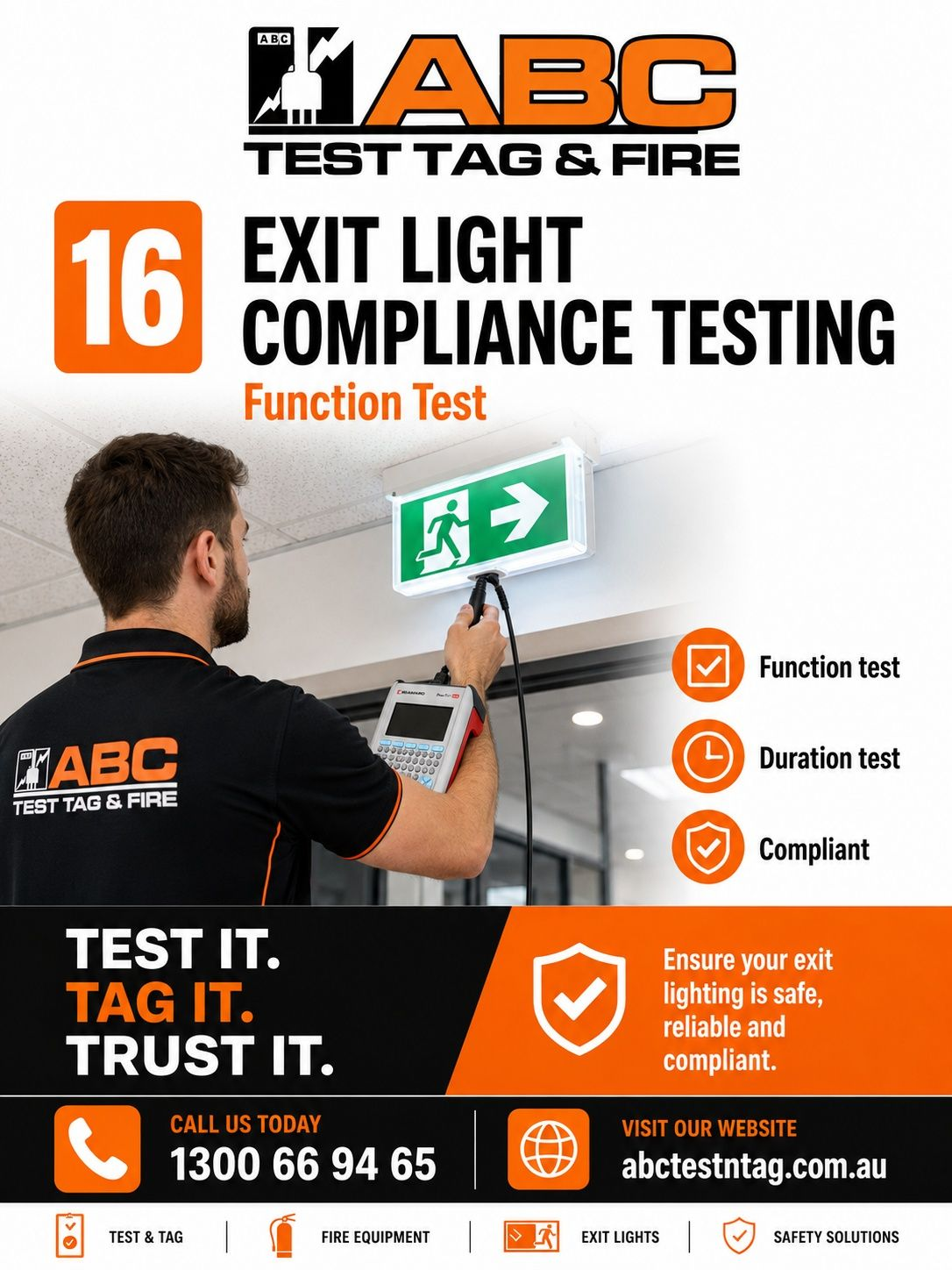
Exit-light function testing as part of a scheduled workplace emergency-lighting compliance inspection.
West End businesses operate across a diverse inner-city environment, including offices, retail premises, restaurants, cafés, community organisations, creative studios, workshops and mixed-use buildings. Around Boundary Street, Montague Road, Vulture Street and the inner-south and river corridor, electrical equipment, fire protection systems and emergency egress arrangements must be managed as part of a systematic workplace safety program.
ABC Test Tag & Fire provides integrated test and tag, RCD testing, fire extinguisher servicing, fire blanket servicing, exit light testing and safety equipment sales for West End businesses. By combining services during one scheduled visit, businesses may save up to 40%, depending on the services required. The more services you book, the more you save.
What Are West End Workplace Safety Compliance Obligations?
Queensland businesses have duties under electrical safety and workplace health and safety legislation to identify hazards, control risks and ensure workplace equipment remains safe. The responsibility generally rests with the business or other relevant Person Conducting a Business or Undertaking (PCBU).
Test and tag is not a substitute for a broader electrical safety system. It is one control within that system.
A compliant program should consider:
- The type and condition of electrical equipment.
- The work environment in which equipment is used.
- Exposure to moisture, heat, dust, impact or frequent movement.
- The presence and performance of safety switches or RCDs.
- The condition and accessibility of fire equipment.
- Emergency lighting, exit signs and evacuation paths.
- Accurate records demonstrating inspection, testing and corrective action.
WorkSafe Queensland guidance explains that specified electrical equipment must be regularly and properly inspected, tested and tagged by a competent person. Even where routine tagging is not specifically required for a particular item, the business still has a duty to ensure the equipment is safe.
How Does Electrical Test and Tag West End Work?
Electrical test and tag should follow a consistent process aligned with AS/NZS 3760:2022, In-service safety inspection and testing of electrical equipment and RCDs.
1. Identify the equipment
The technician identifies applicable portable and plug-in equipment, including:
- Computers, monitors and office appliances.
- Point-of-sale equipment and refrigeration.
- Kitchen appliances, extension leads and power boards.
- Audio-visual equipment and creative studio equipment.
- Portable tools, workshop equipment and chargers.
- Construction or maintenance equipment brought onto the premises.
- Portable and fixed RCDs, where applicable.
2. Complete a visual inspection
A visual inspection is essential. It may identify hazards that an electrical instrument test cannot fully assess, including:
- Cracked plugs, casings or insulation.
- Bent or damaged pins.
- Frayed cords or exposed conductors.
- Damaged strain relief.
- Signs of overheating, melting or contamination.
- Unauthorised modifications.
- Equipment that is unsuitable for the environment.
3. Perform electrical testing
Appropriate electrical tests are conducted using calibrated testing equipment. Depending on the item, this may include insulation resistance, protective earth continuity, polarity and leakage-current testing.
The exact testing method depends on the equipment category and the requirements of the applicable standard.
4. Tag compliant equipment
Equipment that passes is identified with a durable test tag showing relevant information such as:
- Test date.
- Next scheduled inspection or test date.
- Tester or service-provider details.
- Asset or identification information.
ABC Test Tag & Fire can also provide QR-coded tags, allowing businesses to connect physical equipment with digital compliance information.
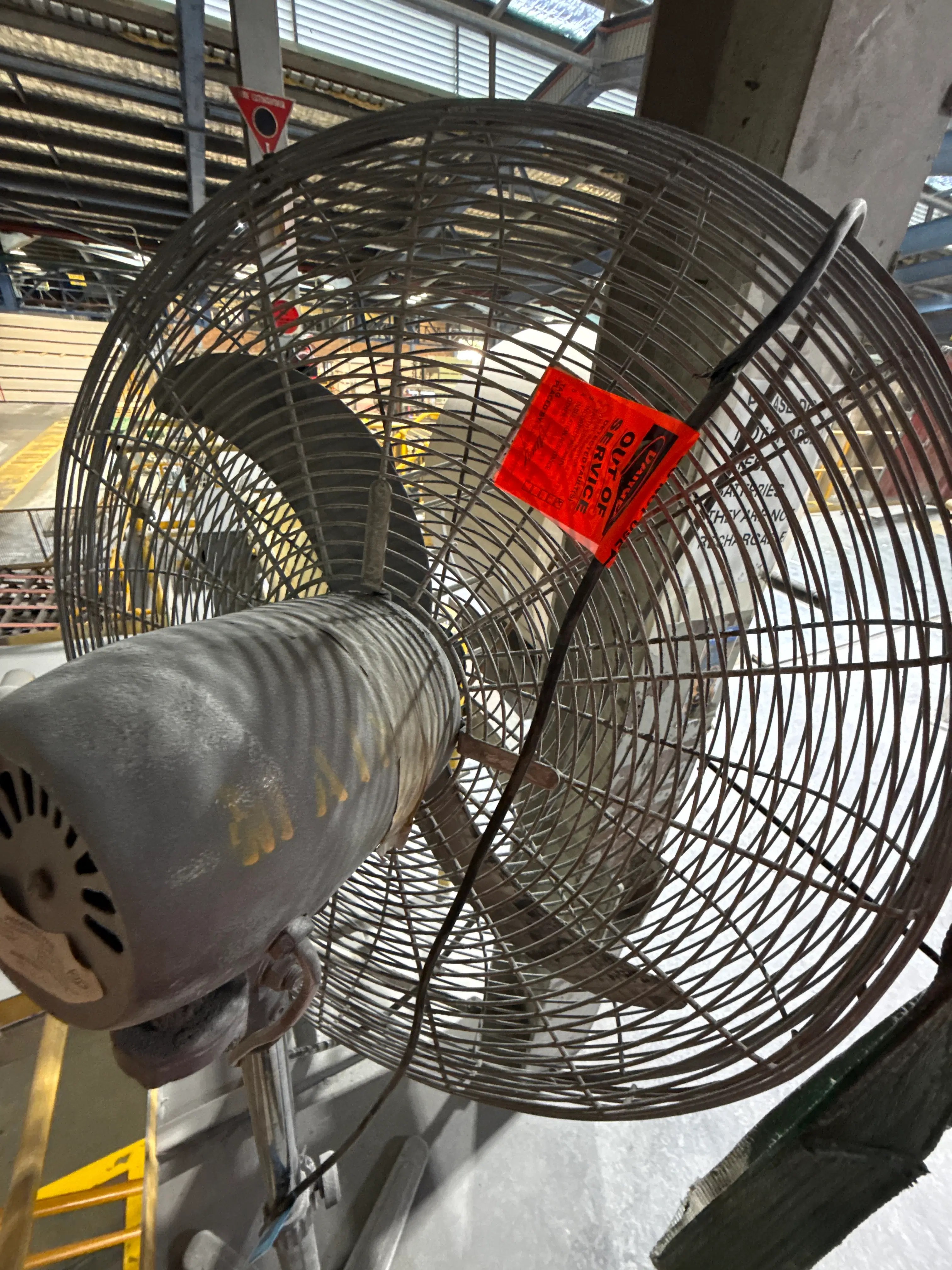
Industrial fan isolated from use and tagged out of service following identification of an electrical safety defect.
5. Isolate failed equipment immediately
What should happen when an item fails?
It must not remain available for general use. Failed equipment should be removed from service, clearly marked with an “Out of Service” or danger tag, and either repaired by an appropriately qualified person and retested or disposed of.
Do not return failed equipment to service without corrective action and confirmation that it has passed the required testing.
What Does RCD Testing West End Involve?
Residual Current Devices, commonly called safety switches or RCDs, are designed to disconnect electrical supply when an imbalance in current indicates a leakage path. They are an important risk-control measure, but they must be tested to confirm that they operate correctly.
RCD testing may include:
- A push-button functional test.
- Instrument testing of operating time and current.
- Inspection of the device, enclosure and identification.
- Recording pass, fail and corrective-action information.
- Confirmation of the next required test date.
Testing intervals vary according to the type of RCD, the work environment and Queensland requirements. WorkSafe Queensland provides different intervals for offices, manufacturing environments, construction work and other workplaces. A West End restaurant kitchen, workshop or premises exposed to moisture and frequent equipment movement may require a more intensive program than a low-risk office.
Businesses should also ensure workers understand that the test button is not necessarily a replacement for formal instrument testing.
For additional information, see ABC’s guide to RCD testing requirements in Brisbane.
How Are Fire Extinguishers and Fire Blankets Serviced?
Electrical compliance does not replace fire safety maintenance. Fire extinguishers and fire blankets require their own inspection and servicing program under the applicable fire safety requirements and AS 1851:2012, Routine service of fire protection systems and equipment.
This is particularly relevant for West End hospitality venues, restaurants, commercial kitchens, retail premises, offices and community facilities.
ABC’s fire service includes inspection of:
- Fire extinguisher condition, access and identification.
- Pressure indicators, seals and physical damage.
- Correct mounting and location.
- Fire blanket enclosure and accessibility.
- Evidence of corrosion, leakage or tampering.
- Service history and maintenance tags.
- Replacement requirements where equipment is defective, expired or unsuitable.
ABC also supplies fire safety equipment where replacement or additional equipment is required. Fire extinguishers and blankets must be suitable for the hazards present, correctly located and kept clear of obstructions.

Overdue fire extinguisher identified for inspection and servicing as part of routine workplace fire compliance.
Fire equipment is only effective when it is correctly selected, accessible, maintained and understood by the people expected to use it.
Where a tenancy is located within a larger commercial or mixed-use building, responsibility for base-building systems such as hydrants, sprinklers and common-area alarms may sit with the owner, body corporate or building manager. Tenants should confirm responsibilities through their lease, building management arrangements and fire safety documentation.
What Is Required for Exit and Emergency Light Testing?
Emergency lighting and exit signs support safe evacuation when normal lighting fails. They must remain visible, operational and unobstructed.
ABC provides exit light and emergency light testing and sales in accordance with the applicable requirements of AS/NZS 2293, the building’s approved design and relevant fire safety documentation.
A practical inspection program should consider:
- Whether exit signs are illuminated and visible.
- Whether emergency lights activate when normal power is interrupted.
- Battery and charging indicators.
- Fittings, diffusers and physical damage.
- Obstructions caused by partitions, shelving or signage.
- Required discharge-test performance.
- Records of failures, repairs and retesting.
Testing frequency must be confirmed against the applicable building requirements and maintenance schedule. Do not assume that a previous tenant’s fit-out or a recently installed sign removes the need for ongoing inspection.
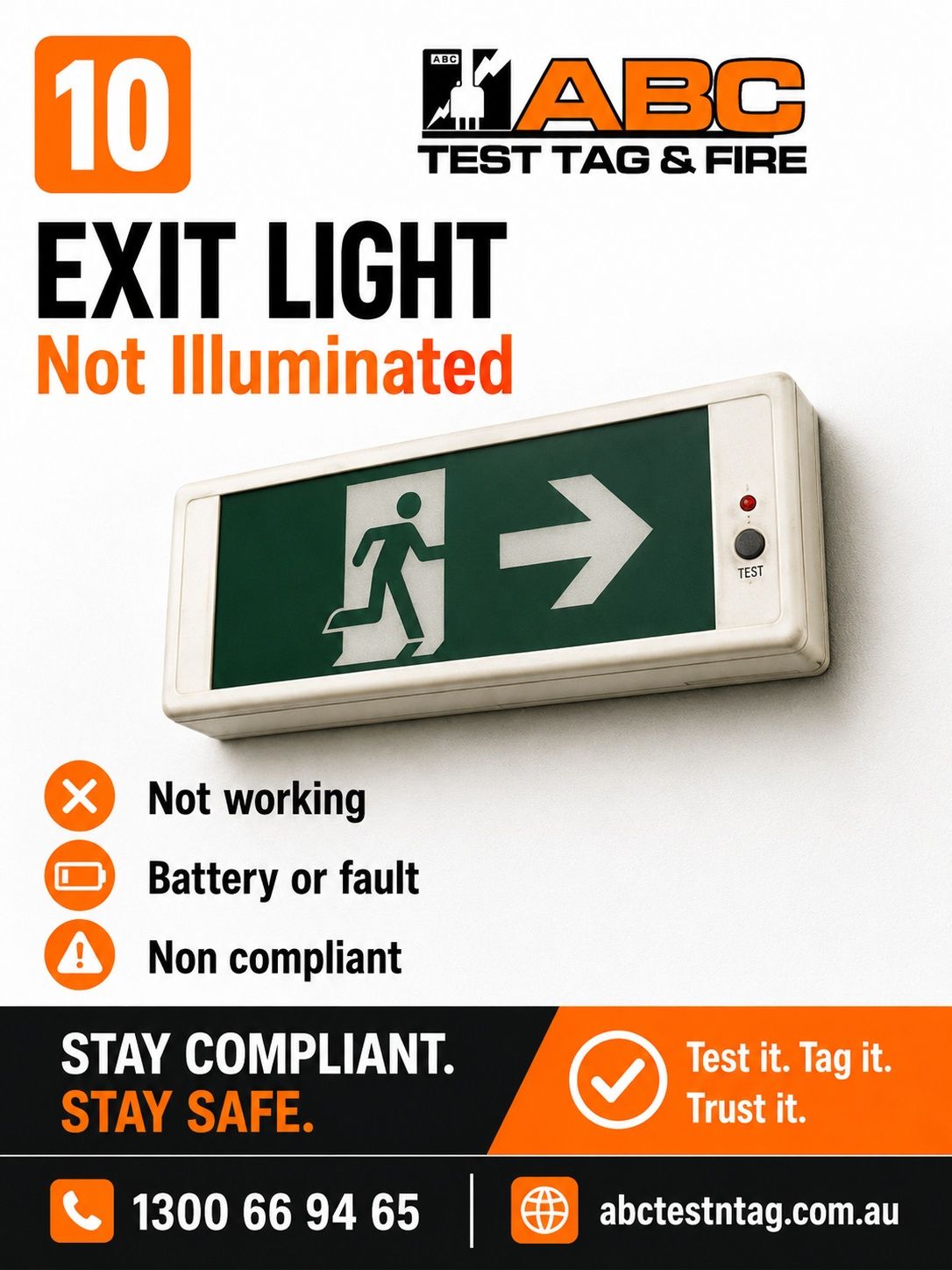
Non-illuminated exit light requiring corrective action following emergency-light compliance testing.
Which Compliance Services Can Be Combined?
ABC Test Tag & Fire can coordinate the following services during a planned West End visit:
| Service | Typical scope | Relevant reference | Documentation or outcome |
|---|---|---|---|
| Electrical test and tag | Visual inspection and electrical testing of applicable equipment | AS/NZS 3760:2022 | Tags, asset records and digital certificates |
| RCD testing | Push-button and instrument testing where applicable | AS/NZS 3760:2022 and Queensland requirements | Test results and corrective-action records |
| Fire extinguisher servicing | Condition, pressure, seals, access and scheduled servicing | AS 1851:2012 and applicable fire requirements | Service tags and reports |
| Fire blanket servicing | Condition, enclosure, location and accessibility | Applicable fire-maintenance requirements | Service record or replacement recommendation |
| Exit light testing | Inspection, functional checks and maintenance | AS/NZS 2293 | Test records and defect recommendations |
| Safety equipment sales | Replacement extinguishers, blankets, exit signs and emergency lights | Product and installation requirements | Supplied equipment and recommendations |
Bundling reduces the need to coordinate multiple contractors and can reduce repeated travel, administration and scheduling costs. ABC offers savings of up to 40%, subject to the scope of work and quotation.
West End Workplace Safety Compliance Checklist
Before booking a compliance visit, a business should:
- Compile a list of portable electrical equipment.
- Identify all extension leads, power boards and RCDs.
- Check whether equipment is used in kitchens, workshops, outdoor areas or other higher-risk environments.
- Remove damaged equipment from use.
- Confirm fire extinguisher and fire blanket locations.
- Ensure fire equipment is visible and unobstructed.
- Check exit paths for storage, furniture or fit-out obstructions.
- Confirm exit signs and emergency lights are visible.
- Review previous service tags and test dates.
- Establish who controls base-building fire systems.
- Request digital records suitable for internal audits and compliance files.
- Schedule future inspections before the next due dates.

Why Choose ABC Test Tag & Fire in West End?
ABC Test Tag & Fire is a locally owned and fully insured provider servicing Brisbane, Ipswich and the Gold Coast. Our integrated approach is designed for businesses that require a straightforward way to manage recurring electrical and fire safety obligations.
Key advantages include:
- Test and tag for 240V, three-phase and low-voltage equipment.
- RCD testing and reporting.
- Fire extinguisher and fire blanket servicing.
- Exit and emergency light testing.
- Safety equipment sales.
- Durable QR-coded compliance tags.
- Fast digital compliance certificates.
- One coordinated service provider.
- Potential savings of up to 40% when services are bundled.
- The opportunity to earn QANTAS Business Rewards points, subject to eligibility, program terms and conditions.
QANTAS Business Rewards eligibility and earning rates can change. Businesses should review the QANTAS Business Rewards terms and conditions and confirm the applicable requirements before relying on points.
Frequently Asked Questions About Test and Tag West End
Is test and tag legally required for every electrical item in a West End office?
Not necessarily. Queensland requirements depend on the type of equipment, work activity and environment. However, the PCBU must ensure all workplace electrical equipment is safe. A risk-based inspection and testing program is an effective way to manage that duty.
How often should RCDs be tested?
The interval depends on whether the RCD is fixed or portable and the type of work environment. Office, manufacturing and construction requirements can differ. ABC can assess the workplace and establish a suitable schedule.
What happens if electrical equipment fails testing?
The equipment should be isolated immediately, marked as out of service and repaired and retested or disposed of. It should not remain available for staff, contractors or customers to use.
Does AS/NZS 3760 cover fire extinguishers?
No. AS/NZS 3760 concerns in-service safety inspection and testing of electrical equipment and RCDs. Fire extinguishers and fire blankets require separate fire safety inspection and servicing arrangements, including consideration of AS 1851:2012.
Can ABC test exit signs and emergency lights?
Yes. ABC provides exit and emergency light testing, maintenance recommendations and equipment sales in accordance with applicable AS/NZS 2293 requirements and the premises’ fire safety documentation.
Can a West End business combine all services in one visit?
Yes. Combining electrical test and tag, RCD testing, fire equipment servicing and exit light testing can simplify scheduling and may provide savings of up to 40%, depending on the work required.
Book West End Electrical and Fire Safety Compliance Services
A documented, risk-based safety program helps West End businesses identify hazards before they become incidents and maintain evidence of ongoing compliance.
For test and tag, electrical safety compliance, RCD testing, fire extinguisher servicing, fire blanket servicing or exit light testing in West End and across Brisbane, contact ABC Test Tag & Fire on 1300 66 94 65.
Request a coordinated quote and ask how bundling your services can reduce costs.