Maintaining workplace safety in a high-intensity industrial hub like Acacia Ridge requires more than a casual commitment; it demands a systematic adherence to Australian Standards and Queensland legislation. As one of Brisbane's most critical logistics and manufacturing precincts, businesses in Acacia Ridge face unique environmental challenges: ranging from heavy dust and moisture to mechanical vibration: that accelerate the wear and tear of safety equipment.
Failure to maintain compliance is not merely a bureaucratic oversight; it is a significant liability. Under the Work Health and Safety Act 2011 (QLD), business owners and managers hold a non-delegable duty of care to ensure the safety of their workers. Inadequate testing of fire equipment or electrical assets can lead to catastrophic failures, voided insurance policies, and severe legal penalties.
Are you inadvertently exposing your business to these risks? Below, we examine seven common mistakes businesses in Acacia Ridge make regarding safety compliance and provide the professional strategies required to rectify them.
Ensuring Compliance with Accurate Testing Intervals
A frequent error in industrial zones like Acacia Ridge is the application of a "one-size-fits-all" approach to testing intervals. Many managers assume that an annual test is sufficient for all electrical equipment. However, AS/NZS 3760:2022 dictates that testing frequency must be determined by the environment in which the equipment operates.
In the heavy-duty workshops and manufacturing plants common to the Southside, equipment is often subject to "hostile environments." This term refers to conditions where the equipment is susceptible to damage, moisture, or dust. For instance, portable equipment used on construction sites or in workshops typically requires testing every 3 to 6 months, whereas equipment in a stable office environment may only require testing every 12 to 60 months.
The Fix: Conduct a thorough risk assessment of your facility. Categorize your workspace into "hostile" and "non-hostile" zones and align your test and tag schedule with the specific requirements of AS/NZS 3760.
2. Is Your Testing Scope Limited Only to the Office?
While the office computer and kitchen kettle are obvious candidates for testing, industrial equipment is often overlooked. In Acacia Ridge distribution centers, we frequently observe 3-phase machinery, heavy-duty extension leads, and battery chargers for forklifts that have missed their scheduled compliance checks.
Compliance under AS/NZS 3760 is not limited to 240V appliances. It extends to all electrical equipment that is plugged into a power supply. Missing a single high-voltage lead in a warehouse can result in a workplace incident that halts production and triggers a WorkSafe QLD investigation.
The Fix: Ensure your complete workplace safety compliance guide includes a comprehensive asset register. Every electrical item, from the warehouse floor to the mezzanine office, must be identified, tagged, and recorded.
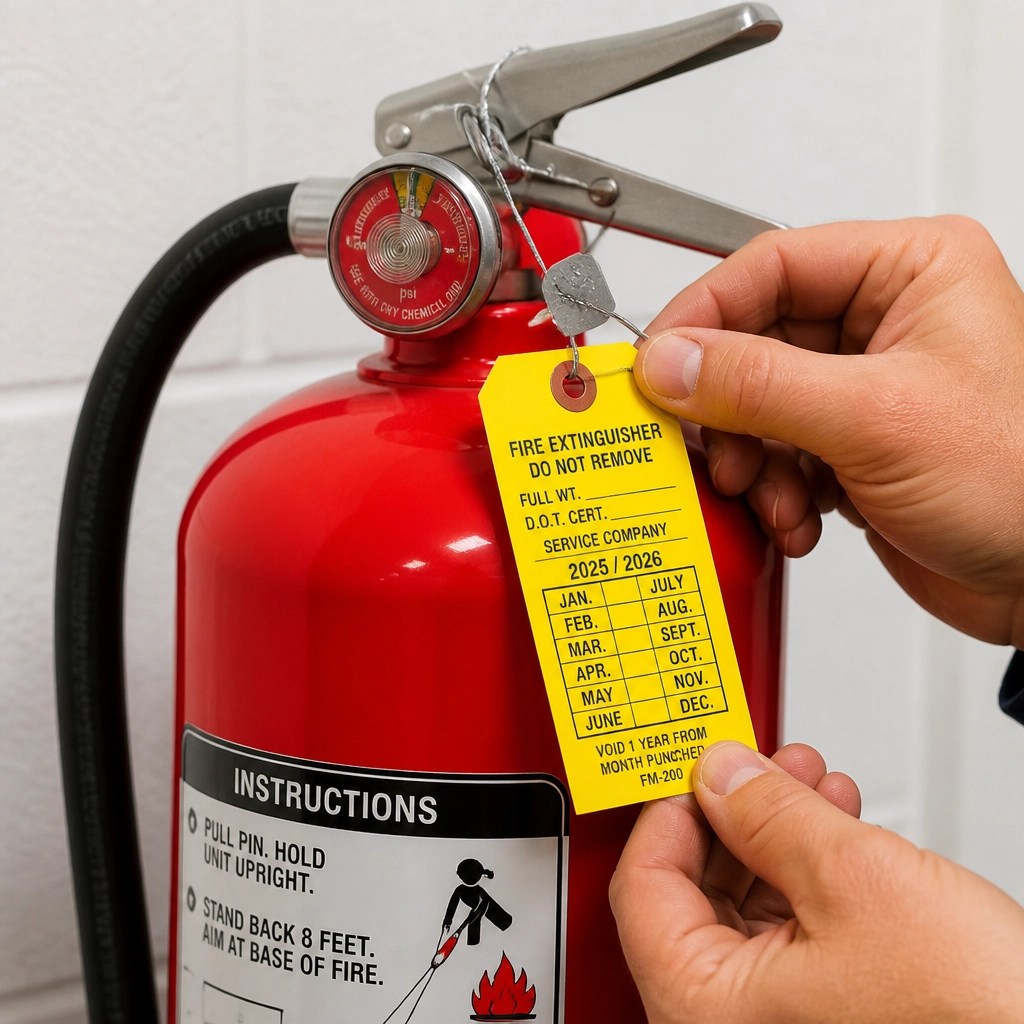
3. How Frequently Are You Maintaining Your Fire Protection Systems?
Fire safety is governed by AS 1851:2012, which mandates a systematic process of routine service for fire protection systems. A common mistake in Acacia Ridge is believing that an annual check is the only requirement. In reality, fire extinguishers, fire blankets, and hose reels require 6-monthly routine testing to ensure they are functional and pressurized.
In industrial settings, fire equipment is often obstructed by pallet racking or damaged by moving machinery. A fire extinguisher with a broken seal or a blocked nozzle is useless in an emergency. Furthermore, Queensland fire safety laws require that these inspections be documented in a compliant logbook or digital register.
The Fix: Engage a professional provider to manage your fire service and sales. Move beyond the annual check and implement the mandatory 6-monthly service schedule to remain fully compliant with AS 1851.
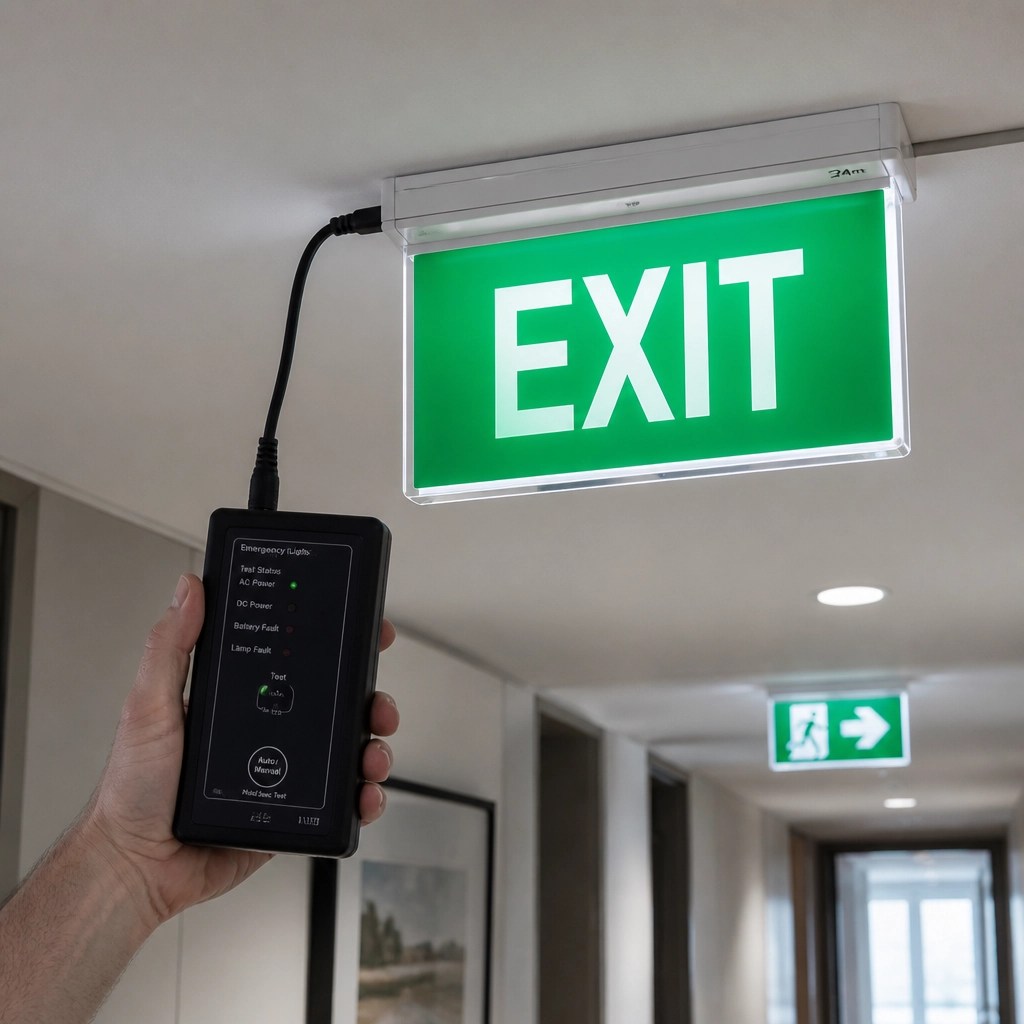
4. Are Your Exit and Emergency Lights Actually Operational?
Emergency escape lighting is often the most neglected component of workplace safety. Under AS/NZS 2293, emergency and exit lights must undergo a discharge test every 6 months. This test involves a manual simulation of a power failure to ensure that the internal batteries can sustain the light for at least 90 minutes.
In the large, windowless warehouses of Acacia Ridge, the failure of an exit sign during a power outage or fire can lead to total darkness, causing panic and preventing a safe evacuation. Simply seeing the light "on" when the power is connected is not proof of compliance; the battery must be verified under load.
The Fix: Schedule 6-monthly discharge testing for all exit and emergency lights. Replacing failed batteries or entire fittings immediately upon discovery is critical for maintaining your building's fire safety certification.
5. Are You Relying on Inadequate Paper Records?
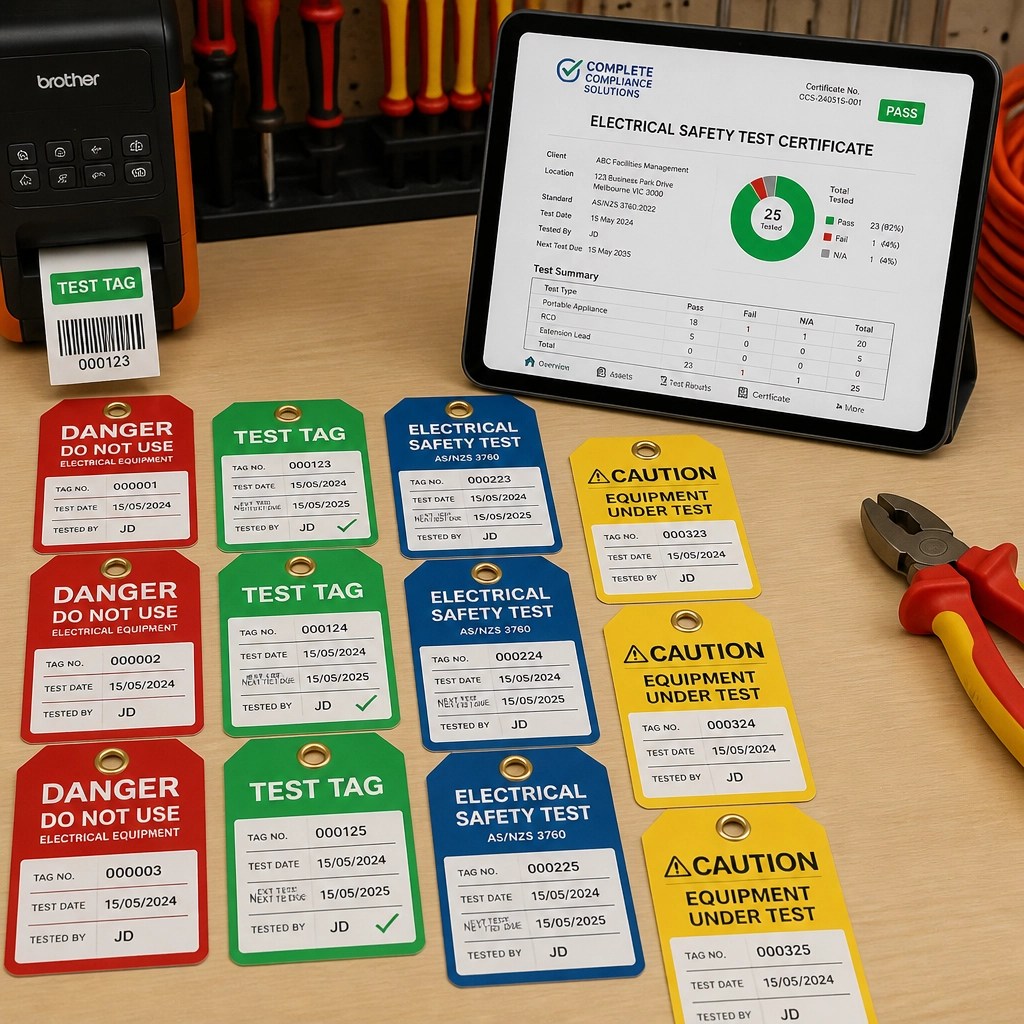
In the event of an audit or an insurance claim, the "tag" on the cord is often insufficient evidence of a systematic safety program. Many businesses still rely on handwritten logbooks that are easily lost, damaged, or incomplete.
Regulatory requirements emphasize the need for a "systematic process." This means being able to produce a digital history of every asset, including its test date, the technician's details, the results of the electrical tests (such as earth leakage and insulation resistance), and the next due date.
The Fix: Transition to a provider that offers digital reporting. At ABC Test Tag & Fire, we provide durable QR-coded tags and digital compliance certificates that are easily accessible during an audit. Automating safety from the office to the warehouse ensures you are never caught without documentation.
6. Are You Using Unqualified Personnel for Critical Safety Tasks?
It is a mistake to assume that any staff member can perform testing and tagging. Queensland law requires that persons performing these tasks must be "competent." This involves specific training and the use of calibrated testing equipment. Using an untrained individual: or a "mate" with a basic multimeter: is a significant risk. If the testing is not performed to the standard of AS/NZS 3760, your compliance is effectively void.
The Fix: Verify the credentials of your service provider. Ensure they are fully insured and use specialized, calibrated equipment designed for safety compliance. Professionalism in testing ensures that "hidden" faults: which visual inspections miss: are identified and mitigated.
7. Are You Overpaying by Using Multiple Service Providers?
Many businesses in Acacia Ridge hire one company for electrical tagging, another for fire extinguishers, and a third for exit lighting. This fragmented approach is not only administratively burdensome but also financially inefficient. Each visit incurs separate call-out fees and coordination time, often resulting in higher overall costs.
The Fix: The most effective strategy for cost reduction is bundling. By integrating your fire and electrical testing, you can streamline the compliance process and achieve significant savings.
"Bundling fire and electrical safety services can reduce your overall compliance costs by 20% to 40%. It is the most logical step for businesses looking to maintain high standards while managing operational budgets." : ABC Test Tag & Fire.
For more information on how this works, see our guide on how to save 40% on maintenance by integrating services.
The Acacia Ridge Solution: Professionalism, Compliance, and Rewards
Rectifying these mistakes does not have to be a logistical nightmare. For businesses in Acacia Ridge, Sunnybank, and throughout Brisbane’s Southside, ABC Test Tag & Fire offers a streamlined, professional solution.
We understand the local industrial landscape and the rigors of Queensland safety legislation. Our technicians provide a comprehensive suite of services designed to keep your workplace safe and your business compliant with AS/NZS 3760 and AS 1851.
Why Choose ABC Test Tag & Fire?
- Cost-Efficiency: Save up to 40% by bundling your electrical and fire testing services. Learn why bundling is the only way to save.
- Expert Knowledge: Our services are performed by local experts who understand the specific needs of Acacia Ridge warehouses and workshops.
- Digital Reporting: Receive hassle-free, digital compliance certificates that satisfy both insurance and regulatory requirements.
- QANTAS Points: As an added benefit for our business clients, you can earn QANTAS points on every fire and electrical service, turning a necessary compliance expense into a business reward.
Don't wait for a WorkSafe inspector or a fire audit to reveal the gaps in your safety program. Professionalism in safety is about proactive risk mitigation. Whether you are operating a large-scale manufacturing plant or a small retail shop, ensuring your compliance is up to date is the only way to protect your people and your assets.
Contact ABC Test Tag & Fire today to schedule a comprehensive site audit and discover the benefits of a bundled safety solution.