SEO title: AS 1851 Fire Equipment Audit Preparation Brisbane | Business Checklist
Meta description: Prepare for your next Brisbane or Ipswich fire safety audit with this AS 1851:2012 checklist covering extinguishers, fire blankets, records, defects and remediation.
Target keywords: AS1851 fire testing Brisbane, fire extinguisher servicing Brisbane, fire blanket testing Brisbane, commercial fire compliance Brisbane, fire audit preparation Ipswich
For Brisbane and Ipswich business owners, facility managers and property managers, fire audit preparation should be treated as a systematic compliance process: not a last-minute search for missing service tags.
Fire extinguishers may be present but incorrectly selected. Fire blankets may be inaccessible. A pressure gauge may be outside the operable range. Service records may be incomplete, or previously identified defects may remain unresolved. Each issue can undermine the effectiveness of your fire safety arrangements and your ability to demonstrate compliance.
This guide explains how to prepare commercial premises for an inspection under the applicable Queensland fire-safety, building and workplace obligations, using AS 1851:2012 as the technical framework for routine servicing.
What does AS 1851:2012 require businesses to understand?
AS 1851:2012 sets out routine service procedures for fire protection systems and equipment. It is not, by itself, a complete statement of every legal duty applying to a building or workplace.
Businesses must also consider applicable Queensland legislation, building approvals, occupancy requirements, workplace health and safety obligations, fire engineering documentation and site-specific risk controls. The responsible owner, employer, person conducting a business or undertaking, body corporate or facility manager must ensure that equipment is suitable, maintained and available for use.
Regulatory reference: AS 1851:2012 provides a technical routine-service framework. The required schedule depends on the equipment, installation, site conditions and applicable regulatory requirements. Do not assume every fire asset has the same servicing interval.
Where applicable to the equipment and site, ABC Test Tag & Fire provides six-monthly routine fire servicing, together with additional servicing, testing, replacement or rectification requirements identified during inspection.
How should you inspect fire extinguishers before an audit?
Begin with a physical walk-through of every designated fire point. Do not rely only on the service tag or asset register.
1. Confirm the extinguisher is suitable
Check whether the extinguisher type corresponds with the hazards in that location. For example:
- Water extinguishers may be suitable for ordinary Class A combustibles.
- Foam units may be used for particular Class A and Class B risks.
- Carbon dioxide extinguishers are commonly selected for certain electrical and flammable-liquid risks.
- Dry chemical powder units may be appropriate for a broader range of risks, subject to the site assessment.
- Wet chemical extinguishers may be required in commercial kitchens involving cooking oils and fats.
Selection and positioning should be assessed against the applicable fire-risk design and equipment requirements, including relevant guidance such as AS 2444. Never move or replace an extinguisher based solely on appearance or convenience.
2. Check access, location and signage
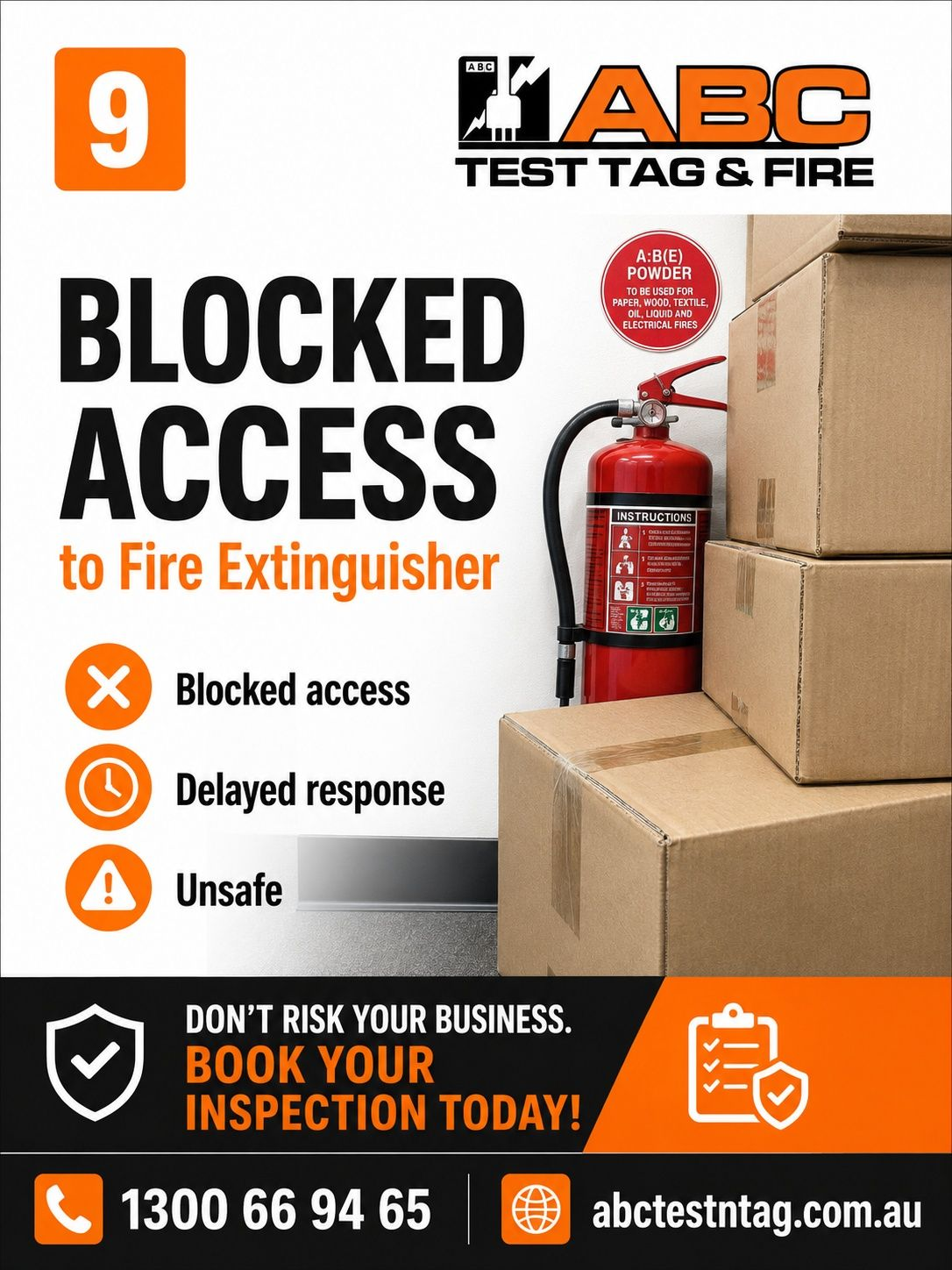
Each extinguisher must be visible, readily accessible and located where occupants can reach it without moving stock, vehicles, machinery or stored materials.
Check for:
- Stacked cartons, pallets or shelving blocking the fire point
- Vehicles, bins or temporary work materials obstructing access
- Missing or damaged identification signs
- Equipment hidden behind doors or partitions
- Extinguishers placed too low, too high or away from the designated location
- Changes to the floor plan that have created new hazards or travel distances
Restore access immediately. Do not wait for an auditor to identify a blocked fire point.

3. Examine the extinguisher condition
Look for visible signs that the equipment may not be ready for service:
- Pressure gauge not within the operable range, where a gauge is fitted
- Corrosion, dents, impact damage or leakage
- Missing or damaged safety pins
- Broken or absent tamper seals
- Cracked, blocked or deteriorated hoses
- Damaged nozzles, horns or discharge components
- Illegible operating instructions or labels
- Evidence of unauthorised discharge
- Unstable mounting brackets or damaged cabinets
Do not discharge, dismantle or repair an extinguisher yourself. Isolate suspected defective equipment from use and arrange assessment by a competent service provider.
4. Verify service tags and due dates
Every item should have a legible service tag or label that can be matched to the site records. Review:
- Date of the most recent service
- Service level or routine completed
- Next due date
- Technician or service-provider details
- Asset identification number, where used
- Evidence of additional service or pressure testing when applicable
The applicable servicing schedule may include routine inspections, annual activities and periodic pressure testing or overhaul. The correct timing depends on the equipment and requirements applying to the site. Missing, illegible or inconsistent dates should be treated as a records and compliance issue requiring investigation.
What should you check on fire blankets?
Fire blankets require the same disciplined approach as extinguishers. A blanket that is present but contaminated, damaged or inaccessible may not be effective when required.
Inspect the fire blanket point for:
- Correct location for the associated cooking or fire risk
- Clear access to the container
- Correct and visible signage
- Intact container and pull-down tabs
- Damage, staining, moisture, grease or contamination
- Legible service identification
- Evidence that the applicable routine inspection has been completed
Fire blanket testing and servicing must reflect the equipment, location and applicable routine schedule. Hospitality businesses should pay particular attention to kitchen access, grease contamination and changes to cooking equipment.
Are your fire safety records audit-ready?
Physical compliance is only one part of an audit. You should also be able to produce evidence that your safety systems are being maintained.
Maintain a central record containing:
- Fire equipment asset register
- Service reports and certificates
- Service tags and due dates
- Defect reports
- Replacement and recharge records
- Pressure-test or overhaul documentation, where applicable
- Photographs of rectified defects
- Work orders and invoices
- Evidence of follow-up inspections
- Current emergency and evacuation documentation
Keep records in a format that can be accessed quickly by the responsible manager. A digital backup is advisable, particularly where paper logbooks may be lost or damaged.

Brisbane audit-readiness table by business type
| Premises | Common audit-preparation priorities |
|---|---|
| Offices | Clear corridors and fire points, suitable equipment for electrical and general risks, current service records and accessible evacuation information |
| Retail and hospitality | Kitchen fire risks, fire blankets, customer-area access, stock not obstructing extinguishers and clear signage |
| Warehouses | Equipment visibility between racking, pallet and forklift access, combustible-stock risks, damaged cylinders and changed storage layouts |
| Workshops | Suitability for flammable liquids, welding and electrical equipment; hose and nozzle condition; corrosion, impact and contamination |
| Construction-related premises | Temporary layouts, mobile equipment, changing work areas, site access, tagged fire equipment and documented defect rectification |
The 10-point AS 1851 audit-preparation checklist
Complete this checklist before your next inspection:
- Confirm every extinguisher is visible and accessible.
- Check that each unit is suitable for the hazard in its location.
- Inspect pressure gauges, where fitted.
- Check pins, tamper seals, hoses, nozzles and labels.
- Look for corrosion, damage, leakage or discharge.
- Confirm fire-point signage is present and legible.
- Inspect fire blankets for damage, contamination and access.
- Match service tags to the asset register and applicable schedule.
- Gather certificates, reports, defect notices and previous follow-up evidence.
- Document and escalate any unresolved defect before the audit.
What is the correct failure and remediation workflow?
A compliant response to a defect should be controlled and documented:
- Identify: Record the asset number, location, defect and date.
- Assess: Determine whether the equipment is unavailable, unsuitable or unsafe.
- Control: Prevent obstruction, isolate defective equipment and provide a suitable interim control where required.
- Notify: Inform the responsible owner, manager, tenant or principal contractor.
- Rectify: Repair, recharge, replace, relocate or service the equipment as appropriate.
- Verify: Confirm the completed work and inspect the asset again.
- Close out: Update the register, service records and supporting photographs.
Do not mark a defect as complete merely because a contractor has been contacted. The issue should remain open until rectification has been verified.
How can bundled compliance services reduce administration?
A fire audit may expose broader workplace compliance gaps. ABC Test Tag & Fire can coordinate:
- Fire extinguisher servicing and sales
- Fire blanket servicing and sales
- Electrical test and tag for 240V, three-phase and low-voltage equipment
- RCD or safety-switch testing
- Emergency exit-light and escape-light testing
- Digital compliance certificates and reporting
- QR-coded electrical tags for easier asset identification
Electrical testing is conducted with reference to AS/NZS 3760:2022, while emergency lighting and exit signs are assessed under the applicable requirements of AS/NZS 2293. Learn more about RCD testing in Brisbane and exit-light services.
Combining appointments can reduce duplicated administration, site access coordination and reporting. Depending on the scope and number of assets, clients may potentially save 20–40%. The more services you book, the more you save.
Frequently asked questions
How often should fire extinguishers be serviced in Brisbane?
The applicable routine schedule depends on the extinguisher, installation, site requirements and governing obligations. Six-monthly routine servicing is commonly applicable and is part of ABC Test Tag & Fire’s service offering, but businesses should also account for annual and periodic servicing or pressure-testing requirements where applicable.
Is AS 1851:2012 the only requirement?
No. AS 1851:2012 provides technical routine-service procedures. Queensland building fire-safety duties, WHS obligations, occupancy conditions, fire engineering documentation and site-specific risk requirements may also apply.
What should I do if an extinguisher is overdue?
Arrange professional assessment promptly. The equipment may require routine servicing, additional testing, replacement or a review of its service history. Record the issue and retain evidence of rectification.
Can you prepare an Ipswich business for a fire audit?
Yes. ABC Test Tag & Fire services commercial premises across Brisbane, Ipswich, the Gold Coast and surrounding suburbs, including offices, warehouses, factories, shops and construction-related worksites.
Arrange your Brisbane or Ipswich compliance inspection
ABC Test Tag & Fire is a locally owned and fully insured provider delivering practical electrical, fire and emergency-lighting compliance services. Clients receive fast, hassle-free digital reporting, QR-coded electrical tags and digital certificates to support ongoing records management.
You can also earn QANTAS Business Rewards points, subject to applicable terms and conditions.
For AS1851 fire testing Brisbane, fire extinguisher servicing Brisbane, fire blanket testing Brisbane or commercial fire compliance Brisbane, call 1300 66 94 65 to discuss your site requirements and arrange an audit-readiness inspection.