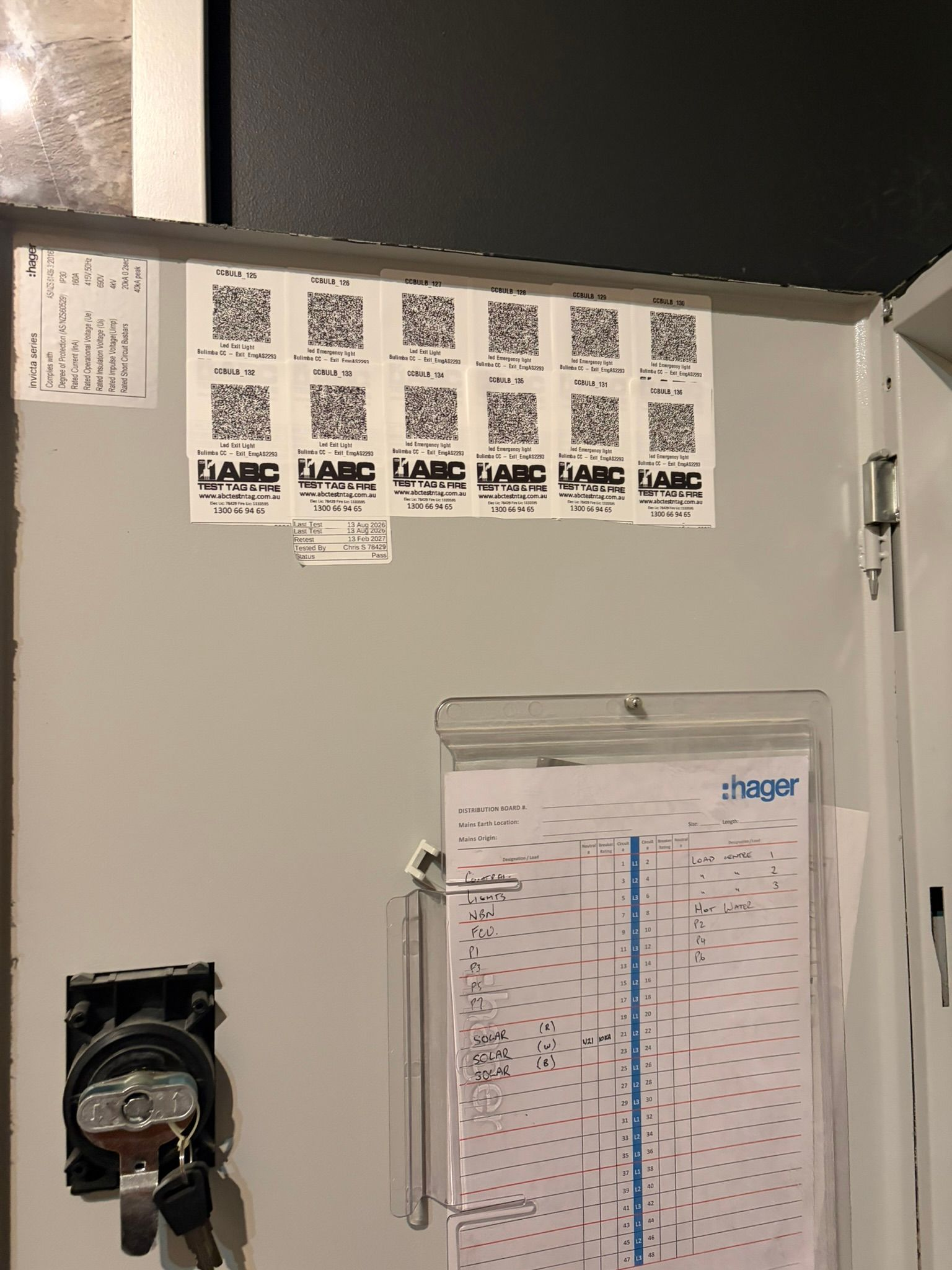
QR-coded switchboard compliance labels supporting documented electrical asset identification and audit-ready recordkeeping.
Businesses operating in Coopers Plains manage a diverse range of workplace risks. Along Boundary Road and Orange Grove Road, commercial and industrial premises include warehouses, workshops, offices, laboratories, engineering facilities, medical environments, retail operations and trade businesses. These workplaces may use portable electrical equipment, power tools, extension leads, machinery, fire extinguishers, fire blankets, exit signs and emergency lighting every day.
How can business operators confirm that these safety systems remain serviceable, accessible and properly documented?
A systematic compliance program is the answer. ABC Test Tag & Fire provides test and tag Coopers Plains, RCD testing, fire extinguisher servicing, fire blanket checks, exit light testing and safety equipment sales, with bundled savings of up to 40%.
The more services you book, the more you save.
Why Is Safety Compliance Important for Coopers Plains Workplaces?
Coopers Plains forms part of Brisbane’s southern commercial and industrial corridor, with connections to Sunnybank, Acacia Ridge, Salisbury, Archerfield and the wider Brisbane Technology Park area at Eight Mile Plains. The local workplace environment is mixed: a single site may contain administrative offices, research areas, workshops, loading zones, storage areas and customer-facing spaces.
Each environment presents different hazards.
- Laboratories may use specialised electrical equipment, refrigerators, testing instruments and extension leads.
- Workshops may operate power tools, portable machinery, battery chargers and three-phase equipment.
- Warehouses may use electrical appliances, pallet-handling equipment and charging stations.
- Offices may contain computers, power boards, kitchen appliances and portable heaters.
- Retail and trade premises may use display equipment, leads, tools and temporary power arrangements.
- Medical and health-related facilities may use equipment requiring specialist inspection regimes beyond general workplace test and tag.
Under Queensland’s Electrical Safety Act 2002, a person conducting a business or undertaking (PCBU) must ensure, so far as is reasonably practicable, that the business is conducted in an electrically safe way. This includes ensuring workplace electrical equipment is safe to use.
The Electrical Safety Regulation 2013 established detailed requirements relating to the inspection, testing, tagging, isolation and removal of unsafe electrical equipment. As Queensland legislation and regulations can change, businesses should confirm the current applicable requirements through Queensland legislation and WorkSafe Queensland electrical safety guidance.
The Work Health and Safety Act 2011 also requires PCBUs to manage risks to workers and other people at the workplace, including risks associated with plant, equipment and systems of work.
Australian Standards provide technical frameworks for inspection and maintenance. They are not legislation by themselves, but they may be referenced by legislation, codes, building requirements, contracts, insurers and workplace safety procedures.
What Does Test and Tag Coopers Plains Involve?
Electrical test and tag is an in-service safety process. It is not simply the application of a coloured label.
A competent technician should complete a structured process involving:
-
Asset identification
Equipment is identified and recorded so that it can be tracked during future inspections. -
Visual inspection
The technician checks plugs, cords, casings, switches, strain relief, pins, enclosures and signs of heat, moisture, corrosion, crushing or mechanical damage. -
Electrical testing
Appropriate tests are performed according to the equipment type and applicable procedures under AS/NZS 3760:2022. This may include testing low-voltage single-phase and polyphase equipment connected by a flexible cord or connecting device. -
Result determination
Equipment is assessed as pass, fail or requiring further action. A visual inspection alone does not replace electrical testing where testing is required. -
Failed-equipment isolation
Unsafe equipment must be disconnected or isolated from the electricity supply and prevented from returning to service until it is repaired, tested and confirmed safe, replaced or permanently removed. -
Tagging and reporting
Equipment that passes is identified with a durable test tag. ABC Test Tag & Fire can provide QR-coded tags and digital compliance certificates to support audit readiness and asset management.
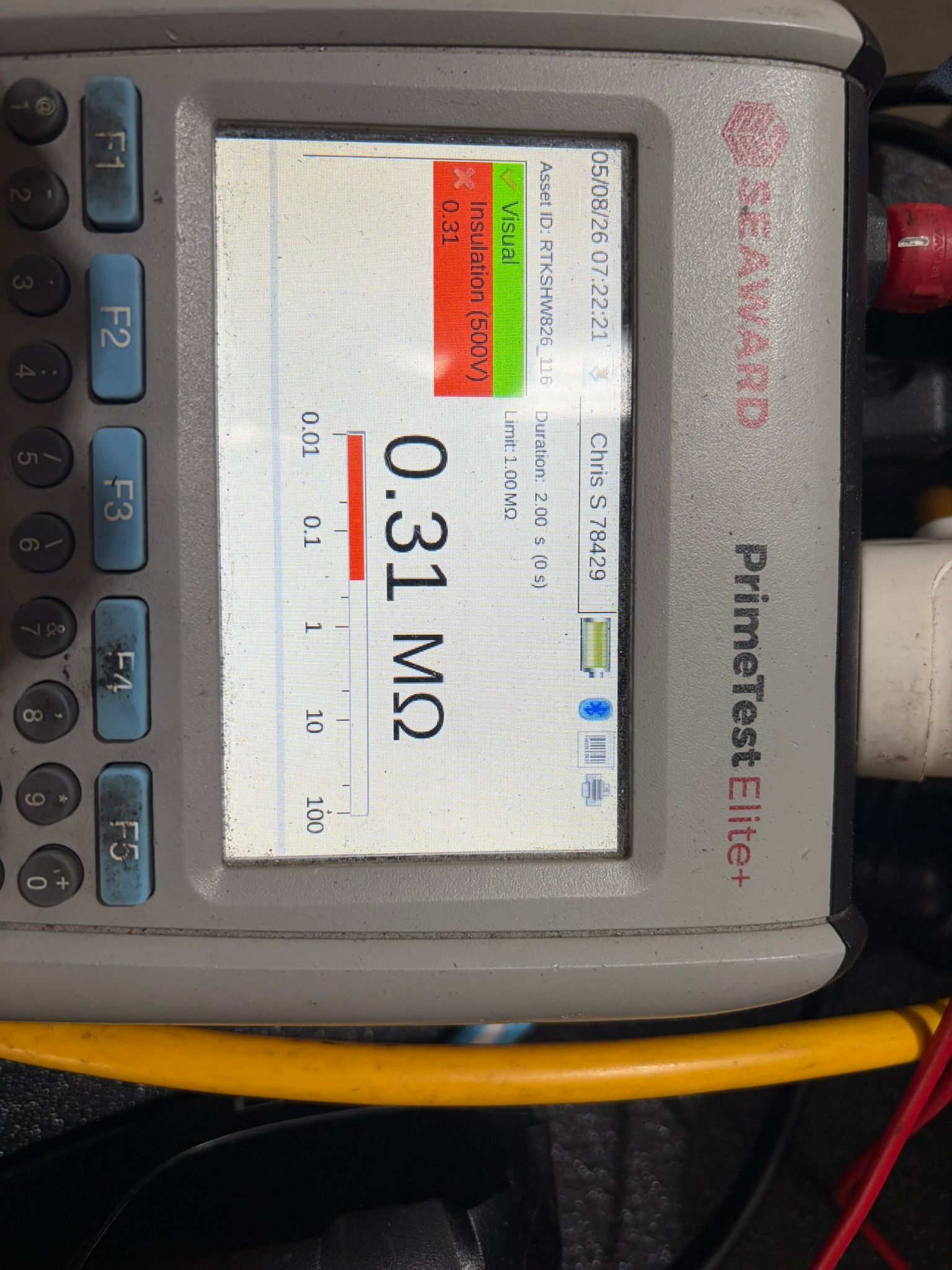
Electrical testing in progress, suitable for failed-equipment assessment and insulation-resistance compliance procedures.
How Does RCD Testing Coopers Plains Reduce Electrical Risk?
Residual current devices, commonly called safety switches, are designed to disconnect electrical supply when they detect an imbalance that may indicate current flowing through an unintended path.
An RCD is a risk-control device: not a substitute for safe equipment, correct installation or safe work practices.
RCD testing Coopers Plains should distinguish between:
- Portable plug-in RCDs and RCD-protected power boards.
- In-line RCD devices used with portable equipment.
- Fixed RCDs installed in an electrical installation.
- RCDs associated with specialist medical or installation systems, which may require other procedures or competent specialists.
Under AS/NZS 3760:2022, in-service RCD testing can involve a functional push-button test and instrument testing using suitable test equipment. The exact testing frequency depends on the RCD type, workplace environment, use and applicable legal or site requirements.
Construction, workshops, outdoor areas, wet locations and environments involving mechanical damage generally require closer risk assessment than a controlled office environment. Do not apply a single testing interval to every asset without reviewing the workplace risk profile.
For electrical safety guidance, see ABC Test Tag & Fire’s electrical test and tag services in Brisbane and RCD testing compliance guide.
What Fire Safety Services Are Required in Coopers Plains?
Fire protection equipment must remain accessible, correctly located, identifiable and serviceable. A fire extinguisher that is blocked by stock, damaged, discharged or overdue for service cannot provide reliable protection.
ABC Test Tag & Fire provides fire extinguisher testing Coopers Plains, fire blanket servicing and fire safety equipment sales in accordance with applicable requirements under AS 1851:2012.
Routine fire equipment checks may include:
- Confirming the extinguisher is in its designated location.
- Checking access, signage and mounting arrangements.
- Inspecting the cylinder, hose, nozzle, pin, seal and pressure indicator where fitted.
- Checking for corrosion, impact damage, leakage or tampering.
- Verifying weight and general condition.
- Inspecting fire blankets, their packaging, mounting and accessibility.
- Recording service outcomes and identifying defects requiring rectification.
Portable fire extinguishers generally require routine servicing at least every six months under AS 1851:2012, with additional annual and five-yearly activities applying to relevant equipment and service schedules. The precise requirements depend on equipment type, condition and the building’s fire safety arrangements.
Business operators should also understand the difference between workplace equipment servicing and broader building fire safety obligations. The responsible occupier, owner, facility manager or body corporate may have additional duties under Queensland building and fire safety requirements.
How Do Exit Lights Support Emergency Egress?
Emergency lighting and exit signs support safe movement when normal lighting fails. Their purpose is not decorative. They must remain visible, operational and unobstructed so occupants can identify an available path to safety.
ABC Test Tag & Fire provides exit and emergency light testing and sales under the AS/NZS 2293 framework. A service review may consider:
- Whether exit signs are visible from the required approach.
- Whether emergency lighting covers relevant paths of travel.
- Whether fittings show damage or failure indicators.
- Whether batteries and charging functions appear operational.
- Whether the discharge test and maintenance schedule have been completed.
- Whether emergency routes are obstructed by stock, equipment or stored materials.
- Whether records are available for inspection.
AS/NZS 2293 maintenance programs commonly include periodic functional checks and six-monthly discharge testing for applicable emergency lighting systems. Annual compliance planning and documentation should also be coordinated with the building’s fire safety schedule and responsible person.

Wall-mounted emergency lighting unit with active charging indicator supporting compliant egress illumination and maintenance visibility.
Which Coopers Plains Workplaces Need Different Testing Approaches?
Testing should be risk-based. The following table is a practical planning guide, not a substitute for a site-specific assessment or the full text of the relevant Standard.
| Workplace environment | Typical assets | Compliance considerations |
|---|---|---|
| Offices | Computers, monitors, power boards, kitchen appliances | Review general electrical equipment, leads, RCD protection and emergency egress |
| Laboratories and research areas | Test equipment, refrigerators, pumps and portable instruments | Identify specialist or medical equipment that may require separate procedures; control moisture and chemical exposure |
| Workshops and engineering businesses | Power tools, welders, chargers, extension leads and three-phase equipment | Consider mechanical damage, dust, heat, conductive environments and higher equipment usage |
| Warehouses | Portable appliances, chargers, leads and material-handling equipment | Protect cords from crushing, traffic and impact; maintain access to fire equipment |
| Retail and trade businesses | Display equipment, tools, appliances and temporary power | Check customer-accessible areas, portable equipment and storage around extinguishers |
| Medical and health facilities | Clinical and general electrical equipment | Separate general workplace assets from medical electrical equipment requiring specialist testing arrangements |
| Construction or temporary worksites | Portable tools, leads and portable RCDs | Apply the relevant construction requirements, including applicable AS/NZS 3012 controls |
What Records Should a Coopers Plains Business Keep?
Compliance is not complete when the technician leaves the site. Results must be retrievable and actionable.
A suitable record system should identify:
- The equipment or fire asset inspected.
- The location and asset description.
- The inspection or service date.
- The result and any defects identified.
- The next scheduled action.
- The person or provider who completed the work.
- Isolation, repair, replacement or rectification actions.
- Relevant certificates, tags and service records.
ABC Test Tag & Fire provides QR-coded tags and digital compliance certificates, allowing responsible managers to access records more efficiently during internal reviews, audits, tenancy management or contractor coordination.
Coopers Plains Workplace Safety Compliance Checklist
Use this checklist before requesting a compliance service:
- Identify all portable and plug-in electrical equipment.
- Separate general equipment from specialist medical or laboratory assets.
- Identify fixed and portable RCDs.
- Review the testing frequency based on workplace risk and equipment use.
- Remove damaged leads, plugs, power boards and equipment from service.
- Keep fire extinguishers and fire blankets accessible.
- Check that fire equipment signage is visible.
- Ensure exit signs and emergency lights are not obstructed.
- Review fire and emergency-lighting service dates.
- Maintain current digital certificates and service records.
- Coordinate electrical, fire and exit-light services where practical.
How Can You Reduce the Cost of Workplace Compliance?
Coordinating separate contractors for electrical testing, RCD testing, fire equipment servicing and exit light testing can create duplicated administration, multiple appointments and additional call-out costs.
ABC Test Tag & Fire offers bundled electrical and fire safety compliance services with savings of up to 40%. The more services you book, the more you save.
Clients can also access:
- Locally owned service.
- Fully insured technicians.
- Fast, hassle-free digital reporting.
- QR-coded asset tags.
- Service coverage across Brisbane, Ipswich and the Gold Coast.
- Eligibility to earn QANTAS Business Rewards points on services, subject to program terms and conditions.
Book Test and Tag and Fire Testing in Coopers Plains
Whether your premises is near Boundary Road, Orange Grove Road, the Sunnybank and Acacia Ridge connections, or the wider southern Brisbane employment corridor, ABC Test Tag & Fire can help coordinate a practical compliance program.
Book test and tag Coopers Plains, electrical safety compliance Coopers Plains, fire extinguisher testing Coopers Plains, RCD testing Coopers Plains and emergency lighting services together.
Call 1300 66 94 65 to arrange a site assessment or request a bundled quote.
For broader information, review our Brisbane electrical test and tag service, commercial fire compliance guide or industrial safety compliance services across Brisbane.