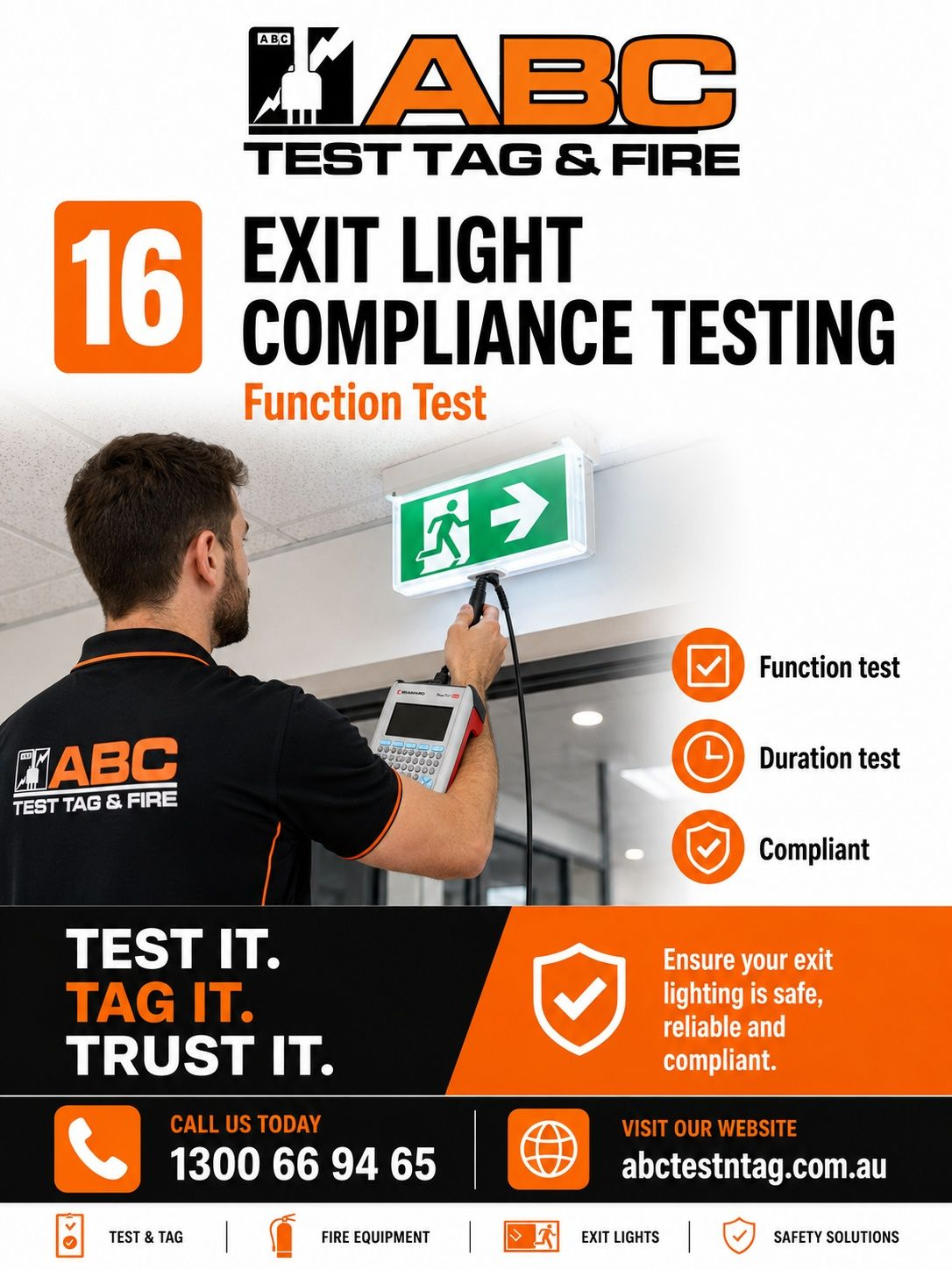
Exit-light compliance function testing during routine emergency-lighting inspection.
Businesses operating in Darra have ongoing responsibilities to manage electrical, fire and emergency-evacuation risks. Warehouses, factories, workshops, transport and logistics facilities, trade suppliers, offices and retail premises may all use electrical equipment and safety systems that require structured inspection, testing, maintenance and recordkeeping.
ABC Test Tag & Fire provides coordinated test and tag Darra, RCD testing, fire extinguisher servicing and exit-light testing for businesses throughout Brisbane, Ipswich and the Gold Coast.
By combining services at the same visit, eligible customers may save up to 40%. The more services you book, the more you save.
Why Is Workplace Safety Compliance Important in Darra?
Darra businesses often operate across mixed commercial and industrial environments, with equipment exposed to regular movement, dust, moisture, impact and heavy use. Workplaces located around Darra’s industrial areas, Monier Road and the Centenary Highway and Western Freeway connections may also manage warehouses, workshops, loading areas, offices and customer-facing spaces from one site.
These conditions can increase the likelihood of:
- Damaged electrical cords, plugs and power boards
- Faults in portable tools and three-phase equipment
- Failure of RCDs or safety switches
- Obstructed fire extinguishers and fire blankets
- Defective emergency lighting or exit signs
- Incomplete inspection records
- Delays in isolating failed equipment
Queensland businesses must manage workplace risks under applicable legislation, including the Electrical Safety Act 2002, the Electrical Safety Regulation 2013 and workplace health and safety laws. Australian Standards provide technical frameworks for inspection, testing and maintenance; they are not legislation by themselves.
The correct compliance approach is therefore systematic. Identify the hazard, assess the risk, apply the appropriate technical standard and Queensland requirement, document the result and correct defects promptly.
What Does Test and Tag Darra Include?
Electrical test and tag is an in-service safety process for equipment such as:
- 240V appliances and portable equipment
- Three-phase equipment and leads
- Extension leads and power boards
- Portable tools and workshop equipment
- Office appliances and kitchen equipment
- Chargers, portable lighting and cleaning equipment
- Relevant low-voltage equipment
- Hire and contractor equipment brought onto a site
Testing is performed with reference to AS/NZS 3760:2022, In-service safety inspection and testing of electrical equipment and RCDs. The standard describes the technical process, while Queensland requirements and the workplace risk assessment determine how the process is applied.
How Is Electrical Equipment Tested?
A competent technician generally follows these stages:
-
Identify the equipment
Each item is recorded by asset number, serial number, location or another reliable identifier. -
Complete a visual inspection
The technician checks the cord, plug, enclosure, switches, strain relief, pins and accessories for damage, overheating, contamination, exposed conductors or unauthorised modifications. -
Conduct appropriate electrical tests
Depending on the equipment, this may include earth continuity, insulation resistance, polarity, leakage current and functional testing. -
Assess the result
Equipment that passes is recorded as compliant. Equipment that fails is clearly identified and removed from use. -
Apply a durable QR-coded tag
A compliant item receives identification showing relevant testing information, including the test date and next due date. -
Issue digital records
Digital compliance certificates and asset records provide accessible evidence for workplace managers, safety officers and audits.
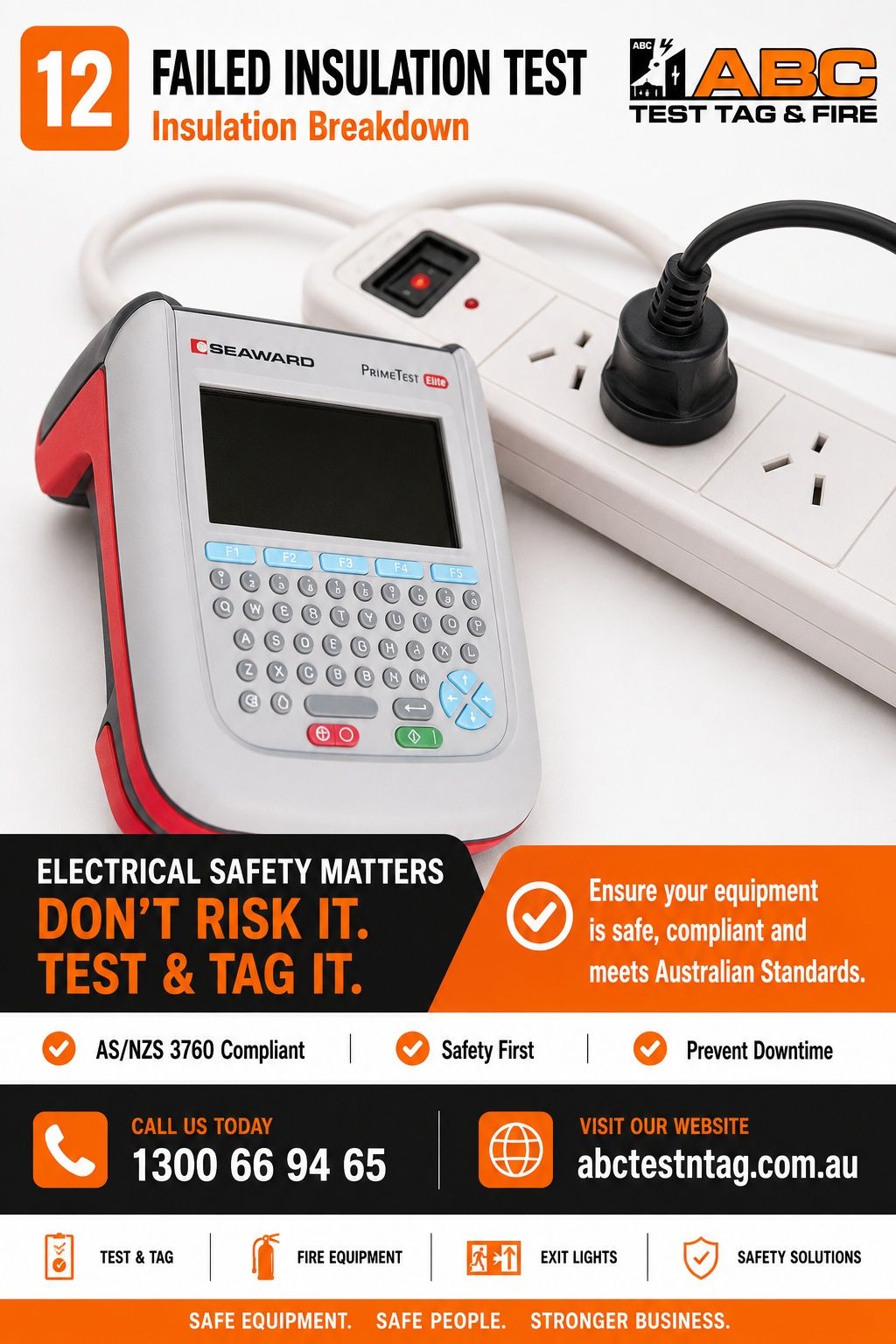
Electrical equipment identified during testing with a failed insulation-resistance result requiring isolation from service.
A failed item must not remain in circulation while awaiting repair. Isolate it immediately, attach an appropriate danger or out-of-service notice and arrange repair, replacement or disposal through a controlled process.
How Often Should Electrical Equipment Be Tested?
There is no single interval that applies to every item in every Darra workplace. Testing frequency should consider:
- The type of work being performed
- Exposure to dust, moisture, heat, chemicals or impact
- Frequency of movement and use
- Condition and age of the equipment
- Whether cords are regularly flexed or disconnected
- Previous failure history
- Whether the equipment is used outdoors or in a hostile environment
- Applicable Queensland statutory intervals
Construction and high-risk environments commonly require more frequent testing than controlled offices. Workshops, factories, warehouses and logistics operations may require six- or twelve-monthly programs depending on the equipment and conditions. Lower-risk office equipment may be subject to longer intervals where permitted, but an office location alone does not justify a longer period.
Use the current WorkSafe Queensland testing and tagging guidance and retain the reasoning behind the selected schedule.
What Is Included in RCD Testing Darra?
Residual Current Devices, commonly called safety switches, are designed to disconnect electrical supply when they detect an imbalance that may indicate current flowing through an unintended path.
RCD testing should not be confused with a simple visual check. It may include:
- Visual inspection
- Push-button functional testing
- Instrument testing of operating time and trip current
- Recording of results and next due dates
- Tagging of portable RCDs where applicable
- Isolation and reporting of failed devices
Fixed RCDs installed in a switchboard are not generally “test and tag” items in the same way as portable appliances, but they still require testing at prescribed intervals. Portable RCDs used with tools, leads and site equipment require a separate testing regime.
WorkSafe Queensland identifies different testing intervals according to the type of work. For example, construction workplaces may require monthly push-button testing of fixed RCDs, daily or pre-use testing of portable RCDs, and periodic instrument testing. Manufacturing, office and service environments have different intervals.
The applicable schedule must be confirmed for the workplace. Do not rely on a generic sticker or an assumed annual interval.
For additional guidance, read ABC Test Tag & Fire’s RCD testing Brisbane compliance guide.
How Does Fire Extinguisher and Fire Blanket Testing Work?
Fire equipment must remain accessible, correctly located and capable of performing its intended function. ABC Test Tag & Fire provides six-monthly fire extinguisher and fire blanket servicing in accordance with AS 1851:2012, together with fire safety equipment sales where replacement or additional equipment is required.
Routine checks may consider:
- Correct equipment type for the identified hazard
- Physical condition of the extinguisher or blanket
- Pressure and safety-seal condition
- Service tag and maintenance history
- Corrosion, damage or leakage
- Mounting and signage
- Unobstructed access
- Suitability of location
- Whether equipment has been discharged or tampered with
Fire extinguishers and fire blankets must not be hidden behind stock, pallets, shelving or stored materials. Keep access routes clear and ensure employees can identify equipment quickly.
AS 1851:2012 is a technical maintenance standard. Its application must be considered alongside Queensland building and fire-safety obligations, the site’s fire safety schedule and the responsibilities of the building occupier.

Fire extinguisher access obstructed by stored boxes, creating a rectification issue during fire-safety inspection.
What About Exit Lights and Emergency Lighting?
Emergency escape lighting and exit signs support safe evacuation if normal lighting fails. ABC Test Tag & Fire provides exit-light and emergency-light testing and sales in accordance with AS/NZS 2293 and the applicable site requirements.
The service can identify:
- Exit signs that are not illuminated
- Failed batteries or lamps
- Damaged fittings
- Poor visibility from normal occupant paths
- Emergency lights that do not operate during testing
- Obstructed or unclear evacuation routes
- Missing or damaged signage
Testing should be recorded, defects should be assigned for rectification and emergency egress routes must remain clear at all times. Emergency lighting is a separate compliance activity from portable appliance test and tag, even when both services are completed during the same site visit.
Which Compliance Services Are Relevant to a Darra Workplace?
| Workplace area | Typical compliance considerations |
|---|---|
| Warehouse and storage areas | Portable equipment, chargers, extension leads, RCDs, extinguisher access and exit signs |
| Factory or workshop | Three-phase equipment, power tools, leads, machinery-related electrical risks and fire equipment |
| Transport and logistics facility | Mobile equipment, loading-area hazards, portable RCDs, emergency lighting and clear egress |
| Trade supplier or retail premises | Point-of-sale equipment, display equipment, customer areas, fire blankets and extinguishers |
| Office attached to an industrial site | Computers, kitchen appliances, power boards, fixed RCDs and emergency lighting |
| Construction or fit-out worksite | High-risk electrical equipment, portable RCDs, frequent visual inspections and strict isolation of failures |
How Can Bundling Reduce Compliance Administration?
Coordinating separate contractors for electrical testing, RCD testing, fire servicing and exit-light testing can create duplicated appointments, additional call-out costs and fragmented records.
ABC Test Tag & Fire can coordinate multiple services through one locally owned and fully insured provider:
- Electrical test and tag for 240V, three-phase and relevant low-voltage equipment
- Fixed and portable RCD testing
- Six-monthly fire extinguisher and fire blanket service
- Fire safety equipment sales
- Annual exit-light and emergency-light testing
- Replacement exit lights and safety equipment
- QR-coded tags
- Digital compliance certificates
- Brisbane, Ipswich and Gold Coast coverage
Eligible customers may save up to 40% by bundling services. The more services you book, the more you save. Eligible bookings may also earn Qantas Business Rewards points, subject to Qantas Business Rewards terms, account eligibility and applicable service conditions.
Darra Workplace Safety Compliance Checklist
Use this checklist before your next scheduled inspection:
- Identify every portable and connectable electrical item.
- Separate 240V, three-phase, low-voltage and RCD-protected equipment.
- Confirm the environment and risk profile for each equipment group.
- Check current test dates and next due dates.
- Remove damaged or failed equipment from service.
- Keep extinguishers and fire blankets accessible and correctly signed.
- Check that exit routes are clear.
- Confirm exit signs and emergency lights are tested as scheduled.
- Maintain digital certificates and defect records.
- Review the schedule after equipment, layout or workplace changes.
Frequently Asked Questions
Is test and tag mandatory for every Darra business?
The obligation depends on the equipment, workplace activities, Queensland requirements and assessed risk. Businesses must manage electrical risks and comply with applicable statutory requirements. A competent person should determine the appropriate testing program.
Are AS/NZS 3760:2022, AS 1851:2012 and AS/NZS 2293 laws?
No. These are technical standards. They provide recognised frameworks for electrical equipment testing, fire equipment servicing and emergency lighting. They must be applied with Queensland legislation, building requirements, fire-safety obligations and site-specific risk assessments.
What happens when equipment fails testing?
The equipment should be removed from service, clearly labelled and recorded as failed. It must be repaired by an appropriately qualified person, replaced or disposed of before being returned to use.
Can you test equipment at a warehouse, factory or workshop?
Yes. ABC Test Tag & Fire services workplaces including warehouses, factories, workshops, transport and logistics facilities, trade suppliers, offices, retail premises and construction worksites across Brisbane and surrounding areas.
Can electrical, fire and exit-light services be booked together?
Yes. Coordinating services can reduce administration and may provide bundled savings of up to 40%. Qantas Business Rewards points may also be available on eligible services, subject to terms.
Book Test and Tag and Fire Compliance in Darra
Do not wait for an incident, audit or overdue tag to expose a gap in your safety program.
Contact ABC Test Tag & Fire on 1300 66 94 65 to arrange test and tag Darra, RCD testing, fire extinguisher and fire blanket servicing, exit-light testing and safety equipment sales.
Request workplace compliance support from ABC Test Tag & Fire