Meta description: Learn how to position, access and maintain workplace fire extinguishers in Brisbane under AS 1851, AS 2444 and Queensland fire safety obligations.
Target keywords: fire extinguisher servicing Brisbane, fire extinguisher testing Brisbane, AS1851 fire testing, fire extinguisher placement Brisbane, fire equipment accessibility Brisbane
For Brisbane businesses, correct fire extinguisher placement is not simply a matter of mounting a red cylinder on the nearest wall. Fire equipment must remain suitable for the hazards present, conspicuous, accessible, correctly signed and maintained in a serviceable condition.
This applies to offices, retail premises, hospitality venues, warehouses, workshops, factories, commercial properties, construction-related sites and other workplaces across Brisbane, Ipswich and the Gold Coast.
The practical installation principles are generally addressed by AS 2444, while routine servicing and maintenance activities are addressed by AS 1851:2012. However, AS 1851 is not legislation by itself. In Queensland, relevant fire safety obligations are established through legislation and regulatory instruments, including the Building Fire Safety Regulation 2008, Queensland Development Code requirements and applicable Australian Standards.
Why does fire extinguisher accessibility matter?
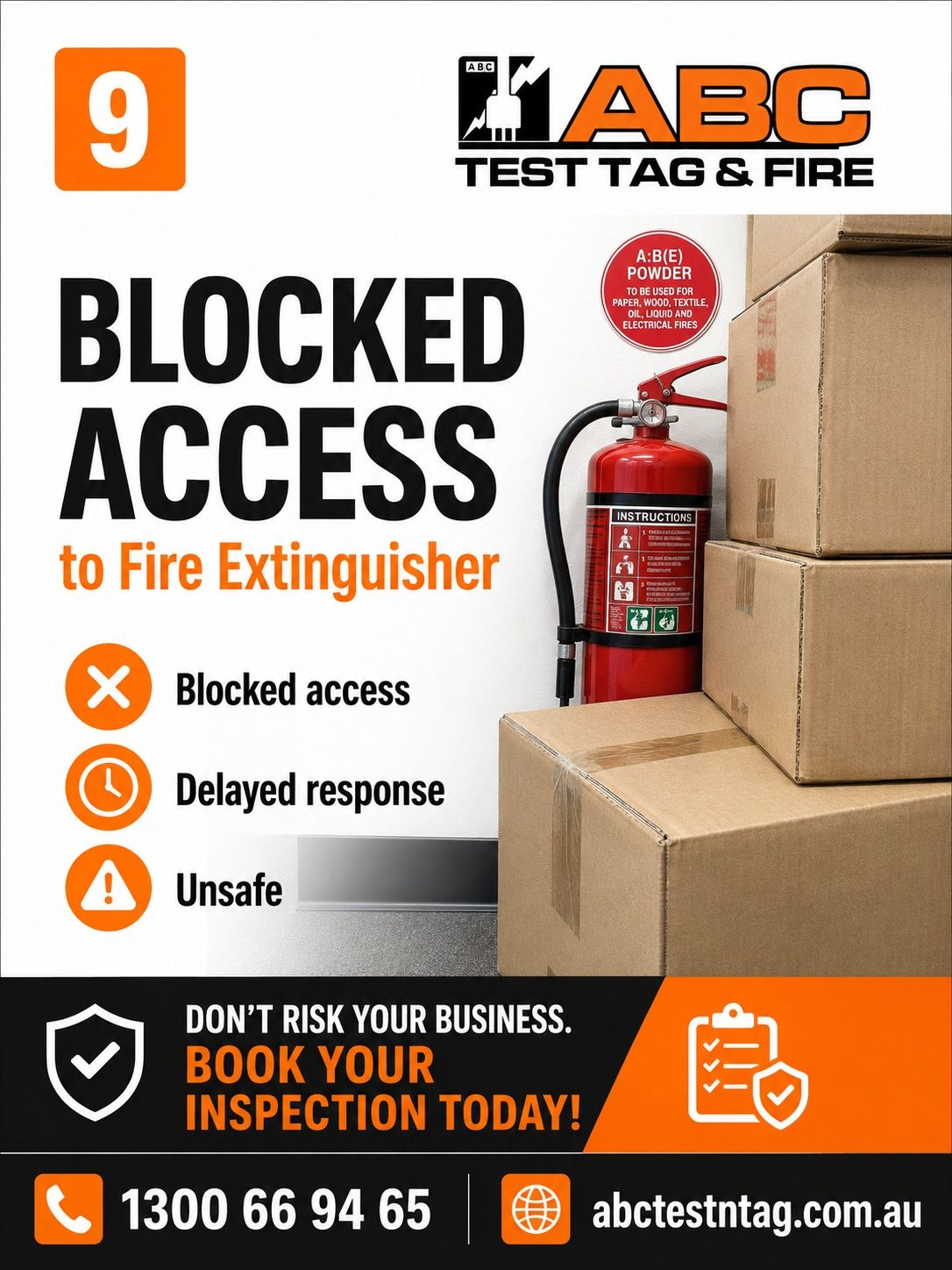
An extinguisher that cannot be found, reached or safely removed is not an effective emergency control. Blocked access can delay intervention, force workers to approach a fire from an unsafe position or prevent the equipment from being used at all.
Common accessibility failures include:
- Stock, cartons, pallets or tools placed in front of the extinguisher
- Extinguishers hidden behind doors, partitions or furniture
- Missing, damaged or poorly positioned location signage
- Units removed from their assigned position and not replaced
- Extinguishers mounted too low, too high or on an unsuitable bracket
- Equipment installed too close to a hazard, creating an unsafe approach path
- Fire extinguishers placed where they are exposed to impact, heat, chemicals or corrosion
AS 1851 routine servicing includes checking whether the extinguisher remains in its assigned location and is conspicuous and readily accessible.
“CHECK the extinguisher is conspicuous, readily accessible and in its assigned location.”
: AS 1851:2012, routine service accessibility requirement, as reproduced in industry guidance
Do not treat a blocked extinguisher as a minor housekeeping issue. Correct it immediately.
What are the basic fire extinguisher placement requirements in Brisbane?
The final layout must be determined by the building design, risk profile, travel distances, extinguisher types and applicable standards. In general, Brisbane workplaces should assess the following matters.
1. Is the extinguisher visible and reachable?
Extinguishers should be located along normal paths of travel and positioned so workers can identify and reach them without moving stock or passing through an unnecessary hazard.
A clear working area should be maintained in front of the extinguisher. Many workplace inspection programs use approximately 1 metre of unobstructed clearance as a practical control, subject to the specific installation and site conditions.
2. Is the extinguisher correctly mounted?
Portable extinguishers should be secured on an appropriate bracket or installed in a suitable cabinet. As a commonly applied AS 2444 installation principle:
- The base should generally be at least 100 mm above floor level
- The carrying handle should generally be no more than 1,200 mm above the floor
- The unit should face outward, with operating instructions legible
- The mounting surface should be stable and suitable for the extinguisher’s weight
The correct height may vary depending on the equipment and installation. A qualified fire service provider should verify the arrangement rather than relying on an informal visual assumption.
3. Is location signage visible?
A person unfamiliar with the premises should be able to identify the extinguisher quickly. Location signs are particularly important where extinguishers are installed in cabinets, near storage areas or in visually complex workspaces.
Signs should be:
- Clearly visible from the approach path
- Positioned above or adjacent to the extinguisher
- Kept unobstructed by shelving, signage or stored goods
- Consistent with the applicable fire equipment identification requirements
- Replaced if faded, missing, damaged or incorrectly located

4. Is the extinguisher suitable for the hazard?
The extinguisher must be selected for the fire risks present. A water extinguisher is not an appropriate response to every workplace fire, and using the wrong equipment can increase the danger.
| Workplace environment | Common fire risks | Placement and equipment considerations |
|---|---|---|
| Offices | Paper, cardboard, furniture, computers and power boards | Class A coverage, electrical-risk assessment, clear access near normal travel paths |
| Retail premises | Packaging, stock, displays and electrical equipment | Maintain visibility despite merchandising; review placement after shop refits |
| Hospitality and commercial kitchens | Cooking oils, fats, gas and electrical appliances | Wet chemical equipment for cooking-oil risks; locate equipment close to, but not directly within, the hazard zone |
| Warehouses | Cardboard, pallets, plastics, forklifts and charging areas | Review travel distances, storage changes, impact protection and access around racking |
| Workshops and factories | Flammable liquids, welding, machinery, fuels and electrical plant | Match extinguisher type to the process; consider foam, dry chemical or CO₂ requirements |
| Construction-related sites | Temporary power, fuels, hot work, timber and combustible materials | Reassess equipment as the site changes; protect extinguishers from damage, weather and unauthorised relocation |
The number and type of extinguishers should be reviewed whenever there is a change to the building layout, stock profile, machinery, production process or tenancy use.
What should be checked during fire extinguisher servicing?
A professional fire extinguisher servicing Brisbane program should assess both the equipment and the installation. Routine checks commonly include:
- Correct location and unobstructed access
- Correct extinguisher type and hazard suitability
- Location signage and visibility
- Bracket, cabinet and mounting condition
- Cylinder damage, dents, leakage or corrosion
- Pressure indication, where the extinguisher is fitted with a gauge
- Hose, horn, nozzle and discharge components
- Operating instructions and labels
- Safety pin and tamper seal
- Weight or charge condition, as applicable
- Service tag, test date and next due date
- Evidence of previous defects and completed rectification
- Requirements for annual, five-yearly or other prescribed maintenance
A pressure gauge is not a complete service test. For example, a CO₂ extinguisher is generally assessed differently from a stored-pressure dry chemical unit and may require weight verification rather than reliance on a gauge.

If a gauge is outside the operable range, the extinguisher should not be relied upon. Isolate the equipment from service and arrange professional assessment, replacement or recharge as required.
How often is AS1851 fire testing required?
For many Queensland commercial workplaces, fire extinguishers form part of the prescribed fire safety installations that must be maintained by an appropriately qualified person. The Queensland framework commonly references:
- Six-monthly routine servicing
- Yearly maintenance activities
- Five-yearly maintenance, discharge, pressure testing or overhaul requirements where applicable
The exact activity depends on the extinguisher type, age, condition, installation and relevant maintenance schedule. Building owners, landlords, facility managers and occupiers should retain service records and confirm requirements for the specific premises.
The Queensland Fire Department Fire Safety Management Tool advisory notes and Business Queensland guidance on fire safety installations provide further information about maintenance evidence and occupier responsibilities.
Do not assume that a service tag alone resolves every obligation. The occupier may also need to maintain records, rectify defects and complete required administrative statements for the building.
What happens when an extinguisher fails inspection?
A clear remediation process reduces the chance that a defect remains unresolved.
Step 1: Identify the defect
Record the equipment location, asset identification, extinguisher type and defect. Photograph blocked access, missing signage, corrosion or damage where useful.
Step 2: Assess immediate risk
If the extinguisher is inaccessible, overdue, discharged, damaged, incorrectly selected or outside its operable pressure range, do not rely on it. Determine whether temporary replacement equipment is required.
Step 3: Correct the installation
Remove stored goods, restore signage, replace unsuitable brackets, reposition the extinguisher or revise the layout where required.
Step 4: Service or replace the equipment
A qualified technician should determine whether the extinguisher can be serviced, recharged or tested, or whether replacement is more appropriate.
Step 5: Document the outcome
Retain the service record, defect report, photographs, replacement details and compliance certificate. Schedule the next inspection before closing the corrective action.

Brisbane fire equipment accessibility checklist
Facility managers and workplace supervisors can use this checklist between formal services:
- Every extinguisher is in its assigned location
- Access is clear and unobstructed
- Location signage is present and visible
- The extinguisher is correctly mounted or secured
- Instructions and labels face outward
- The cylinder shows no obvious corrosion, impact damage or leakage
- The hose, horn or nozzle is intact
- The pin and tamper seal are present
- The pressure gauge is in the operable range, where fitted
- The service tag is current
- The equipment is suitable for the nearby hazard
- Defects have been reported and rectified
- Maintenance records and certificates are retained
This checklist supports workplace risk management but does not replace formal AS 1851 servicing.
How ABC Test Tag & Fire can coordinate your compliance services
ABC Test Tag & Fire provides locally owned, fully insured safety compliance services across Brisbane, Ipswich, the Gold Coast and surrounding suburbs.
Our fire services include:
- Six-monthly routine fire extinguisher servicing, where applicable
- Fire extinguisher inspections, maintenance and sales
- Fire blanket servicing and sales
- Fire-hose-reel checks where included in the agreed scope
- Fire equipment placement, accessibility and signage assessments
- Digital compliance certificates and coordinated reporting
We also provide:
- Electrical test and tag and RCD testing for 240V, three-phase and low-voltage equipment under AS/NZS 3760:2022
- QR-coded electrical tags for asset identification and tracking
- Exit and emergency-light testing and sales under AS/NZS 2293
- Digital records to support audits, facility management and compliance administration
Bundling services can reduce duplicated visits and administration. Clients may save 20–40% by combining electrical, fire and emergency-lighting services. The more services you book, the more you save. Eligible customers may also earn QANTAS Business Rewards points, subject to applicable terms and conditions.
For professional fire extinguisher testing Brisbane businesses can rely on, contact ABC Test Tag & Fire on 1300 66 94 65 or visit the fire extinguisher testing Brisbane service page.
Frequently asked questions
How often should fire extinguishers be serviced in Brisbane?
Many commercial Queensland premises require six-monthly routine servicing, with additional yearly and five-yearly activities where applicable. The required schedule depends on the building, installation and equipment type. Confirm the maintenance regime with an appropriately qualified fire service provider.
Is AS 1851 legislation?
No. AS 1851:2012 is an Australian Standard. It may be referenced or applied through Queensland legislation, building requirements, contracts and fire safety maintenance arrangements. The standard should not be described as legislation by itself.
Can employees move an extinguisher if access is blocked?
Employees should clear the obstruction immediately, but should not relocate an extinguisher without approval from the responsible facility manager or fire service provider. Moving equipment can create coverage gaps and affect the assigned-location records.
Does a green pressure gauge mean the extinguisher is compliant?
Not necessarily. A gauge only indicates one aspect of a stored-pressure extinguisher. The unit still requires checks for age, corrosion, seals, hose or nozzle condition, suitability, service interval and installation accessibility.
Do landlords or tenants have responsibility for extinguisher maintenance?
Responsibility depends on the occupancy arrangement, lease, building classification and applicable Queensland requirements. In general, the occupier has important maintenance responsibilities, while landlords and property owners should ensure contractual and building obligations are clearly allocated and evidenced.
What records should a business retain?
Retain service tags, inspection reports, defect and rectification records, replacement details, compliance certificates and relevant occupier documentation. ABC Test Tag & Fire provides digital compliance certificates to simplify record management.
Leave a Reply