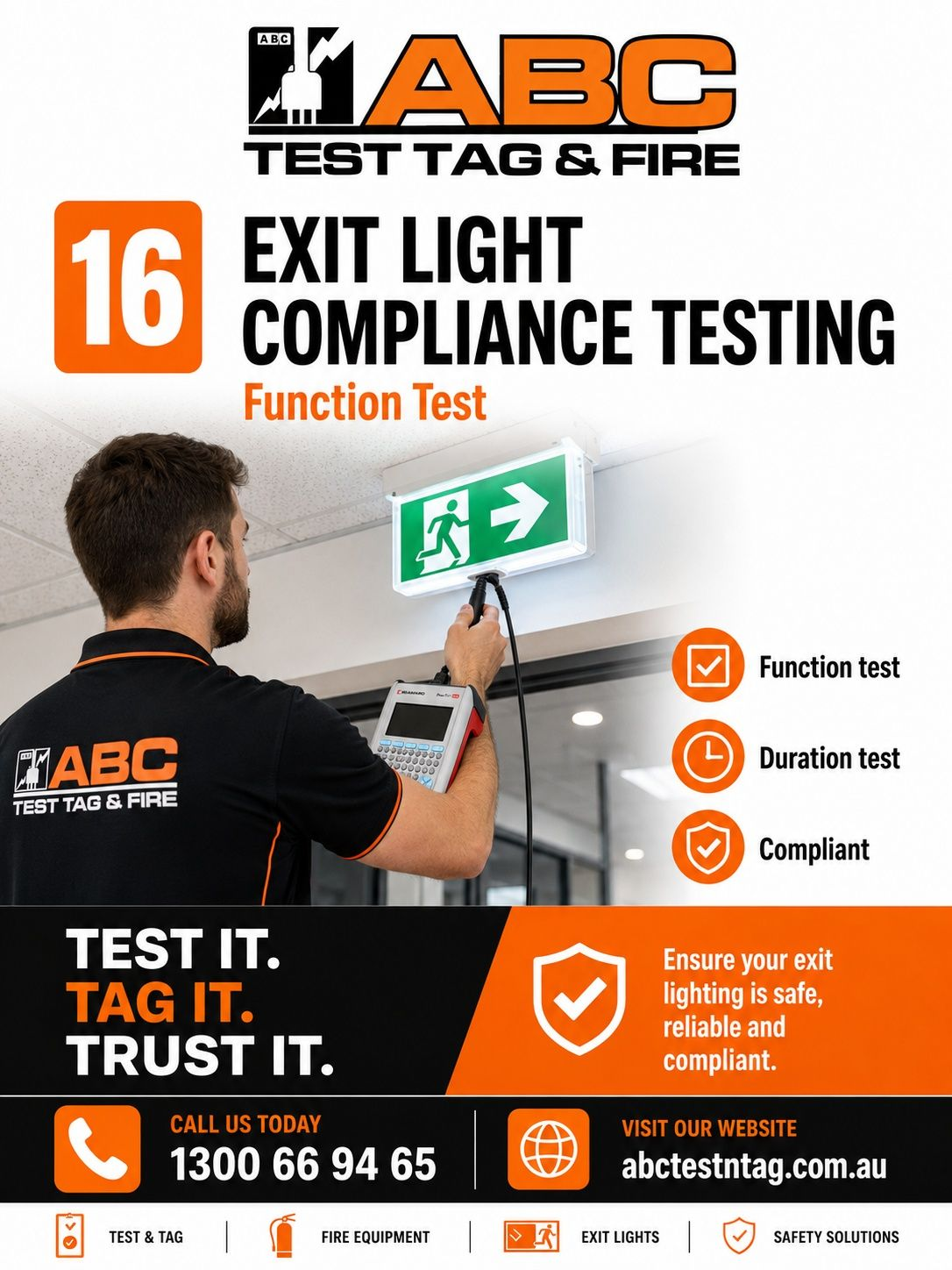
Exit-light compliance function testing in progress as part of workplace emergency-lighting maintenance and documentation.
Workplace safety compliance is an operational responsibility for every business in Heathwood, Brisbane. Warehouses, logistics facilities, trade businesses, offices, retail premises, childcare and community facilities all use electrical equipment and fire safety systems that must be maintained, inspected and documented.
For businesses operating near the Logan Motorway, Stapylton Road and southern Brisbane growth corridors, a structured compliance program can help manage electrical hazards, fire equipment defects and emergency egress risks.
ABC Test Tag & Fire provides coordinated test and tag, RCD testing, fire extinguisher servicing, fire blanket servicing, exit light testing and safety equipment sales across Heathwood, Brisbane, Ipswich and the Gold Coast.
What Does Workplace Safety Compliance Mean in Heathwood?
Workplace compliance is not achieved merely by placing a sticker on an appliance or keeping a fire extinguisher on the wall. It requires a systematic process that identifies hazards, applies appropriate testing intervals, isolates defective equipment and retains evidence of completed inspections.
Queensland businesses must manage electrical and workplace health and safety risks under applicable legislation, including the:
- Electrical Safety Act 2002
- Electrical Safety Regulation 2013
- Queensland work health and safety legislation and associated codes of practice
- Relevant building, fire safety and emergency egress requirements
Australian Standards provide technical frameworks for inspection, testing and maintenance. They are not legislation by themselves, but they may be referenced, adopted or relied upon as part of a business’s legal risk-management process.
“Regular inspection and testing help identify potential risks before they become dangerous.”
: Standards Australia, AS/NZS 3760:2022 overview
Why Is Test and Tag Important for Heathwood Businesses?
Electrical equipment in warehouses, workshops and trade environments is often exposed to movement, impact, dust, moisture, chemicals and repeated connection to power supplies. Office and retail equipment may operate in a lower-risk environment, but damage, deterioration and defective leads can still occur.
Electrical test and tag Heathwood services should generally include:
- 240V portable electrical equipment
- Three-phase equipment and cord sets
- Extension leads and power boards
- Portable tools and machinery
- Office appliances and kitchen equipment
- Portable lighting
- Chargers and power supplies
- Suitable low-voltage equipment
- Electrical equipment used on construction or commercial worksites
The process under AS/NZS 3760:2022 involves more than visual inspection. It normally combines:
- Visual inspection for damaged cords, plugs, enclosures, strain reliefs, exposed conductors, overheating and unauthorised modifications.
- Electrical testing using suitable test equipment and procedures for the equipment type.
- Pass or fail identification so workers can distinguish safe equipment from items requiring isolation.
- Durable tagging showing relevant testing and identification details.
- Digital documentation for asset tracking, audit preparation and corrective-action management.

Damaged pedestal fan isolated and marked out of service following identification of an electrical safety defect.
What Happens When Equipment Fails?
A failed item must not remain available for general use. The immediate control should be to:
- Disconnect or isolate the equipment where safe to do so.
- Attach a clear Danger: Out of Service tag.
- Notify the responsible manager or supervisor.
- Record the defect and equipment identifier.
- Arrange repair, replacement or disposal.
- Re-test the item after repair before returning it to service.
Common failure points include damaged cable insulation, broken plugs, exposed wiring, failed earth continuity, inadequate insulation resistance and signs of overheating.
Do not allow employees to bypass an out-of-service tag. A failed item represents an uncontrolled electrical hazard until it has been appropriately repaired and verified.
How Often Should Electrical Equipment Be Tested?
There is no single interval that applies to every appliance in every Heathwood workplace. Testing intervals should reflect the work environment, equipment condition, frequency of use and likelihood of damage.
Risk factors include:
- Construction, demolition or outdoor use
- Exposure to dust, water, heat or chemicals
- Frequent movement or cord flexing
- Use by multiple workers
- Previous failure history
- Harsh warehouse or workshop conditions
- The consequences of equipment failure
- Whether the equipment is protected by an RCD
WorkSafe Queensland provides guidance for specified electrical equipment and different categories of work. Businesses should review the current regulator guidance and maintain a documented rationale for their testing schedule.
| Workplace type | Typical compliance considerations |
|---|---|
| Warehouses and logistics facilities | Inspect portable tools, chargers, leads, cleaning equipment and loading-area appliances for impact and cord damage. |
| Trade businesses and workshops | Consider shorter intervals for power tools, extension leads and equipment exposed to dust, moisture or mechanical wear. |
| Offices | Maintain inspection records for computers, monitors, kitchen equipment, printers, chargers and portable appliances. |
| Retail premises | Include point-of-sale equipment, display equipment, portable appliances and staff-room equipment. |
| Childcare and community premises | Consider accessibility, frequent equipment movement, user interaction and the need for clear defect controls. |
| Construction worksites | Apply the requirements relevant to construction work, including higher-risk inspection and testing arrangements. |
Intervals must not be extended simply because equipment has passed previous tests. Review the schedule after an incident, equipment change, relocation or material change in workplace conditions.
What Is Involved in RCD Testing Heathwood?
Residual Current Devices, commonly called safety switches, are designed to disconnect electrical supply when they detect an imbalance that may indicate current flowing through an unintended path.
RCD testing Heathwood services can include:
- Visual inspection of fixed and portable RCDs
- Push-button functional testing
- Instrument testing of operating time and performance
- Identification of inaccessible, damaged or incorrectly labelled devices
- Documentation of test results
- Recommendations for repair or further electrical investigation
The push-button test confirms that the test mechanism operates. It does not provide the same information as an instrument test, which measures the RCD’s performance against relevant requirements.
Testing frequencies depend on the type of RCD, workplace activity, risk profile and applicable Queensland requirements. Construction, manufacturing, outdoor and high-use environments may require more frequent testing than controlled office areas.
RCD testing is part of electrical safety management. It does not replace the inspection and testing of connected appliances, leads and portable equipment.
How Are Fire Extinguishers and Fire Blankets Maintained?
Fire extinguisher testing Heathwood should be scheduled as part of a broader fire safety maintenance program. ABC Test Tag & Fire conducts routine servicing of fire extinguishers and fire blankets in accordance with AS 1851:2012, the relevant site requirements and the applicable regulatory framework.
Routine checks may consider:
- Correct location and visibility
- Unobstructed access
- Correct mounting and signage
- Cylinder condition
- Pressure indication
- Safety pin and tamper seal
- Hose, nozzle and operating mechanism
- Corrosion, leakage or physical damage
- Fire blanket packaging and condition
- Service history and maintenance records
Fire extinguishers and blankets must remain accessible. Do not store stock, pallets, cartons or other materials in front of fire equipment.
ABC also supplies fire safety equipment where existing units require replacement, additional coverage or a different type of extinguisher for the identified hazard.

Overdue fire extinguisher identified for servicing as part of routine fire equipment compliance maintenance.
Why Are Exit Lights and Emergency Lighting Essential?
Emergency lighting and exit signs support safe evacuation when normal lighting is interrupted. In warehouses, offices, retail premises and community facilities, emergency egress routes must remain identifiable and free from obstruction.
ABC provides exit light testing and sales in accordance with AS/NZS 2293, relevant building requirements and the applicable service schedule.
The inspection process may identify:
- Failed lamps or LED modules
- Battery or charging faults
- Poor sign visibility
- Damaged fittings
- Obstructed escape routes
- Missing or incorrectly positioned signage
- Defects requiring rectification
Emergency exits are not merely signage assets. They form part of a life-safety system. Keep corridors, doors, stairs and paths of travel clear at all times.

Missing emergency lighting highlighted as a compliance defect affecting safe emergency egress visibility.
What Documentation Should a Heathwood Business Retain?
A defensible compliance system should provide clear evidence of what was inspected, when it was tested and what happened when a defect was found.
ABC Test Tag & Fire provides:
- Durable QR-coded compliance tags
- Digital compliance certificates
- Equipment and asset identification
- Test results and pass or fail outcomes
- Defect and corrective-action records
- Fire service documentation
- Exit-light testing records
QR-coded tags allow managers to connect physical equipment with its digital compliance record. This can assist during internal reviews, client audits, tenancy handovers and contractor management.
How Can Bundling Reduce Compliance Costs?
Coordinating electrical, fire and emergency-lighting services through separate providers can create multiple appointments, administration requirements and reporting systems.
ABC Test Tag & Fire offers bundled compliance services that can provide up to 40% savings, depending on the services, equipment quantities and scope of the booking.
The principle is straightforward:
The more services you book, the more you save.
A Heathwood business may combine:
- Electrical test and tag
- RCD testing
- Six-monthly fire extinguisher servicing
- Fire blanket servicing
- Exit light and emergency lighting testing
- Fire equipment sales
- Replacement tags and digital documentation
ABC is locally owned and fully insured, with service coverage across Brisbane, Ipswich and the Gold Coast. Eligible customers may also earn QANTAS Business Rewards points, subject to applicable program terms and conditions.
Heathwood Workplace Compliance Checklist
Use this checklist to identify immediate compliance priorities:
- All portable electrical equipment is identified and accessible.
- Test and tag intervals reflect the workplace risk profile.
- RCDs are tested at the required frequency.
- Failed equipment is isolated and clearly marked.
- Fire extinguishers are visible, accessible and within service date.
- Fire blankets are correctly located and in suitable condition.
- Exit signs and emergency lights are tested and documented.
- Emergency egress paths are clear.
- Digital certificates and inspection records are retained.
- Defects have assigned corrective actions and completion dates.
- The compliance schedule is reviewed after workplace changes.
Frequently Asked Questions
Is test and tag legally required in every Heathwood workplace?
Requirements depend on the equipment, work activity, workplace environment and applicable Queensland legislation. Businesses must identify and manage electrical risks. AS/NZS 3760:2022 provides an important technical framework, while WorkSafe Queensland guidance and statutory requirements determine relevant obligations.
How often should fire extinguishers be serviced?
Routine fire extinguisher servicing is commonly conducted six-monthly under AS 1851:2012-based maintenance programs. Additional periodic servicing, testing or replacement may apply depending on the equipment and condition.
Does RCD testing replace test and tag?
No. RCD testing verifies the protective device. Test and tag assesses connected electrical equipment, cords, plugs and related items. These are separate controls that should operate together.
Can ABC service warehouses and logistics sites near Heathwood?
Yes. ABC services warehouses, logistics facilities, trade businesses, offices, retail premises, childcare and community premises across Heathwood, Brisbane and surrounding regions.
Can one booking include electrical and fire services?
Yes. ABC can coordinate test and tag, RCD testing, fire equipment servicing and exit-light testing as a bundled compliance booking, subject to site scope and scheduling.
Arrange Test and Tag and Fire Safety Compliance in Heathwood
Do not wait for an audit, incident or failed inspection before reviewing your workplace safety controls.
For test and tag Heathwood, electrical safety compliance, RCD testing, fire extinguisher servicing and exit-light testing, contact ABC Test Tag & Fire on 1300 66 94 65.
Contact ABC Test Tag & Fire to arrange a documented compliance service for your Heathwood workplace.
Learn more about electrical test and tag services in Brisbane, AS/NZS 3760:2022 requirements, RCD testing in Brisbane and commercial fire service requirements.