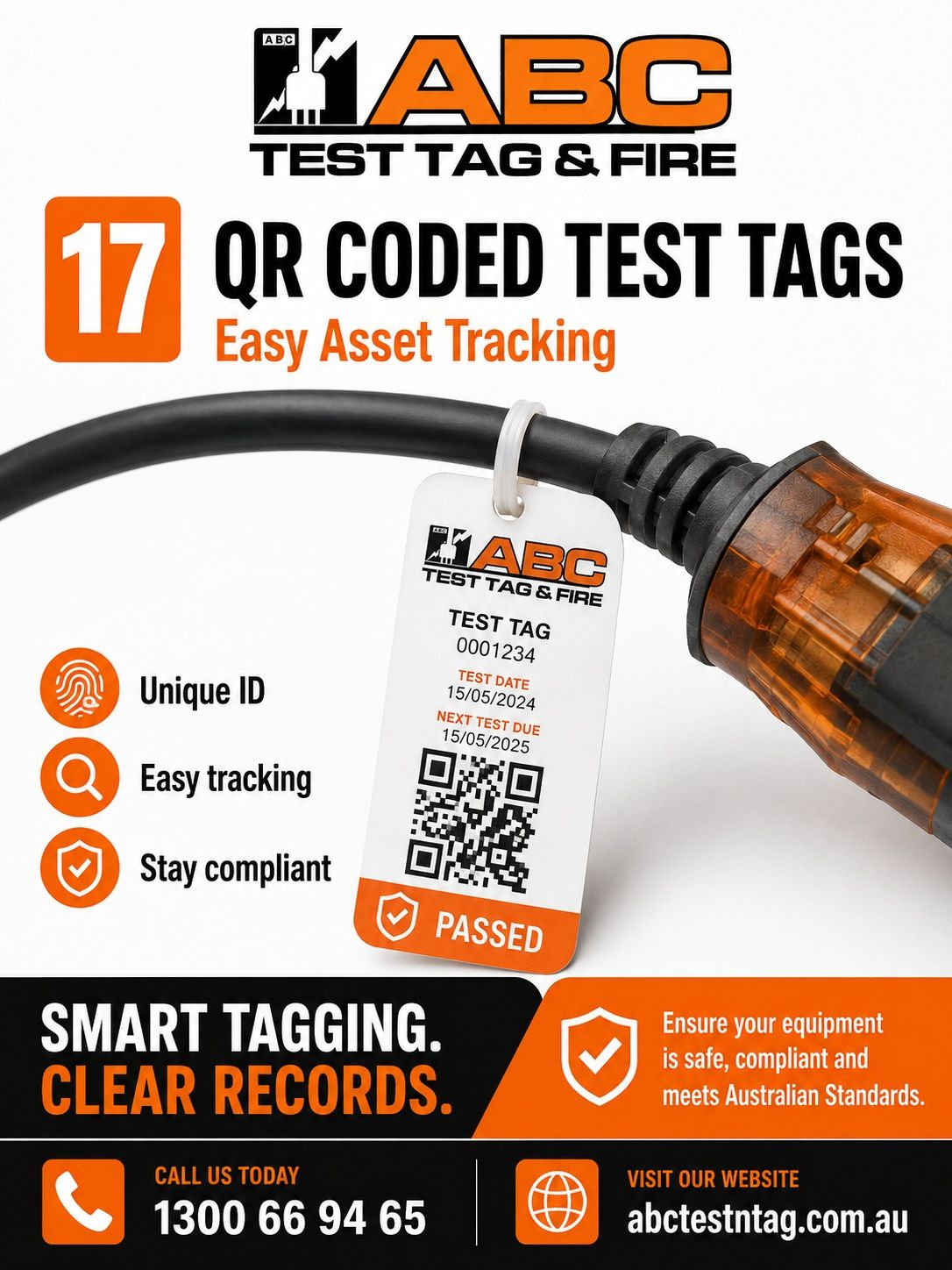
QR-coded electrical test tag documented during workplace compliance servicing.
Kedron businesses operate across a wide range of commercial environments, including offices, retail premises, hospitality venues, medical practices, workshops, trade businesses and other workplaces connected to Gympie Road, Kedron Brook and the Stafford–Chermside commercial corridor.
Each workplace has different hazards, equipment inventories and operational requirements. However, every business has a responsibility to manage foreseeable electrical, fire and emergency-evacuation risks. A systematic compliance program helps demonstrate that equipment is being inspected, tested, maintained and documented appropriately.
ABC Test Tag & Fire provides integrated test and tag Kedron, electrical safety compliance Kedron, RCD testing Kedron, fire equipment servicing and emergency-lighting services. Businesses can also save up to 40% when services are bundled: the more services you book, the more you save.
What Workplace Safety Obligations Apply in Kedron?
Queensland workplaces must manage electrical and other workplace risks so far as is reasonably practicable. These duties arise under Queensland electrical safety and work health and safety legislation, including the:
- Electrical Safety Act 2002 (Qld)
- Electrical Safety Regulation 2013 (Qld)
- Work Health and Safety Act 2011 (Qld)
- Work Health and Safety Regulation 2011 (Qld)
WorkSafe Queensland provides guidance on the inspection and testing of electrical equipment, safety switches and portable electrical equipment. Its requirements should be considered alongside the relevant Australian Standards and the specific hazards present at the workplace.
WorkSafe Queensland advises that electrical equipment and safety switches must be regularly inspected, tested and maintained by a competent person, with testing intervals determined by the type of work and workplace risk.
Review the WorkSafe Queensland testing and tagging guidance when developing or reviewing a workplace electrical safety procedure.
How Does Test and Tag Kedron Support Electrical Safety Compliance?
AS/NZS 3760:2022 – In-service safety inspection and testing of electrical equipment and RCDs provides the technical framework for inspecting and testing electrical equipment in service.
A professional test and tag process generally includes:
-
Asset identification
Electrical appliances, leads, tools, power boards, chargers and other in-scope equipment are identified and recorded. -
Visual inspection
The technician checks the plug, cable, casing, switches, strain relief, pins and other components for damage, contamination, overheating, unauthorised modification or deterioration. -
Electrical testing
Suitable test instruments are used for the equipment type. Testing may include earth continuity, insulation resistance, polarity and leakage-related checks where applicable. -
Pass or fail assessment
Equipment is assessed against the relevant testing requirements and the conditions of use. -
Tagging and documentation
Equipment that passes is fitted with a durable compliance tag. ABC Test Tag & Fire also provides QR-coded tags and digital compliance certificates to support asset identification and record retrieval. -
Isolation of failed equipment
Failed equipment must not remain available for use. It should be disconnected where safe to do so, clearly marked with an “Out of Service” or danger tag, and repaired, replaced or otherwise controlled.
A test tag is not a substitute for ongoing visual checks. Employees should report damaged equipment immediately and should not use any appliance, lead or tool that appears unsafe.
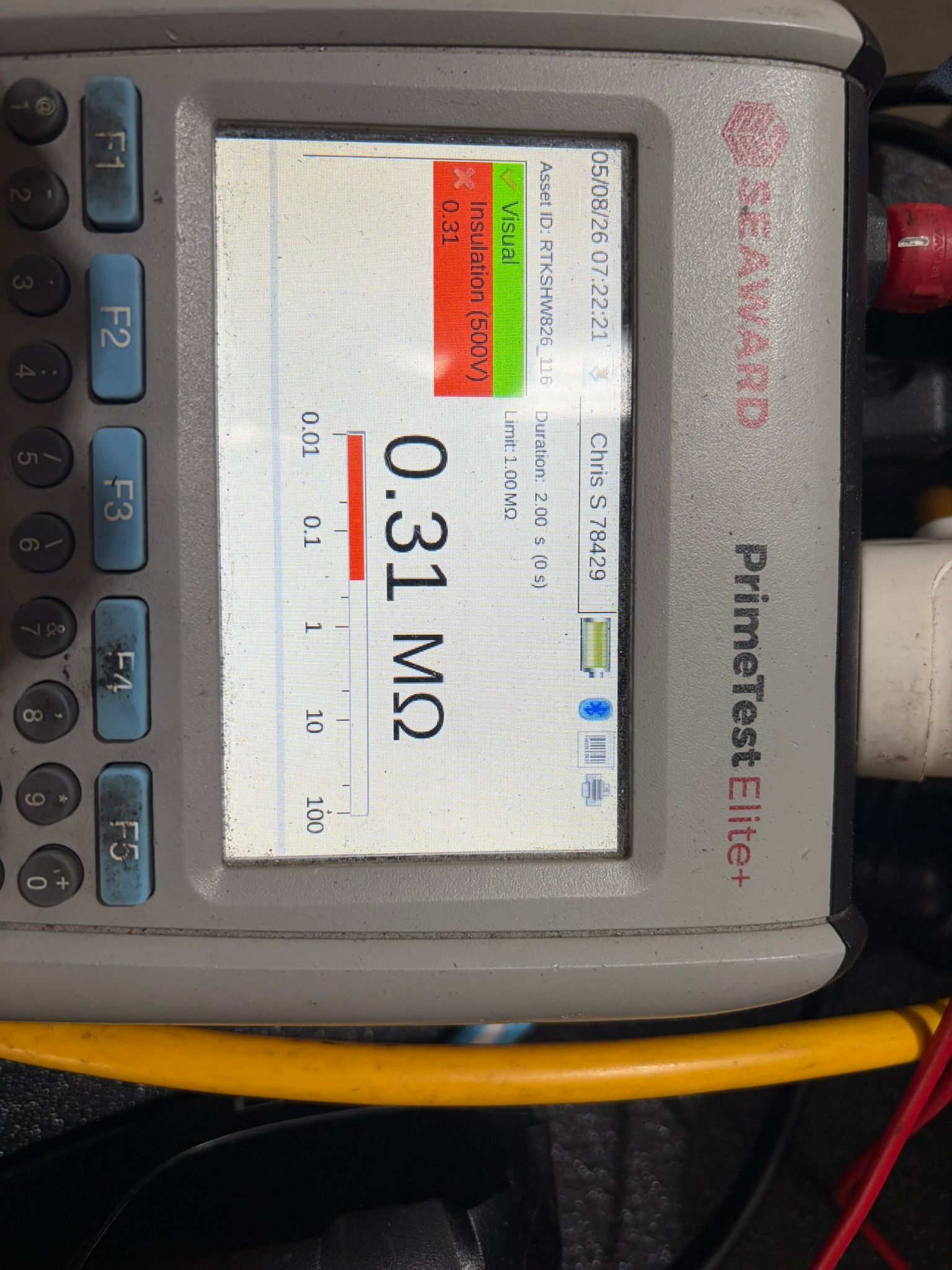
Failed insulation resistance test identified during electrical compliance testing of workplace equipment.
Why Is Risk-Based Testing Important for Kedron Businesses?
There is no single testing interval that is appropriate for every Kedron workplace. The required maximum interval may depend on the type of work, the environment, the equipment and whether the equipment is exposed to conditions such as:
- Moisture or wet areas
- Dust, chemicals or corrosive substances
- Mechanical impact or vibration
- Frequent relocation
- Outdoor use
- Construction or renovation activity
- High levels of employee or public use
- Heat-producing equipment
- Workshop and trade work
Office equipment generally presents a different risk profile from portable tools used in a workshop, warehouse or construction environment. A documented risk assessment can justify a suitable testing schedule, while high-risk equipment may require testing more frequently than the applicable maximum interval.
Indicative Electrical Testing Considerations
| Workplace or equipment environment | Typical compliance consideration |
|---|---|
| Office or administrative premises | Lower environmental exposure, but equipment remains subject to inspection and risk management |
| Retail and hospitality | Public access, frequent use, food-service equipment, cleaning and moisture may increase risk |
| Medical premises | Equipment access, patient safety and operational continuity require careful scheduling |
| Workshops and trade businesses | Tools, leads and portable equipment may be exposed to impact, dust and movement |
| Construction and renovation sites | Higher-risk conditions require strict inspection, testing, tagging and RCD controls |
| Warehouses and commercial premises | Equipment may include chargers, power boards, tools, machinery and mobile devices |
This table is a planning guide only. The final schedule should reflect the actual risk assessment, applicable legislation, relevant standards and the nature of the workplace.
What Is Included in RCD Testing Kedron?
Residual Current Devices, commonly called safety switches, are designed to disconnect electrical supply when they detect an imbalance that may indicate current flowing through an unintended path.
RCD testing should distinguish between:
- Push-button testing, which confirms that the device trips when the test button is operated; and
- Operating-time and current testing, which uses suitable test equipment to assess the RCD’s performance.
WorkSafe Queensland identifies different maximum testing intervals for fixed and portable RCDs, depending on the type of work. For example, construction, manufacturing, office and service environments have different testing requirements. Portable RCDs used on construction sites require particularly frequent controls.
Businesses should also ensure that workers understand any user-test procedure applicable to their workplace. An RCD that does not trip, resets incorrectly or fails an instrument test must be treated as defective until the problem has been investigated and rectified.
Fixed electrical installation repairs, alterations or replacement of fixed RCDs must be undertaken by an appropriately licensed electrical worker.
For further information, see ABC Test Tag & Fire’s RCD testing Brisbane compliance guide.
How Does Fire Extinguisher Testing Apply to Kedron Premises?
Fire extinguishers and fire blankets must remain accessible, correctly located, identifiable and serviceable. Fire equipment should never be obstructed by stock, furniture, vehicles, stored materials or temporary displays.
Routine servicing is undertaken with reference to AS 1851:2012 – Routine service of fire protection systems and equipment, together with the applicable Queensland building and fire safety requirements. The exact obligations can depend on the building classification, installed systems, occupancy and the maintenance regime adopted for the premises.
ABC Test Tag & Fire provides:
- Routine fire extinguisher inspections and servicing
- Fire blanket inspections
- Maintenance tags and service records
- Replacement or additional fire extinguishers
- Fire blanket sales
- Advice regarding equipment placement and accessibility
- Identification of defects requiring rectification
A typical inspection considers the extinguisher’s condition, pressure indication where applicable, pin and seal, hose or nozzle, mounting, signage, accessibility and service history. Fire blankets are checked for condition, enclosure, identification and unobstructed access.
Additional periodic servicing, including more detailed examination or pressure testing, may apply depending on the extinguisher type and service history. Businesses should not rely solely on the presence of a current-looking tag; maintenance records and the correct service schedule are also important.

Overdue fire extinguisher identified during routine site fire compliance review.
What Must Kedron Businesses Do About Exit and Emergency Lighting?
Emergency escape lighting and illuminated exit signs are critical components of egress management. They must be visible, accessible and capable of supporting occupants if normal lighting fails.
ABC Test Tag & Fire provides exit-light and emergency-lighting testing and sales in accordance with AS/NZS 2293, including:
- Visual inspection of fittings and signs
- Functional operation checks
- Battery and discharge testing where required
- Identification of failed or damaged fittings
- Replacement and sales of exit signs and emergency lights
- Digital records and reporting
Testing should confirm that exit signs remain illuminated and that emergency fittings operate for their required duration. Defects should be recorded and rectified promptly, particularly where a fitting is positioned above a final exit, along an escape path, near a change of direction or in a location required for safe egress.

Missing emergency lighting identified during an emergency-escape compliance inspection.
Why Bundle Electrical, Fire and Lighting Services?
Coordinating separate contractors can result in duplicated travel costs, fragmented records and missed maintenance dates. An integrated visit allows ABC Test Tag & Fire to review multiple compliance categories during a coordinated site appointment.
Bundling may include:
- Electrical test and tag
- Fixed and portable RCD testing
- Fire extinguisher servicing
- Fire blanket inspection
- Fire equipment sales
- Exit-light testing
- Emergency-light testing
- Replacement safety equipment
- QR-coded compliance tags
- Digital compliance certificates
Clients can save up to 40% on bundled services, depending on the scope of work and site requirements. The more services you book, the more you save. QANTAS Business Rewards points may also be available on eligible services, subject to the applicable QANTAS Business Rewards terms and conditions.
ABC Test Tag & Fire is locally owned, fully insured and services businesses across Brisbane, Ipswich and the Gold Coast. Digital reporting is designed to provide a fast, straightforward record of completed work, outstanding defects and recommended actions.
Kedron Workplace Safety Compliance Checklist
Use this checklist when reviewing your current compliance arrangements:
- Electrical equipment has been identified and included in an asset register.
- Visual inspections and electrical tests are completed by a competent person.
- RCDs are tested at intervals appropriate to the type of work and risk.
- Failed equipment is isolated, tagged and removed from service.
- Fire extinguishers are accessible and routinely serviced.
- Fire blankets are visible, identified and in serviceable condition.
- Exit signs and emergency lights are tested under the applicable AS/NZS 2293 requirements.
- Defects are recorded with clear corrective actions.
- QR-coded tags and digital certificates are retained for audit purposes.
- Future testing and service dates are scheduled.
Frequently Asked Questions About Test and Tag Kedron
Is test and tag legally required for every electrical appliance in a Kedron office?
Not every appliance necessarily has the same testing obligation or interval. Requirements depend on the workplace, equipment, environment and applicable Queensland duties. A risk-based assessment is necessary to establish an appropriate schedule.
How often should RCDs be tested?
Intervals vary for fixed and portable RCDs and depend on whether the workplace involves construction, manufacturing, office, service or other work. Push-button testing and instrument-based operating-time/current testing may have different intervals.
What happens when electrical equipment fails testing?
The equipment should be removed from use or otherwise isolated, clearly marked and referred for repair, replacement or further assessment. It must not be returned to service without appropriate confirmation that the electrical risk has been controlled.
Can ABC Test Tag & Fire service offices and medical premises?
Yes. ABC Test Tag & Fire provides electrical, fire and emergency-lighting compliance services for offices, retail businesses, hospitality venues, medical practices, workshops, trade businesses and commercial premises.
Can services be scheduled together?
Yes. Coordinating test and tag, RCD testing, fire servicing and emergency-light testing can reduce disruption and may provide bundle savings of up to 40%, subject to the scope of work.
Book Kedron Safety Compliance Services
Do not wait for an audit, lease inspection or equipment failure to identify gaps in your compliance process. Arrange a coordinated review of your electrical equipment, RCDs, fire equipment and emergency lighting.
Call ABC Test Tag & Fire on 1300 66 94 65 to discuss test and tag Kedron, electrical safety compliance, RCD testing, fire extinguisher testing, emergency lighting and bundled service options across Brisbane, Ipswich and the Gold Coast.