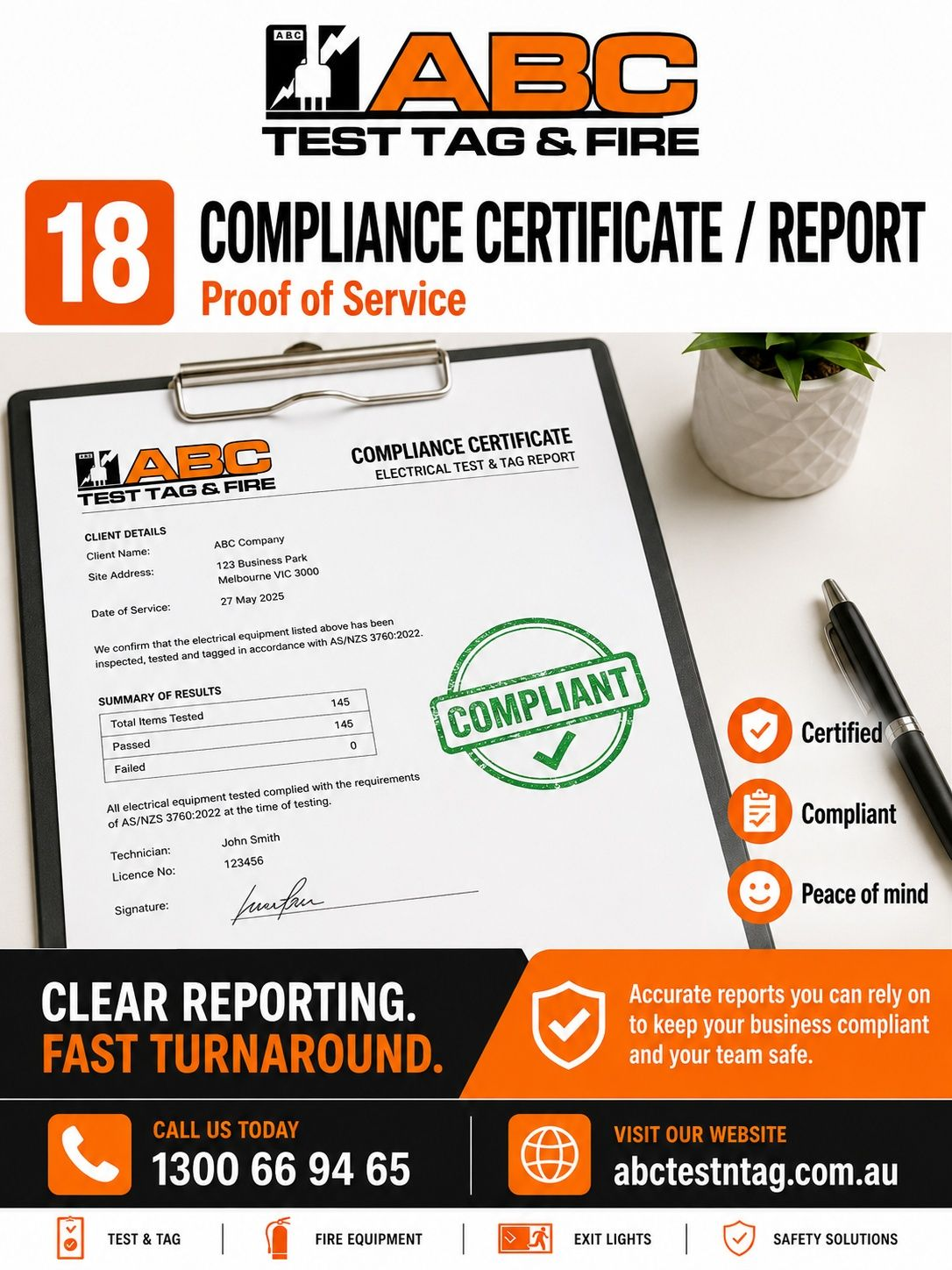
Electrical compliance certificate and reporting documents, illustrating the documented record-keeping and digital reporting that underpin a defensible workplace compliance program.
For businesses operating in Morningside and Brisbane’s eastern commercial corridor, workplace safety compliance requires more than placing a fire extinguisher on a wall or attaching an electrical test tag to an appliance. A compliant safety program is a systematic process involving risk assessment, inspection, instrument testing, defect management and accurate record-keeping.
ABC Test Tag & Fire provides integrated workplace safety services for Morningside offices, retail premises, hospitality venues, warehouses, workshops, trade businesses and logistics operations near Wynnum Road, Lytton Road access and surrounding eastern Brisbane areas.
Our services include:
- Electrical test and tag for 240V, three-phase and low-voltage equipment
- RCD and safety switch testing
- Six-monthly fire extinguisher and fire blanket servicing
- Fire safety equipment sales
- Exit light and emergency lighting testing
- Exit signs and emergency lighting sales
- QR-coded compliance tags
- Digital compliance certificates and reporting
- Bundled service savings of up to 40%, subject to scope
- QANTAS Business Rewards points on eligible services, subject to applicable terms
What Does Workplace Safety Compliance Require in Morningside?
Queensland businesses have duties to identify hazards, assess risks and implement reasonably practicable controls. Electrical equipment, portable tools, extension leads, RCDs, fire protection equipment and emergency egress systems should therefore be managed as part of the workplace’s broader WHS framework.
The relevant technical standards commonly used for these controls include:
- AS/NZS 3760:2022 for the in-service inspection and testing of electrical equipment and RCDs
- AS 1851:2012 for the routine servicing of fire protection systems and equipment
- AS/NZS 2293 for emergency escape lighting and exit signs
- Queensland electrical safety and WHS legislation, regulations and codes of practice
Standards should not be treated as a substitute for legal advice or a site-specific risk assessment. However, they provide recognised technical benchmarks for establishing a defensible compliance program.
“A person conducting a business or undertaking must ensure, so far as is reasonably practicable, that workers and other persons are not put at risk from work carried out as part of the conduct of the business or undertaking.”
, Work Health and Safety Act 2011 (Qld)
For electrical safety matters, businesses should also consult the Queensland electrical safety legislation and codes of practice.
How Does Electrical Test and Tag Work in a Morningside Workplace?
Electrical test and tag is a risk-control process for plug-in electrical equipment. It is not a visual labelling exercise. The equipment must first be inspected and, where required, tested using suitable instruments by a competent person.
The process generally involves:
-
Asset identification
Equipment is identified and, where appropriate, recorded against a location, department or asset description. -
Visual inspection
The technician checks plugs, cords, casings, switches, strain relief, extension leads, power boards and other accessible components for deterioration, damage, contamination or unsafe modification. -
Instrument testing
Appropriate electrical tests are conducted according to the equipment type and applicable requirements. These may include earth continuity, insulation resistance and polarity-related checks. -
Pass or fail determination
Equipment is assessed against the relevant safety criteria and the conditions in which it is being used. -
Tagging and reporting
Passing equipment receives a durable test tag. Failed equipment is identified and reported for corrective action.
ABC Test Tag & Fire can test equipment operating across common commercial and industrial environments, including:
- Computers, monitors and office appliances
- Kitchen and hospitality equipment
- Extension leads and power boards
- Portable power tools
- Workshop equipment
- Warehouse appliances and machinery with flexible cords
- Three-phase and low-voltage equipment within the applicable testing scope
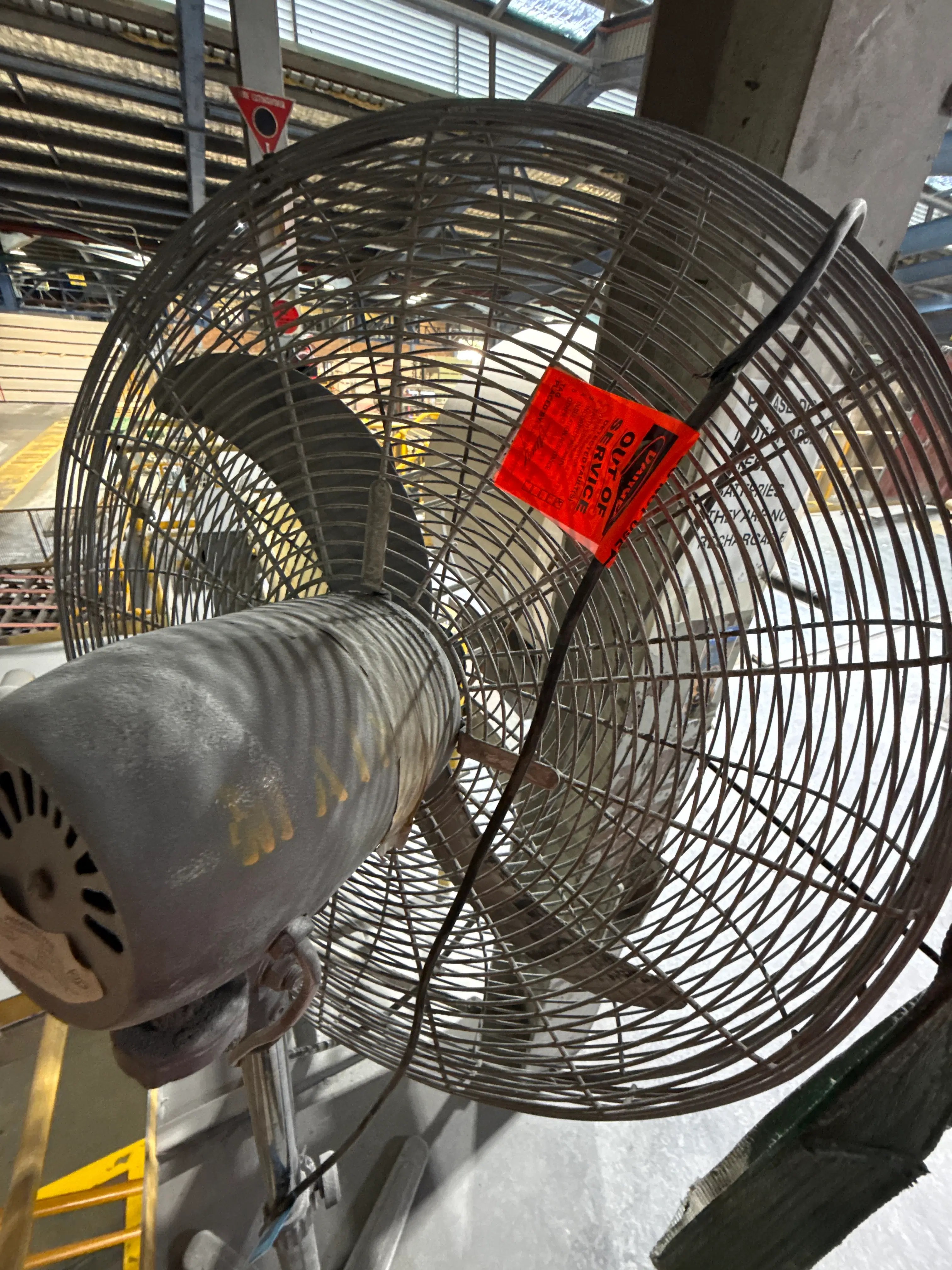
Industrial fan marked out of service, illustrating how failed equipment should be clearly identified and removed from use pending corrective action.
What Happens When Electrical Equipment Fails?
A failed item must not remain available for ordinary use. Continuing to use damaged equipment undermines the purpose of testing and may expose workers, customers and the business to electric shock, fire or equipment failure.
A suitable failed-equipment procedure should include:
- Attaching a clear DANGER, OUT OF SERVICE warning
- Isolating the item from use where practicable
- Recording the asset and defect in the compliance report
- Notifying the responsible manager or supervisor
- Repairing, replacing or disposing of the item
- Re-testing repaired equipment before it returns to service
Do not remove an out-of-service tag until the fault has been addressed.
How Often Should Test and Tag and RCD Testing Be Completed?
There is no single interval that applies to every Morningside business. Testing frequency should reflect the work activity, equipment type, operating environment, frequency of use, likelihood of mechanical damage, moisture, dust and the history of failures.
Typical risk considerations include:
| Workplace environment | Examples of relevant equipment | Testing approach |
|---|---|---|
| High-risk or hostile areas | Construction equipment, outdoor tools, leads exposed to damage | Shorter, risk-based intervals; construction work commonly requires frequent testing |
| Workshops and warehouses | Portable tools, machinery leads, extension equipment | Regular inspection and testing, commonly at shorter intervals than controlled offices |
| Retail and hospitality | Kitchen appliances, point-of-sale equipment, portable leads | Routine testing based on use, public access, heat, moisture and movement |
| General office areas | Computers, printers and fixed-position appliances | Risk-based intervals may be longer where equipment is controlled and protected |
| Portable RCDs | Temporary power and portable tools | User push-button checks and competent-person instrument testing as required |
| Fixed RCDs | Switchboard or socket-outlet safety switches | Regular user checks and periodic operating-time/current testing |
WorkSafe Queensland’s testing and tagging guidance should be reviewed alongside the site risk assessment and the requirements of AS/NZS 3760:2022.
RCD testing may involve both:
- A push-button functional test; and
- An instrument test confirming operating time and current performance.
Testing should be scheduled around the actual Morningside workplace environment, rather than applying an unsuitable interval to every asset.
What Fire Extinguisher and Fire Blanket Services Are Required?
Fire extinguishers and fire blankets must remain accessible, correctly positioned, visibly identifiable and maintained in serviceable condition.
ABC Test Tag & Fire provides routine fire safety servicing for Morningside businesses in accordance with applicable fire safety requirements and AS 1851:2012, including:
- Fire extinguisher inspection and servicing
- Fire blanket inspection
- Condition and accessibility checks
- Safety pin and tamper seal checks
- Service tag updates
- Identification of defects or missing equipment
- Replacement and sales of fire safety equipment
Routine fire extinguisher and fire blanket servicing is generally scheduled six-monthly for the services provided by ABC Test Tag & Fire. Additional inspection, testing, replacement or overhaul requirements may apply depending on the equipment, building, environment and maintenance regime.

Fire extinguisher pressure gauge showing a warning condition, highlighting the need for routine inspection, defect identification and timely corrective action.
A fire extinguisher that is blocked by stock, hidden behind a vehicle or missing its service history may not provide effective protection when needed. Fire access must remain clear at all times.
Why Are Exit Lights and Emergency Lighting Important?
Emergency escape lighting and exit signs support safe egress when normal lighting fails. In a retail premises, warehouse, office, workshop or hospitality venue, staff and visitors must be able to identify exit routes and move toward a safe place.
ABC Test Tag & Fire provides exit light and emergency lighting services in accordance with the applicable requirements of AS/NZS 2293, including:
- Inspection of emergency lighting units
- Testing of illuminated exit signs
- Identification of failed lamps, batteries or fittings
- Assessment of visibility and access
- Testing records and digital reporting
- Sales and replacement of exit signs and emergency lighting equipment

Exit light undergoing function testing in a commercial building, demonstrating routine verification of emergency egress systems in accordance with maintenance requirements.
ABC’s standard service offering includes annual exit light testing. However, the required maintenance schedule may depend on the building, system design, occupancy, fire safety schedule and applicable regulatory requirements. Defects should be rectified promptly, particularly where an exit route is not adequately illuminated or identified.
How Do QR Tags and Digital Certificates Improve Compliance?
Paper records can become difficult to manage when a business operates across several rooms, storage areas, vehicles or work zones. QR-coded tags and digital records provide a more efficient way to identify assets and retrieve compliance information.
Digital reporting can assist with:
- Locating individual tested assets
- Reviewing pass and fail results
- Tracking outstanding defects
- Confirming next scheduled testing dates
- Providing evidence during audits or internal reviews
- Managing multiple business locations
- Reducing administrative duplication
The objective is not simply to create a report. The objective is to maintain a current, accessible record of the workplace’s safety controls.
How Can Morningside Businesses Reduce Compliance Costs?
Coordinating electrical test and tag, RCD testing, fire servicing and exit light testing through separate contractors can create repeated site visits, multiple invoices and fragmented documentation.
ABC Test Tag & Fire offers bundled compliance services that can reduce eligible combined-service costs by 20–40%, with savings of up to 40% depending on the scope of work.
The more services you book, the more you save.
A business may be able to combine:
- Electrical test and tag
- RCD testing
- Fire extinguisher servicing
- Fire blanket servicing
- Fire safety equipment sales
- Exit light testing
- Emergency lighting or exit sign sales
The exact saving depends on asset numbers, service requirements, site access and the services selected. ABC is locally owned, fully insured and provides coverage across Brisbane, Ipswich and the Gold Coast.
Eligible customers may also earn QANTAS Business Rewards points on services, subject to the applicable QANTAS Business Rewards terms and conditions.
Morningside Workplace Safety Compliance Checklist
Use this checklist to identify common compliance actions:
- Complete a documented electrical and fire risk assessment
- Identify all plug-in electrical equipment and RCDs
- Classify equipment according to its work environment and use
- Arrange inspection and testing by a competent person
- Attach durable tags showing test information
- Isolate and report failed electrical equipment
- Confirm fire extinguishers are accessible and correctly located
- Service fire extinguishers and fire blankets at the required interval
- Inspect exit signs and emergency lighting
- Keep digital certificates, defect reports and service histories
- Review testing intervals when equipment, premises or work activities change
- Coordinate services to reduce disruption and improve record control
Frequently Asked Questions About Test and Tag Morningside
Is test and tag required for every business in Morningside?
The requirement depends on the work activity, equipment, environment and applicable Queensland duties. Businesses must manage electrical risks and may need testing and tagging where equipment is exposed to conditions that could create a safety risk. A risk assessment should determine the appropriate control measures and intervals.
Does ABC Test Tag & Fire test three-phase equipment?
Yes. ABC provides testing for applicable 240V, three-phase and low-voltage equipment. The equipment must be within the relevant testing scope and accessible for inspection.
How often should RCDs be tested?
RCD testing intervals vary according to the type of RCD, work environment and Queensland requirements. Testing may include push-button checks by users and periodic instrument testing by a competent person. WorkSafe Queensland guidance and AS/NZS 3760:2022 should be considered when establishing the schedule.
What should we do with equipment that fails testing?
Immediately prevent the equipment from being used, attach an out-of-service warning, record the defect and arrange repair, replacement or disposal. Repaired equipment should be tested before being returned to service.
Can fire extinguisher servicing and electrical testing be completed on the same visit?
In many cases, yes. Combining services is subject to site access, asset numbers, technician availability and the required testing schedule. Bundling can reduce administration, disruption and eligible service costs.
Does ABC provide digital compliance certificates?
Yes. ABC provides digital reporting and compliance certificates, together with QR-coded tags for suitable assets.
Book Morningside Workplace Safety Compliance Services
Morningside businesses should not wait for an incident, insurance request or compliance audit to identify overdue testing or inaccessible fire equipment.
For a coordinated assessment covering electrical test and tag, RCD testing, fire extinguisher servicing, fire blanket servicing, exit light testing and safety equipment sales, contact ABC Test Tag & Fire on 1300 66 94 65.
You can also review our guides to electrical test and tag services in Brisbane, AS/NZS 3760:2022 compliance, RCD testing in Brisbane and commercial fire servicing requirements.