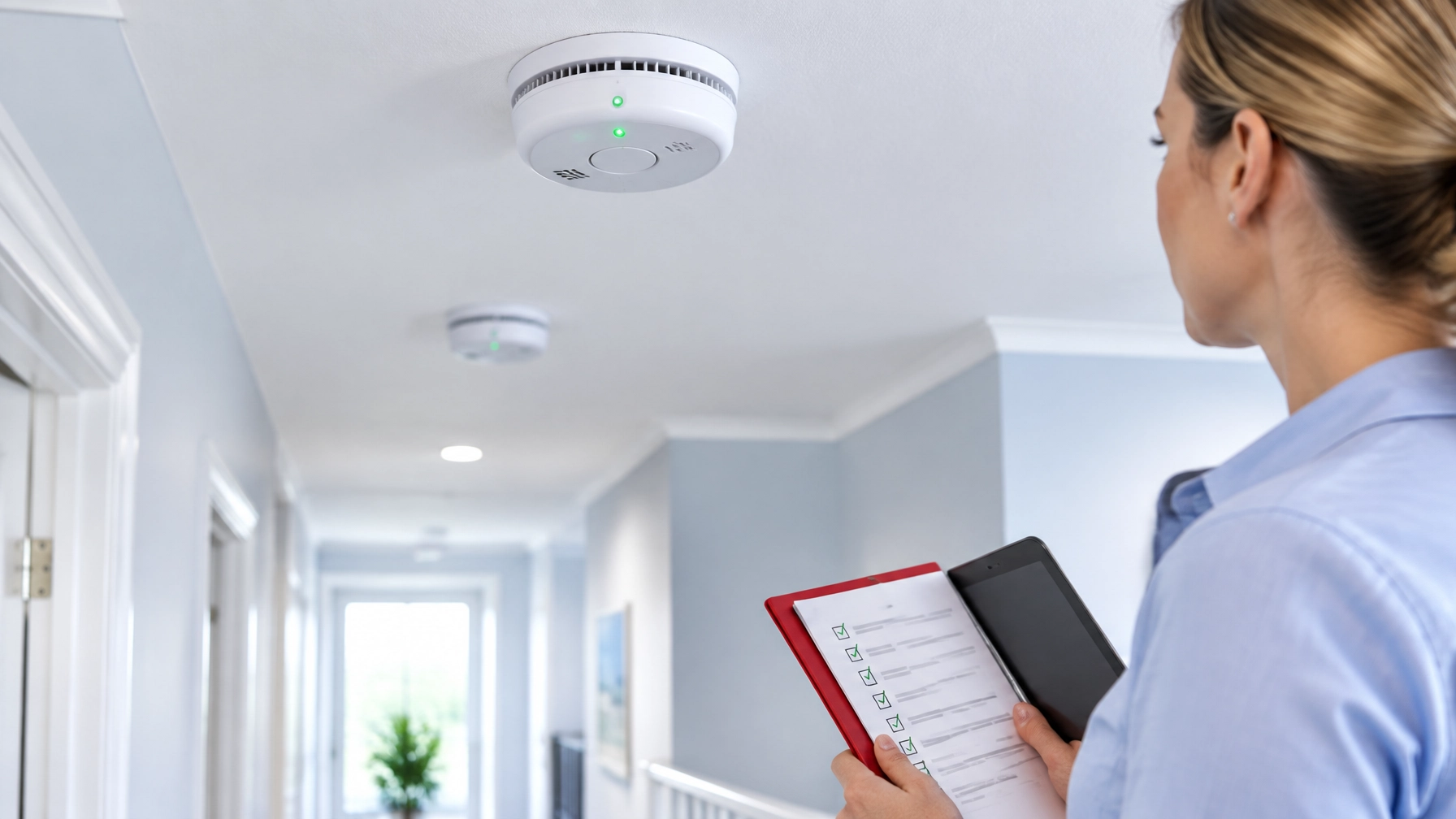
Queensland’s final smoke alarm reform deadline is approaching. From 1 January 2027, all remaining existing domestic dwellings must have compliant, interconnected photoelectric smoke alarms.
For Brisbane and Ipswich rental providers, property managers, real estate agents and businesses managing residential or mixed-use property, this is not a matter to defer until December. The required work may involve property inspections, alarm replacement, interconnection testing, electrical work, access coordination, tenant communication and compliance documentation.
Late 2026 is also expected to produce a significant surge in demand. As bookings become concentrated around the deadline, service availability may reduce and pricing may increase due to labour, access and equipment constraints.
The prudent approach is to audit your property portfolio now.
What Is the Queensland Smoke Alarm Deadline?
Queensland introduced its smoke alarm requirements through a staged implementation process:
| Property or event | Compliance requirement |
|---|---|
| New dwellings and substantial renovations | Compliant alarms required from 1 January 2017 |
| Dwellings being sold or leased | Compliant alarms required from 1 January 2022 |
| All remaining existing domestic dwellings | Compliant interconnected photoelectric alarms required by 1 January 2027 |
The legislation applies to domestic dwellings, including houses, townhouses, units and manufactured homes. It does not mean that every warehouse, office or retail tenancy is automatically classified as a domestic dwelling. However, businesses may still be responsible for smoke alarm compliance where they own, manage, lease or operate residential accommodation, employee housing, mixed-use premises or other covered dwellings.
The Queensland Fire Department’s smoke alarm guidance states:
“All existing private homes, townhouses, units and manufactured homes require interconnected photoelectric smoke alarms by 1 January 2027.”
Do not assume that an existing alarm remains acceptable simply because it activates during a basic test.
What Smoke Alarms Must Be Installed?
For existing dwellings, the required system must generally include:
- Photoelectric smoke alarms.
- Interconnection between every required alarm, so that activation of one alarm activates all alarms.
- Compliance with AS 3786-2014, as identified in Queensland’s current smoke alarm legislation and official guidance.
- No ionisation sensor.
- A manufacture date less than 10 years old.
- Reliable operation when tested.
- Mains power with suitable backup, or a non-removable 10-year battery.
- Installation in the legally required locations.
For new installations completed after 1 May 2025, property managers should also check whether the selected product and building work are specified to AS 3786:2023, together with the applicable Queensland building approval and certification requirements. Queensland’s official smoke alarm guidance has continued to refer to AS 3786-2014, so the position should be confirmed with the licensed installer, building certifier or relevant authority before a large-scale rollout.
The important operational rule is simple: specify compliant, photoelectric and interconnected alarms, and retain evidence of the product specification and installation.
Where Must Alarms Be Located?
Required alarm locations include:
- Every storey of the dwelling.
- Every bedroom.
- Hallways connecting bedrooms to the rest of the dwelling.
- Where there is no hallway, the room connecting the bedroom to the remainder of the storey.
- On a storey without bedrooms, the most likely path of travel to exit the dwelling.
Placement also matters. Alarms should generally be mounted on the ceiling where practicable and positioned away from corners, light fittings, air-conditioning supply vents and ceiling-fan blades in accordance with the applicable requirements.
A property manager should not rely on a simple alarm count. The correct compliance assessment must consider the floor plan, bedroom locations, storeys, access paths, existing wiring, alarm age and interconnection method.
Who Is Legally Responsible?
What must the property owner or rental provider do?
The property owner or lessor is responsible for ensuring the dwelling has compliant smoke alarms. This includes arranging installation, replacement and rectification work where required.
For a rental property, the lessor must ensure that alarms are tested and cleaned within the relevant period before a tenancy begins. Queensland Fire Department guidance identifies a period of 30 days before the start of a tenancy for this work.
The owner should retain:
- Alarm installation or replacement records.
- Product details and compliance markings.
- Test and cleaning records.
- Electrical certificates where hardwired alarms are installed.
- Photographs or inspection reports where useful.
- Tenant and property manager correspondence.
What must the property manager or real estate agent do?
A property manager is often the party controlling the compliance process in practice. This includes identifying affected properties, issuing work orders, arranging access, engaging appropriately qualified contractors, checking documentation and following up outstanding defects.
Delegating a task does not remove the need for effective oversight. If an agency manages a portfolio, it should maintain a property-by-property register showing:
- Current alarm type.
- Manufacture or replacement date.
- Interconnection status.
- Required alarm locations.
- Outstanding defects.
- Scheduled rectification date.
- Evidence of completion.
What must the tenant do?
During a tenancy, tenants are generally responsible for basic testing and cleaning in accordance with the manufacturer’s instructions. They must not remove batteries, disable interconnection or interfere with an alarm because of nuisance activation.
If an alarm fails, becomes damaged or repeatedly activates without an obvious cause, the issue should be reported promptly to the property manager or rental provider.
What Must Be Done Before 1 January 2027?
A systematic compliance program should follow these steps.
Step 1: Identify every affected dwelling
Review properties in Brisbane, Ipswich, Springfield, Redbank, Ripley, Logan and surrounding areas. Separate domestic dwellings from commercial premises and identify properties that are:
- Currently leased.
- Due for lease renewal.
- Being prepared for sale.
- Subject to renovation.
- Part of a strata or body corporate arrangement.
- Managed on behalf of multiple owners.
Step 2: Complete a physical assessment
Check alarm locations, alarm age, product markings, power supply and interconnection. A test button alone does not prove that every alarm communicates with the others.
Step 3: Confirm the installation pathway
Hardwired installations and alterations to electrical wiring must be undertaken by an appropriately licensed electrical contractor. Battery-powered interconnected systems may be suitable in some existing dwellings, subject to the applicable requirements and product instructions.
Step 4: Rectify faults immediately
Replace expired, damaged, non-photoelectric or non-interconnected alarms. Do not leave failed alarms tagged for later attention while the property remains occupied.
Step 5: Record and verify completion
Obtain documentation that identifies the property, work completed, alarm specifications, test result and any remaining limitations. Documentation is particularly important for property transactions, agency audits, insurance records and tenancy disputes.

Why Should You Book Before the Late-2026 Surge?
The 1 January 2027 deadline is likely to create concentrated demand across Brisbane and South East Queensland. Property owners and agencies that wait until November or December may encounter:
- Longer booking lead times.
- Limited contractor availability.
- Difficulty coordinating access with tenants.
- Delays obtaining replacement equipment.
- Additional after-hours or urgent-service charges.
- Reduced time to rectify failed or inaccessible installations.
The cost of non-compliance is not limited to the service invoice. Delays can affect tenancy commencement, settlement preparation, agency performance obligations and portfolio risk controls.
Book early. A planned inspection is easier to budget, coordinate and document.
What Are the Penalties for Non-Compliance?
Failure to install required smoke alarms is an offence under Queensland’s legislative framework. The Queensland smoke alarm reforms identify a maximum penalty of 5 penalty units, with a fine of 2 penalty units for the relevant offence. The monetary value of a penalty unit can change, so the current dollar amount should be confirmed through the relevant Queensland legislation or authority.
Other consequences may include:
- Inability to demonstrate compliance during a sale or tenancy process.
- Infringement action against the property owner or landlord.
- Delays to property handover or tenancy commencement.
- Increased exposure during insurance assessment.
- Greater liability if a fire occurs and required safety systems were not maintained.
- Disputes between owners, agents, tenants and contractors.
The legal consequences are only one part of the risk assessment. The primary purpose of interconnection is early warning throughout the dwelling, including when occupants are located away from the room where smoke is first detected.
How Can ABC Test Tag & Fire Support a Broader Compliance Program?
Smoke alarm compliance should be reviewed alongside other safety obligations, particularly for property portfolios, warehouses, offices, factories, construction sites and mixed-use facilities.
ABC Test Tag & Fire provides:
- Electrical test and tag for 240V, three-phase and low-voltage equipment in accordance with AS/NZS 3760.
- RCD testing for portable and fixed residual current devices.
- Six-monthly fire extinguisher and fire blanket testing in accordance with AS 1851:2012.
- Fire extinguisher sales and replacement equipment.
- Annual emergency exit light and escape lighting testing in accordance with AS/NZS 2293.
- Fire hose reel and broader workplace fire safety support where applicable.
- Digital compliance certificates and reporting.
- QR-coded electrical test tags for easier asset identification and record access.

Bundling services can reduce duplicated travel, administration and scheduling costs. ABC Test Tag & Fire’s bundled programs can save clients 20–40%, depending on the site, asset numbers and scope of work.
Clients may also be eligible to earn Qantas Points on services, subject to the applicable program terms.

A combined site visit can help property and facilities managers address several compliance tasks within one coordinated program:
| Compliance area | Typical output |
|---|---|
| Smoke alarm review | Inspection findings, replacement recommendations and installation coordination |
| Electrical equipment | AS/NZS 3760 test results, QR-coded tags and digital records |
| RCDs | Functional test results and defect identification |
| Fire extinguishers and blankets | AS 1851 inspection, servicing tags and recommendations |
| Exit lights | Annual function and duration testing under AS/NZS 2293 |
| Portfolio reporting | Digital certificates and consolidated compliance documentation |
What Should Brisbane and Ipswich Property Managers Do Now?
Do not wait for the final quarter of 2026.
Start by auditing your property register, identifying dwellings affected by the deadline and requesting a structured inspection program. Confirm who controls access, who authorises replacement work and where completed certificates will be stored.
For workplace and property safety support across Brisbane, Ipswich and surrounding areas, contact ABC Test Tag & Fire on 1300 66 94 65.
Book early, document the outcome and treat smoke alarm compliance as part of a broader, systematic safety management process.
This article provides general information and is not a substitute for legal advice, electrical certification or direction from Queensland’s relevant regulatory authorities. Requirements should be confirmed for the specific property, building classification and installation date.