Navigating workplace safety regulations in Queensland requires precision, strict adherence to statutory frameworks, and an unyielding commitment to risk mitigation. For business owners and facility managers across Brisbane and Ipswich, electrical safety is not merely a corporate recommendation: it is a strict legal obligation. At the core of this statutory duty lies the Residual Current Device (RCD), commonly known as a safety switch.
What is an RCD, and why are regulatory authorities so uncompromising regarding its testing schedule? How do statutory frequencies differ between a corporate office in the Brisbane CBD and a heavy manufacturing plant in Ipswich? This comprehensive guide examines the regulatory requirements under AS/NZS 3760:2022 and AS/NZS 3000, detailing testing intervals, operational distinctions, and the severe liabilities associated with non-compliance.
What is an RCD and Why Is It Mandatory in QLD Workplaces?
An RCD (Residual Current Device) is a life-saving electrical safety device designed to monitor the flow of electrical current through a circuit. When an imbalance is detected: such as current leaking through a damaged cord or a human body touching a live component: the RCD instantly interrupts the electricity supply within milliseconds, preventing fatal electric shocks and mitigating electrical fire hazards.
Under the Queensland Electrical Safety Act and associated regulations, employers and PCBUs (Persons Conducting a Business or Undertaking) have a primary duty of care to ensure the workplace is electrically safe. Because electrical hazards pose immediate risks to life, installing and systematically testing safety switches is mandatory across virtually all commercial, industrial, and construction environments in Queensland.
Fixed vs. Portable RCDs: Understanding the Core Distinctions
Before establishing an inspection schedule, facility managers must differentiate between the two primary categories of safety switches utilized in modern commercial operations:
1. Fixed RCDs
Fixed RCDs are permanently installed directly within electrical switchboards or distribution boards. They protect entire circuits or specific sub-circuits throughout a building. Because they guard fixed wiring and multiple outlets simultaneously, their structural integrity is critical to building-wide safety compliance.
2. Portable RCDs
Portable RCDs (including plug-in safety switches and RCD-protected power boards) are mobile units utilized predominantly in high-risk environments such as construction worksites, temporary manufacturing zones, or commercial cleaning operations. Because portable units endure mechanical stress, harsh environmental conditions, and frequent relocation, they demand significantly more rigorous inspection intervals.
The Two Types of RCD Testing: Push-Button vs. Instrument Testing
How do regulatory standards evaluate RCD functionality? Compliance relies on two distinct testing methodologies, each serving a unique operational purpose:
1. The 6-Monthly Push-Button User Test
What does the push-button test accomplish? Every RCD is equipped with a 'T' or 'Test' button. Pressing this button simulates an earth leakage fault, forcing the safety switch to trip. This functional check verifies that the internal mechanical latching and trip mechanisms operate freely. While workers or designated internal staff can perform routine user tests, results must be meticulously documented.
2. The 12-Monthly / 2-Year Instrument Test
Can a push-button test guarantee complete safety? No. While a push-button test confirms mechanical movement, it does not measure tripping time or trip current thresholds. A qualified technician must conduct a specialized instrument test using calibrated electrical testing equipment. This diagnostic process measures the exact trip time (in milliseconds) against AS/NZS 3760 performance parameters to verify that the device responds rapidly enough to save a human life.
RCD Testing Frequencies by Workplace Environment
Regulatory compliance mandates specific testing intervals dictated by the operational environment. The following comparison table outlines the minimum mandatory frequencies for both fixed and portable RCDs across various industries in Brisbane and Ipswich:
| Workplace Environment | Fixed RCD: Push-Button Test | Fixed RCD: Instrument Test | Portable RCD: Push-Button Test | Portable RCD: Instrument Test |
|---|---|---|---|---|
| Construction Worksites | Every 1 Month | Every 12 Months | Daily (or before each use) | Every 3 Months |
| Manufacturing Plants | Every 6 Months | Every 12 Months | Daily (or before each use) | Every 12 Months |
| Commercial Offices | Every 6 Months | Every 2 Years | Every 3 Months | Every 2 Years |
| Warehouses & Storage | Every 6 Months | Every 2 Years | Every 6 Months | Every 2 Years |
| Commercial Cleaning | N/A (Fixed RCDs not mandated) | N/A | Daily (or before each use) | Every 6 Months |
To ensure your facility meets these exact requirements without operational disruption, explore professional electrical test and tag services in Brisbane designed for complete regulatory alignment.
What Happens When an RCD Fails Testing?
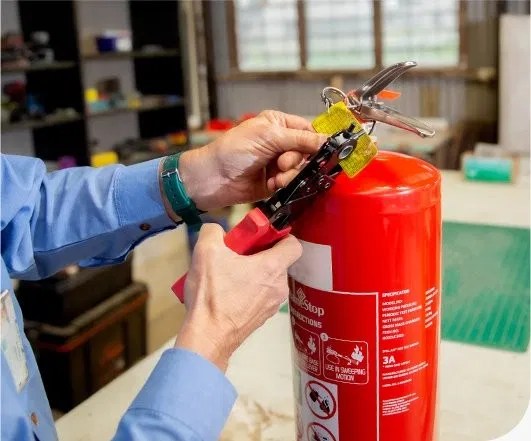
When an RCD fails either a user push-button check or a professional instrument test, immediate corrective action is non-negotiable.
- Immediate Decommissioning: The failing safety switch or associated circuit must be taken out of service immediately. The technician will isolate the power supply and tag the switch as out-of-service to prevent accidental energization.
- Investigation and Replacement: A licensed electrician must determine whether the failure stems from upstream wiring anomalies, excessive leakage current from connected appliances, or internal mechanical degradation of the RCD itself. Defective units must be replaced immediately with compliant, high-quality components.
- Re-Testing and Certification: Following replacement, a full diagnostic verification test is performed to confirm operational parameters before the circuit is reinstated into service. All maintenance actions are recorded in the facility's compliance register.
Legal Penalties and Risk Mitigation: Insurance Invalidation and Safety Fines
What are the legal ramifications of neglecting RCD testing frequencies? Ignoring statutory testing intervals exposes a business to severe regulatory penalties and catastrophic liabilities:
- Statutory Fines: Under Queensland workplace health and safety laws, failing to maintain electrical safety devices can result in substantial corporate fines and personal liabilities for directors and managers.
- Insurance Invalidation: Commercial property and liability insurance policies explicitly require policyholders to comply with relevant Australian Standards (such as AS/NZS 3760 and AS/NZS 3000). If an electrical fire or injury occurs and investigations reveal lapsed RCD testing records, insurers may legally deny coverage, leaving the business exposed to devastating financial losses.
Proactive risk mitigation requires partnering with certified professionals who understand local regulatory enforcement across Brisbane and Ipswich. Learn more about customized statutory requirements by reviewing our detailed RCD testing Brisbane compliance guide.
Risks of Non-Compliance: Legal Penalties and Insurance Risks

Managing multiple separate contractors for electrical testing, fire extinguisher servicing, and emergency exit light checks is inefficient, costly, and prone to scheduling oversights.
At ABC Test Tag & Fire, we provide an integrated, cost-efficient solution for businesses across all Brisbane suburbs and Ipswich. By bundling your RCD testing with comprehensive electrical test & tag services and routine fire service maintenance, your organization achieves:
- 20–40% Cost Savings: Bundling services eliminates duplicate call-out fees and streamlines service delivery into a single, predictable appointment.
- Earn Qantas Points: Reward your business by earning Qantas Business Rewards points on all compliance services.
- Fast Digital Reporting & QR-Coded Tags: Receive instant digital compliance certificates, transparent asset registers, and durable QR-coded tags on all tested equipment.
- Local Expertise: Fully insured, locally owned technicians dedicated to protecting Brisbane and Ipswich workplaces.
Conclusion & Next Steps
Maintaining precise RCD testing frequencies is a fundamental pillar of corporate governance, workplace safety, and legal compliance in Queensland. Do not leave your employees, assets, and insurance validity to chance.
Take control of your regulatory obligations today. Contact ABC Test Tag & Fire to schedule your comprehensive safety assessment, bundle your compliance services, and secure your Brisbane or Ipswich workplace.