
Rocklea is a major industrial and logistics precinct in Brisbane’s south-west, supporting warehouses, factories, workshops, transport depots, trade suppliers, offices, retail premises and market-related operations. Activity around the Rocklea Markets, Sherwood Road industrial corridor and Ipswich Road creates a working environment where electrical equipment, mobile plant, storage systems, vehicles and fire-protection equipment must be managed systematically.
For these workplaces, compliance is not limited to attaching a test tag. A defensible safety program should address electrical inspection and testing, RCD performance, fire equipment accessibility, emergency egress, environmental exposure and accurate digital records.
ABC Test Tag & Fire provides test and tag Rocklea services, RCD testing, fire extinguisher servicing and exit light testing for businesses throughout Rocklea, Brisbane, Ipswich, the Gold Coast and surrounding areas.
What Does Industrial Safety Compliance Require in Rocklea?
Why does Rocklea’s industrial environment require a risk-based approach?
Industrial workplaces typically expose equipment to greater mechanical movement, dust, moisture, impact and cord damage than a controlled office. In Rocklea, businesses should also consider:
- High-volume freight and vehicle movements
- Portable tools used in warehouses, workshops and depots
- Refrigeration, loading-bay and market-related equipment
- Stock stored near electrical outlets, leads and switchboards
- Moisture exposure in wash-down, loading and outdoor areas
- Flood and overland-flow exposure at individual properties
- Restricted access to fire extinguishers or exit paths caused by stock
- Temporary equipment used during maintenance, fit-outs or construction
Rocklea businesses should check their individual site conditions rather than assume that every property carries the same risk. Brisbane City Council’s FloodWise Property Report provides property-specific information about flood types, historic levels and relevant planning data.
Flood exposure also has direct electrical-safety implications. Water-damaged equipment, power boards, extension leads and appliances must not be returned to service merely because they appear dry. Isolate them and arrange assessment by an appropriately competent person or licensed electrical contractor.
What Is Included in Test and Tag Rocklea Services?
How does electrical test and tag support compliance?
Electrical test and tag is a systematic process involving visual inspection, electrical testing, identification, tagging and recordkeeping. ABC Test Tag & Fire can assess workplace equipment including:
- 240V portable appliances
- Three-phase equipment and cord sets
- Power tools and portable lighting
- Extension leads and power boards
- Office and administration equipment
- Warehouse and workshop appliances
- Cleaning equipment and chargers
- Relevant low-voltage equipment
- Equipment used in temporary or higher-risk areas
Testing is performed in accordance with the applicable requirements of AS/NZS 3760:2022, the current technical framework for in-service inspection and testing of electrical equipment and RCDs.
The process generally includes:
- Visual inspection of plugs, cords, enclosures, strain relief, pins and accessories.
- Electrical testing appropriate to the equipment classification.
- Identification using an asset number, plant number, serial number or other reliable reference.
- Pass tagging with the test date, next due date and tester identification.
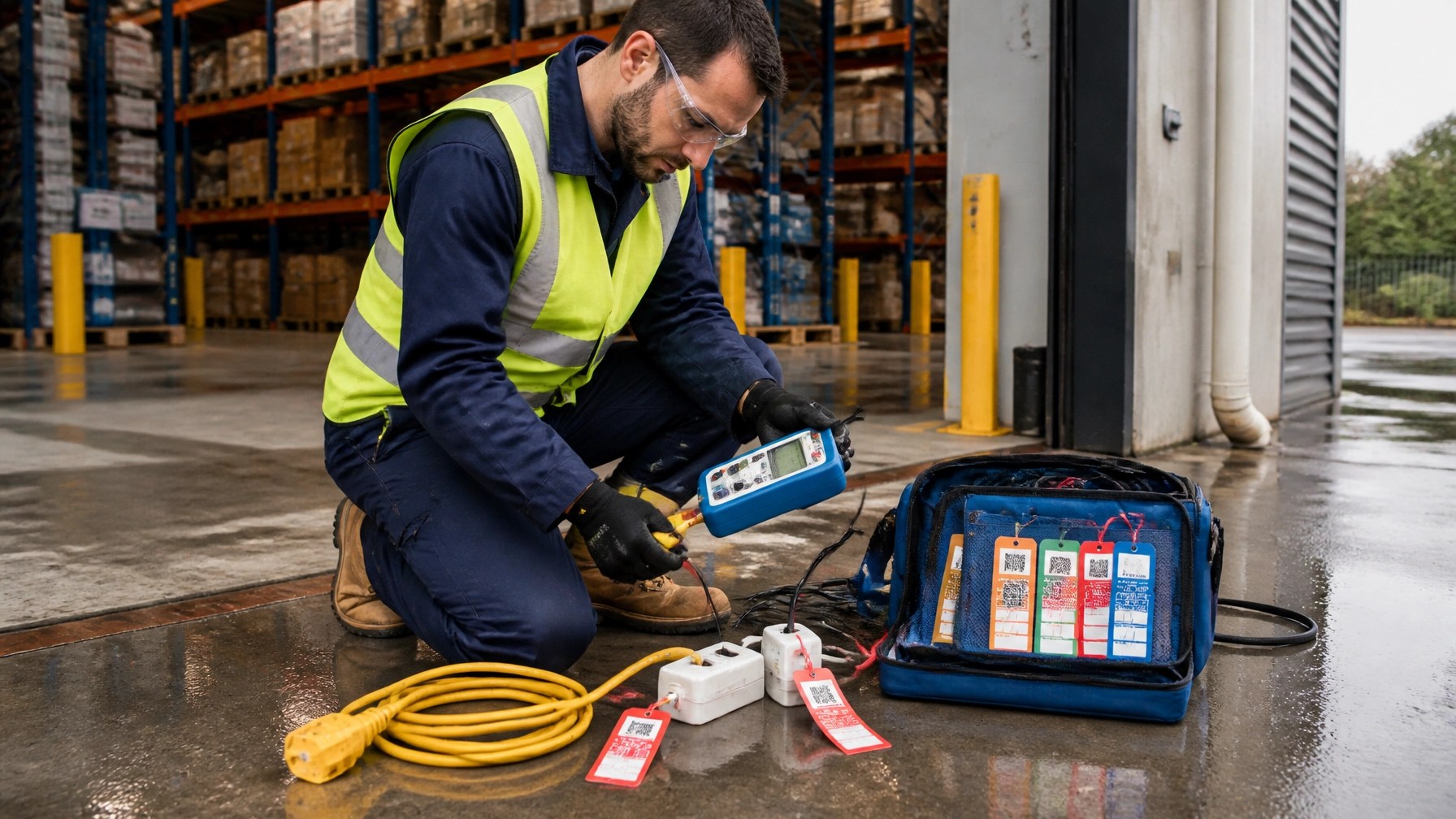
- Isolation of failed equipment using a conspicuous “Do Not Use” or out-of-service label.
- Digital reporting recording results, defects, locations and corrective actions.
A tag is not proof that an item is permanently safe. Equipment must remain in service only while it is maintained, used correctly and protected from damage.
What Are the RCD Testing Requirements?
RCDs, commonly called safety switches, are designed to disconnect electrical supply when they detect an imbalance in current. They are an important protective measure, but an RCD must be tested to confirm that it operates within the required parameters.
Is pressing the test button enough?
No. The operator push-button test confirms that the RCD’s test mechanism causes the device to trip. It does not provide the same evidence as an instrument test measuring operating performance.
A competent person may conduct instrument testing using appropriate calibrated equipment. The testing program should distinguish between:
- Fixed RCDs and portable RCDs
- Push-button testing and instrument testing
- Construction, manufacturing, warehouse and office environments
- Equipment protected by a safety switch and equipment without that protection
- Normal operating conditions and higher-risk or hostile environments
The following table provides practical starting points. It is not a substitute for the current Queensland Regulation, the applicable standard or a site-specific risk assessment.
| Workplace environment | Typical risk factors | Practical testing consideration |
|---|---|---|
| Construction or refurbishment site | Frequent movement, dust, impact and temporary supplies | Electrical equipment may require testing at short intervals, commonly three-monthly; portable RCDs may require testing before use and at prescribed intervals |
| Factory or workshop | Machinery, vibration, cord movement, metalwork and contamination | Equipment commonly requires more frequent inspection than office equipment; six-monthly programs may be appropriate depending on risk |
| Warehouse or transport depot | Forklift movements, charging areas, loading bays and mobile equipment | Assess each zone separately, with shorter intervals for frequently moved or exposed equipment |
| Market-related or wash-down area | Moisture, refrigeration, cleaning processes and outdoor exposure | Use moisture-resistant controls, inspect frequently and isolate equipment after water exposure |
| Office or retail area | Lower mechanical exposure but continued use of leads, chargers and appliances | Longer intervals may be permitted in suitable low-risk conditions, but electrical safety duties still apply |
For further background, refer to ABC Test Tag & Fire’s AS/NZS 3760:2022 guide for Brisbane workplaces.
What Happens to Equipment That Fails?
Why must failed equipment be isolated immediately?
A failed item may have an earth-continuity fault, damaged insulation, incorrect polarity, excessive leakage current or a visible mechanical defect. Continuing to use it exposes workers to electric shock, fire and equipment-failure risks.
The required response is straightforward:
- Stop using the equipment.
- Attach a durable, conspicuous out-of-service label.
- Remove it from the work area where practicable.
- Record the defect and asset details.
- Arrange repair by an appropriately licensed person, or replace the item.
- Retest repaired equipment before returning it to service.
Do not place failed equipment back into a drawer or storage cage without labelling it. Isolation must be clear to anyone who may handle the item.

Caption: Failed extension leads and power boards clearly marked with out-of-service tags for isolation.
Which Queensland Laws Apply to Electrical Safety Compliance Rocklea?
The Electrical Safety Act 2002 (Qld) establishes the primary legal framework for preventing death, injury and property damage caused by electricity. Detailed requirements were previously set out in the Electrical Safety Regulation 2013.
As of 1 September 2026, the Electrical Safety Regulation 2013 has been replaced by the Electrical Safety Regulation 2026. The Queensland Government’s remake retained the practical workplace test-and-tag and RCD requirements, although provisions have been reorganised and renumbered.
Australian Standards are technical frameworks; they are not Acts of Parliament by themselves. However, they may be referenced by legislation, regulatory guidance, contracts, building requirements or workplace procedures. The Regulation takes precedence where a legislative requirement differs from a standard.
“The requirements of the Electrical Safety Regulation take precedence over AS/NZS 3760 where there is a conflict.”
: WorkSafe Queensland, Testing and tagging electrical equipment
Businesses must also manage workplace risks under the Work Health and Safety Act 2011 (Qld). This includes identifying hazards, implementing reasonably practicable controls and preparing emergency arrangements appropriate to the workplace.
How Does Fire Extinguisher Testing Rocklea Work?
Are accessible extinguishers enough?
No. Fire extinguishers and blankets must be both accessible and maintained. Stock, pallets, vehicles or temporary displays must not obstruct fire equipment, signage or evacuation paths.
ABC Test Tag & Fire conducts routine servicing of fire extinguishers and fire blankets in accordance with AS1851:2012, including:
- Six-monthly routine inspections
- Condition and accessibility checks
- Maintenance-tag updates
- Identification of damaged or discharged equipment
- Recommendations for replacement or additional equipment
- Sales of extinguishers, fire blankets and related safety products
- Digital compliance certificates
Routine servicing does not remove the need for employees to understand emergency procedures, fire-equipment locations and evacuation responsibilities.
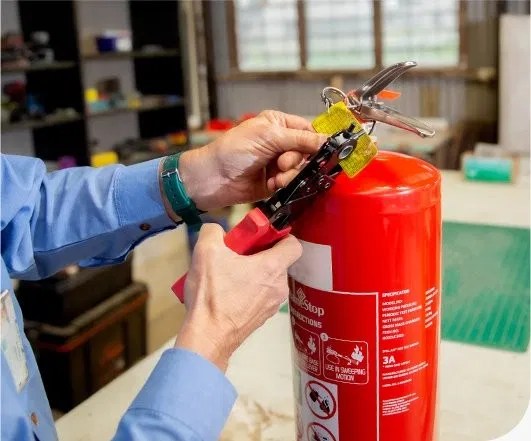
Caption: Technician attaching a maintenance tag to a workplace fire extinguisher during routine servicing.
What Is Required for Exit and Emergency Lighting?
Emergency escape lighting and illuminated exit signs must support safe egress when normal lighting fails. ABC Test Tag & Fire provides testing and sales services in accordance with AS/NZS 2293, including the routine maintenance principles of AS/NZS 2293.2.
Annual testing is commonly scheduled for emergency and exit lighting systems, subject to the building’s requirements, system design and applicable compliance schedule. Inspections should consider:
- Whether exit signs are visible from relevant approaches
- Whether emergency lights illuminate evacuation routes
- Battery and charging indicators
- Physical damage or unauthorised alterations
- Obstructions caused by stock or racking
- Emergency doors and egress paths
- Records of tests, faults and rectification

What Should a Rocklea Workplace Compliance Checklist Include?
Use the following checklist to review your site:
- All relevant electrical equipment has been identified.
- Test intervals reflect the workplace environment and equipment risk.
- RCDs are tested using the required push-button and instrument procedures.
- Failed equipment is isolated and clearly labelled.
- Fire extinguishers and blankets are accessible and not obstructed.
- Fire equipment has current maintenance records.
- Exit signs and emergency lights are visible and operational.
- Emergency egress routes remain clear of stock and vehicles.
- Flood, moisture and water-damage risks have been considered.
- Digital compliance certificates are stored centrally.
- Overdue actions and repeated equipment failures are reviewed.
- Emergency procedures are communicated and tested with workers.
How Can Businesses Save on Compliance Services?
Bundling services reduces scheduling, administration and repeat attendance. ABC Test Tag & Fire can coordinate electrical test and tag, RCD testing, fire servicing and exit light testing during an organised site visit where practicable.
Clients may save up to 40% by combining services. The more services you book, the more you save.
Additional benefits include:
- Durable QR-coded tags
- Fast digital compliance certificates
- Locally owned and fully insured service
- Coverage across Brisbane, Ipswich and the Gold Coast
- Eligibility to earn QANTAS Business Rewards points, subject to program terms
For professional test and tag Brisbane services and local Rocklea compliance support, contact ABC Test Tag & Fire on 1300 66 94 65.
Book electrical testing, RCD testing, fire servicing and exit light testing together to establish a clearer, more efficient workplace compliance program.