Brisbane skyline and ABC Test Tag & Fire brand overview, reflecting the company’s local electrical, fire and emergency-lighting compliance services across industrial workplaces in Wacol and greater Brisbane.
Wacol is a significant industrial and logistics location in Brisbane’s western corridor, with warehouses, freight operations, manufacturing sites, transport depots, workshops and construction-related premises operating around the industrial precinct, Progress Road, major inbound and outbound routes and the Centenary Highway.
These environments commonly use portable electrical equipment, power boards, extension leads, three-phase machinery, battery chargers, tools and safety-critical fire equipment. A structured compliance program is therefore essential: not only to reduce workplace risk, but also to demonstrate that electrical, fire and emergency-evacuation obligations are being actively managed.
ABC Test Tag & Fire provides integrated test and tag Wacol, RCD testing, fire extinguisher servicing, fire blanket servicing, emergency exit-light testing and safety equipment sales for businesses across Wacol, Brisbane, Ipswich and the Gold Coast.
What Does Workplace Safety Compliance Require in Wacol?
Workplace safety obligations arise from Queensland legislation, including the Electrical Safety Act and Regulation and the Work Health and Safety Act and Regulation. These laws place duties on persons conducting a business or undertaking, employers, officers and workers to identify hazards, manage risks and maintain a safe workplace.
Technical standards provide the procedures and criteria used to support those duties. They are not legislation themselves.
The principal standards relevant to Wacol workplaces include:
- AS/NZS 3760:2022 for in-service inspection and testing of electrical equipment and certain RCDs.
- AS 1851:2012 for routine servicing of fire protection systems and equipment, including portable fire extinguishers and fire blankets.
- AS/NZS 2293 for emergency escape lighting and exit signs.
Businesses should consider the applicable legislation, building requirements, equipment manufacturer instructions, workplace risk profile and relevant standards when establishing a compliance schedule. WorkSafe Queensland provides guidance on testing and tagging electrical equipment.
Why Is Test and Tag Important for Wacol Warehouses and Workshops?
Electrical equipment can deteriorate through impact, dust, moisture, heat, vibration, movement and repeated handling. These conditions are common in logistics, manufacturing, construction and workshop environments.
A test and tag program helps identify defects before equipment remains in service. The process generally involves:
- Asset identification – Equipment is identified and, where appropriate, recorded in the compliance system.
- Visual inspection – The cord, plug, casing, pins, strain relief, switches, guards and general condition are examined.
- Electrical testing – Appropriate tests are completed in accordance with the equipment type and applicable procedures under AS/NZS 3760:2022.
- Pass or fail decision – The result is assessed against the relevant safety criteria.
- Durable tagging – Equipment that passes receives a durable, legible compliance tag, including QR-coded identification where applicable.
- Digital documentation – Test results and compliance certificates are provided for internal records and audit preparation.
ABC Test Tag & Fire can test 240V, three-phase and low-voltage equipment, subject to the nature of the equipment and the testing requirements applicable to it.
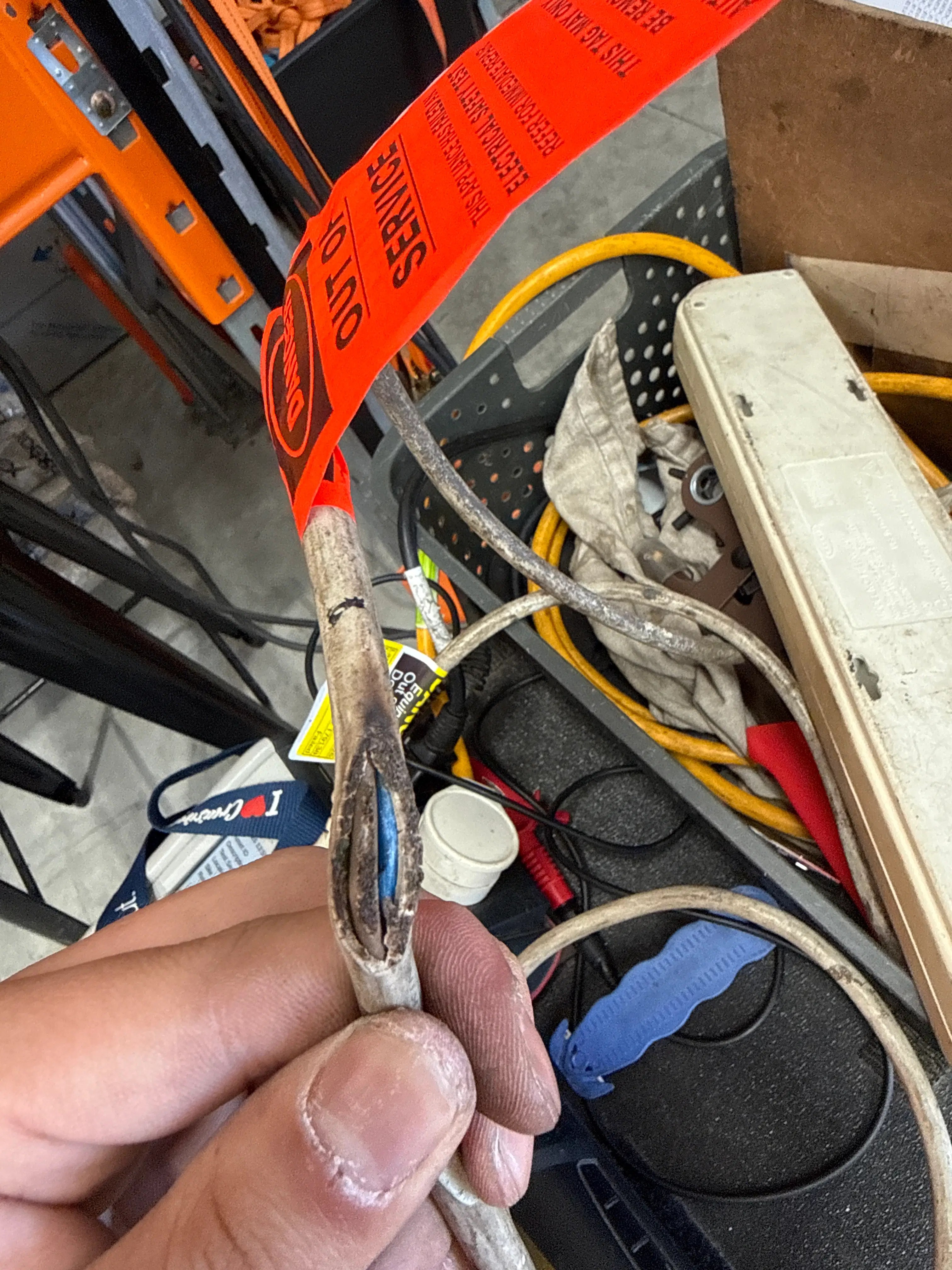
Charred cable removed from operational use and marked out of service, demonstrating the importance of isolating failed electrical equipment before it can present further risk in the workplace.
What Happens When Electrical Equipment Fails?
Failed equipment must not be left in circulation.
Where an appliance, lead, power board or tool fails visual or electrical testing, it should be removed from service, clearly identified and isolated from further use until repaired, replaced or otherwise dealt with by a competent person.
A practical failed-equipment process includes:
- Attach a clear Danger: Out of Service tag.
- Remove the item from the work area where practicable.
- Notify the responsible supervisor or site manager.
- Record the defect and test result.
- Arrange repair, replacement or disposal.
- Re-test repaired equipment before returning it to service.
This approach is particularly important where equipment is shared between warehouse teams, contractors, drivers, maintenance personnel and production staff.
How Does RCD Testing Support Electrical Risk Mitigation?
Residual Current Devices, commonly called safety switches, are designed to disconnect electrical supply when an imbalance is detected. They are an important risk-control measure, but they must be tested at the required intervals and maintained in working order.
RCD testing may include:
- Visual inspection of the device and associated equipment.
- Functional operation using the test button where appropriate.
- Electrical performance testing using suitable test equipment.
- Recording the result, test date and any defect requiring rectification.
The required frequency depends on the type of RCD, the workplace environment, the equipment connected to it, the level of risk and applicable Queensland guidance. Construction areas, workshops, outdoor work, wet or harsh environments and frequently moved equipment may require more frequent attention than lower-risk office equipment.
Do not rely only on a tag colour or a previous certificate. Maintain a documented, risk-based schedule.
For additional information, see ABC Test Tag & Fire’s guide to RCD testing in Brisbane.
How Often Should Wacol Businesses Schedule Safety Testing?
There is no single testing interval that applies identically to every item in every workplace. The schedule should be determined through a documented risk assessment and consideration of:
- The type and construction of the equipment.
- How often it is used or moved.
- Whether it is exposed to dust, moisture, heat, chemicals or mechanical damage.
- Whether it is used by multiple workers or contractors.
- The workplace industry and work activity.
- Previous failure rates.
- Manufacturer requirements and relevant regulatory guidance.
A useful planning framework is:
| Compliance area | Typical scope | Scheduling considerations | Required follow-up |
|---|---|---|---|
| Electrical test and tag | Visual inspection and electrical testing of portable, plug-in, 240V, three-phase and low-voltage equipment | Risk-based; consider construction, workshops, warehouses, movement, environment and failure history | Tag passed items; isolate failed items and record corrective action |
| RCD testing | Portable and fixed safety-switch testing, as applicable | Use the interval required by Queensland guidance, risk assessment and the equipment or installation context | Record results and arrange qualified rectification for failures |
| Fire extinguishers | Inspection and routine servicing under AS 1851:2012 | ABC Test Tag & Fire provides six-monthly routine servicing as part of its fire service offering; additional service requirements may apply | Maintain service records, replace defective units and preserve access |
| Fire blankets | Condition, packaging, accessibility and suitability checks | Include kitchens, staff facilities, workshops and areas where combustible materials are handled | Replace damaged, contaminated or inaccessible blankets |
| Emergency exit lights | Functional and emergency-operation checks under AS/NZS 2293 | Annual testing is offered by ABC Test Tag & Fire; confirm the site-specific statutory and maintenance schedule | Rectify failed batteries, fittings, signs or illumination issues |
| Safety equipment sales | Fire extinguishers, blankets, exit signs and related equipment | Select equipment according to the hazard, location and applicable requirements | Install, position and maintain equipment so it remains accessible |
The schedule must be documented and reviewed when the workplace layout, plant, tenancy, operations or risk profile changes.
What Is Included in Fire Extinguisher Testing and Sales?
Fire equipment is only useful when it is correctly selected, serviceable, visible and accessible. In a Wacol warehouse, workshop or transport depot, extinguishers may be obstructed by stock, pallets, vehicles, racking or temporary materials.
Routine fire service activities may include:
- Checking extinguisher location and accessibility.
- Inspecting the cylinder, hose, nozzle, pin and safety seal.
- Checking labels, pressure indicators and visible condition.
- Identifying corrosion, damage, discharge or other defects.
- Applying the appropriate maintenance record tag.
- Providing digital compliance documentation.
- Recommending replacement or additional equipment where required.
ABC Test Tag & Fire also supplies fire extinguishers, fire blankets and other safety equipment. Equipment selection should reflect the fire risks present, such as ordinary combustibles, flammable liquids, electrical equipment or cooking hazards.
Keep fire equipment unobstructed. Do not store pallets or materials in front of extinguishers, hose reels or exit paths.

Overdue fire extinguisher in a workplace setting, illustrating the importance of timely routine servicing, maintenance records and rectification under AS 1851:2012.
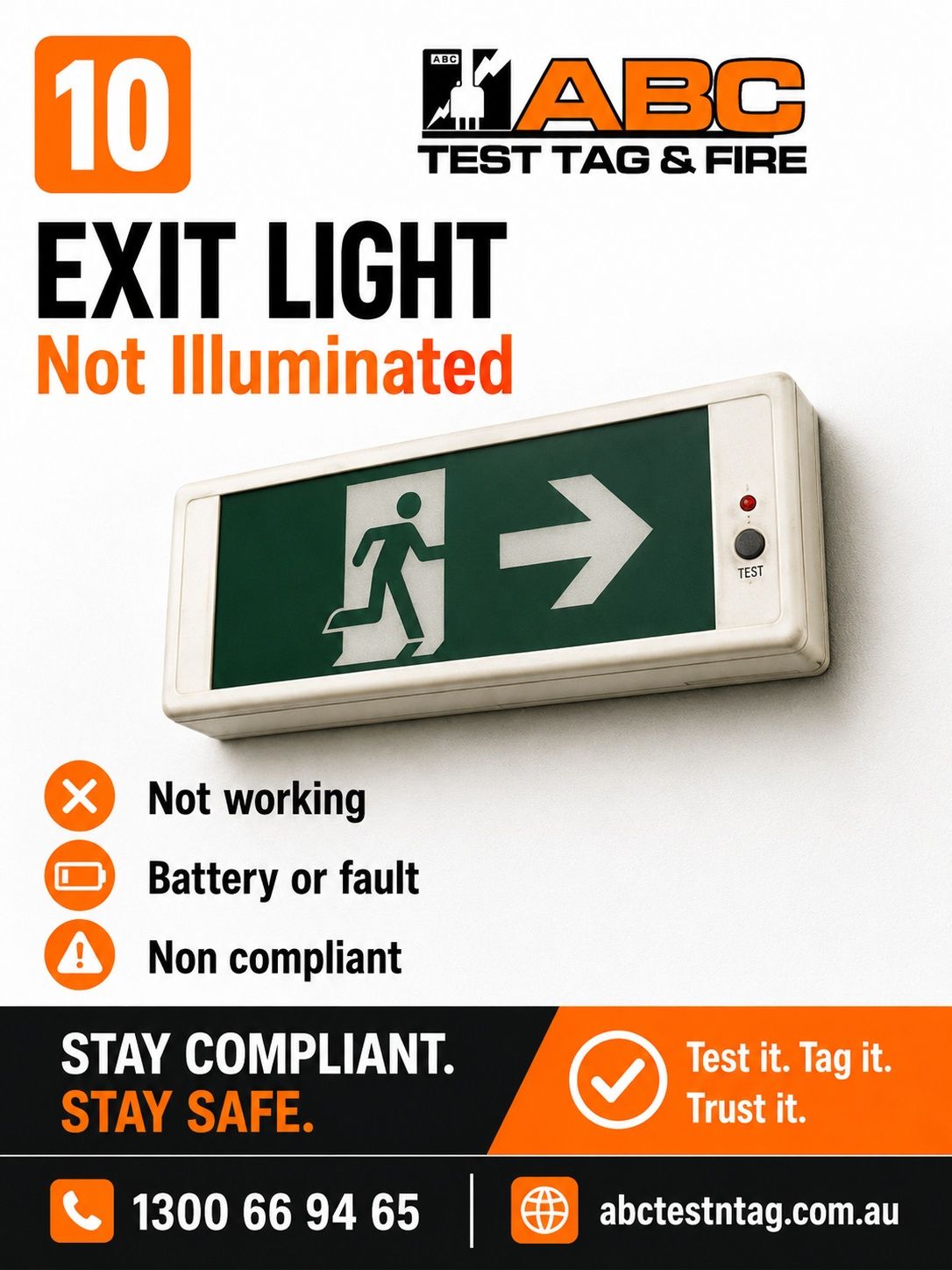
Non-illuminated exit light in a commercial workplace, demonstrating why emergency-lighting systems must be inspected, tested and promptly rectified when signage or illumination is not functioning as intended.
Why Are Exit Lights and Emergency Egress Controls Essential?
In an emergency, workers, visitors and contractors must be able to identify escape routes and exit points, including where normal lighting may be unavailable.
Emergency-lighting compliance should consider:
- Visibility of exit signs from relevant approaches.
- Clear access to exit doors and pathways.
- Operation of emergency luminaires.
- Battery and fitting condition.
- Obstructions caused by storage, racking or temporary work.
- Coordination with evacuation plans and site inductions.
ABC Test Tag & Fire provides exit light and emergency-light testing and sales in accordance with the relevant AS/NZS 2293 requirements and site-specific obligations. Failed fittings, batteries or signs should be recorded and rectified promptly.
How Can Digital Records Improve Contractor Coordination?
Wacol sites often involve multiple parties: property managers, warehouse operators, principal contractors, subcontractors, transport providers and maintenance teams. Compliance records must therefore be easy to access and understand.
ABC Test Tag & Fire provides:
- QR-coded tags for asset identification.
- Digital compliance certificates.
- Recorded pass and fail results.
- Defect and corrective-action information.
- Service documentation for electrical and fire equipment.
- Fast, hassle-free reporting by email.
Before a scheduled visit, nominate a site contact, identify restricted areas, advise workers and contractors, and ensure equipment, switchboards, fire appliances and exit routes are accessible. This reduces delays and supports a systematic inspection process.
Wacol Workplace Safety Compliance Checklist
Use this checklist when preparing for a compliance review:
- Portable electrical equipment is listed or identifiable.
- Extension leads and power boards are free from visible damage.
- Three-phase and low-voltage equipment has been assessed appropriately.
- RCDs are included in the testing schedule.
- Failed electrical equipment is isolated and tagged out.
- Fire extinguishers are visible, accessible and correctly positioned.
- Fire blankets are present where required and remain in good condition.
- Exit doors and emergency paths are not obstructed.
- Exit signs and emergency lights are tested to the applicable schedule.
- Contractor and maintenance records are coordinated.
- Digital certificates are stored for audit and management review.
- Defects have assigned owners and completion dates.
Frequently Asked Questions About Test and Tag Wacol
Is test and tag legally required for every item in a Wacol workplace?
The obligation is to manage electrical risks and ensure equipment is safe. The applicable testing requirements depend on the equipment, work activity, environment and Queensland regulatory guidance. A documented risk assessment should establish the program.
Can ABC Test Tag & Fire test warehouse and industrial equipment?
ABC Test Tag & Fire provides testing for 240V, three-phase and low-voltage equipment, including equipment used in warehouses, factories, workshops, logistics operations and worksites, subject to the item and applicable testing requirements.
What happens if an item fails?
The item should be removed from service, clearly tagged, recorded and repaired or replaced. It should not return to use until appropriately assessed and, where necessary, re-tested.
Can electrical, fire and exit-light services be booked together?
Yes. Combining services can reduce administration and site disruption. Businesses can save up to 40% through bundled services: the more services you book, the more you save.
Can businesses earn QANTAS Business Rewards points?
Eligible services may earn QANTAS Business Rewards points, subject to program eligibility, applicable terms and conditions. Confirm eligibility when requesting a quotation.
Which areas does ABC Test Tag & Fire cover?
ABC Test Tag & Fire is locally owned and fully insured, providing services across Brisbane, Ipswich, the Gold Coast and surrounding suburbs, including Wacol.
Book Test and Tag and Fire Compliance Services in Wacol
A coordinated compliance program provides a practical way to manage electrical testing, RCD testing, fire equipment servicing, emergency lighting and digital records across an industrial site.
ABC Test Tag & Fire offers local service, QR-coded tags, digital certificates, qualified and fully insured technicians, safety equipment sales and bundled savings of up to 40%.
Contact ABC Test Tag & Fire or call 1300 66 94 65 to discuss test and tag Wacol, fire extinguisher testing, exit-light testing and an integrated compliance schedule for your workplace.
This article provides general information only. Businesses should obtain advice appropriate to their premises, equipment, work activities and current Queensland legal requirements.