Suggested SEO meta description: Learn which electrical test and tag records Brisbane businesses must keep for AS/NZS 3760:2022 compliance, including asset registers, RCD results, repairs, QR tags and digital certificates.
Target keywords: electrical test and tag Brisbane, test and tag Brisbane, AS/NZS 3760 compliance, electrical compliance certificates Brisbane, QR-coded test tags, workplace electrical records
Why Are Workplace Electrical Records Important?
For Brisbane business owners, facility managers and safety officers, a test tag attached to a power lead is only one part of an electrical safety system. It indicates that an item was inspected and tested at a particular time, but it does not provide the complete evidence needed to demonstrate a systematic compliance process.
A robust recordkeeping system should show:
- What equipment was inspected
- Where the equipment is located
- What visual defects were identified
- Which electrical tests were completed
- Whether the item passed or failed
- What action was taken when a fault was found
- When the next inspection is due
- Who performed the work and whether they were competent
- Which certificate or report relates to the asset
This information is particularly important during internal audits, insurance reviews, incident investigations or requests from a workplace safety regulator.
What Is AS/NZS 3760:2022: and What Is Queensland Law?
AS/NZS 3760:2022 is the technical framework for the in-service safety inspection and testing of electrical equipment and residual current devices. It provides a structured method for visual inspection, electrical testing, RCD testing, tagging and record management.
However, AS/NZS 3760:2022 is not Queensland legislation.
Queensland businesses must also consider their duties under the:
- Electrical Safety Act 2002
- Electrical Safety Regulation 2013
- Work Health and Safety Act 2011 and associated WHS duties
- Applicable requirements for construction and demolition work, including AS/NZS 3012 where relevant
The legal obligation is to manage electrical risks and provide a safe workplace. AS/NZS 3760:2022 supports that obligation by setting out an accepted technical and procedural approach.
Regulatory principle: Queensland businesses should be able to demonstrate that workplace electrical equipment is identified, assessed, maintained and controlled through a documented process.
: Refer to WorkSafe Queensland guidance on testing and tagging electrical equipment
The required testing approach may vary according to the workplace environment, equipment type and risk profile. Construction sites, factories, warehouses and workshops generally require more frequent controls than low-risk office environments.
What Equipment Should Be Included in the Register?
A complete workplace electrical register should cover relevant in-service equipment, not merely the items that were easiest to find during the last visit.
Depending on the workplace, this may include:
- 240V portable appliances
- 3-phase equipment and machinery
- Low-voltage equipment and power supplies
- Extension leads and portable power boards
- Portable tools and test instruments
- Kitchen and hospitality equipment
- Office appliances
- Workshop and factory equipment
- Construction-site tools, leads and portable RCDs
- Fixed and portable RCDs
The register should identify the work environment, equipment owner or department, asset location and the type of use. Equipment used in a warehouse, workshop or construction environment may experience greater mechanical damage, moisture, dust and cord flexing than equipment used in a controlled office.
Why Is Visual Inspection Alone Not Enough?
Visual inspection is essential, but it cannot identify every electrical defect.
A competent person may identify visible concerns such as:
- Cut, crushed or abraded cords
- Damaged plugs or pins
- Exposed conductors
- Cracked housings
- Missing guards or covers
- Heat damage or discolouration
- Damaged strain reliefs
- Signs of moisture ingress or unauthorised modification
However, some faults are not visible. Insulation breakdown, earth continuity problems, leakage current and incorrect polarity may require electrical testing with suitable calibrated equipment.
The correct process is therefore:
- Identify the asset.
- Complete a visual inspection.
- Remove the item from service if a visual defect is found.
- Perform the appropriate electrical tests if the item passes visual inspection.
- Record the results.
- Apply a compliant tag only when the item passes.
- Provide a report or certificate linked to the asset record.
Do not treat visual inspection as a substitute for electrical testing where testing is required by the workplace risk assessment, applicable legislation, standard or site procedure.
What Should an Audit-Ready Electrical Record Contain?
Each asset record should contain sufficient information to reconstruct the inspection and testing history.
1. Asset identification
Record:
- Unique asset number or QR code
- Equipment description
- Make, model and serial number where available
- Location, department or work area
- Equipment owner or responsible manager
- Equipment class or relevant environment
2. Visual inspection results
Record the condition of the:
- Cord and outer sheath
- Plug, pins and socket connection
- Appliance enclosure
- Strain relief
- Switches, guards and ventilation
- Signs of overheating, contamination or modification
Record both individual findings and the overall visual pass/fail result.
3. Electrical test results
Depending on the equipment, records may include:
- Earth continuity resistance
- Insulation resistance
- Leakage current
- Polarity
- Protective conductor or earth integrity
- Functional test outcome
- Instrument identification or calibration reference
A simple “tested” entry is weak evidence. Where applicable, record actual readings and the limits or criteria used to determine the outcome.
4. RCD results
RCD records should be maintained separately or clearly linked to the relevant asset and circuit. Record:
- RCD identification and location
- Fixed or portable status
- Circuit or switchboard reference
- Test date and next due date
- Trip time
- Trip current where measured
- Push-button test result
- Pass/fail outcome
- Corrective action or replacement details
For further information, see ABC Test Tag & Fire’s RCD testing Brisbane guide.
5. Status and corrective action
The register should clearly state whether the asset is:
- Passed and in service
- Failed
- Withdrawn from service
- Awaiting repair
- Repaired and awaiting retest
- Replaced or disposed of
A failed item should be isolated or removed from use. Record the fault, the person notified, the repair or disposal decision, and the retest result before returning the equipment to service.

Why Is a QR-Coded Tag More Effective Than a Basic Tag?
A durable, legible test tag should display the relevant test information, including the test date, next due date, tester or service-provider identification and status.
A QR-coded test tag can provide an additional link between the physical asset and its digital history. When scanned, it may allow an authorised manager to access:
- Previous test results
- Visual inspection notes
- RCD information
- Repair and retest history
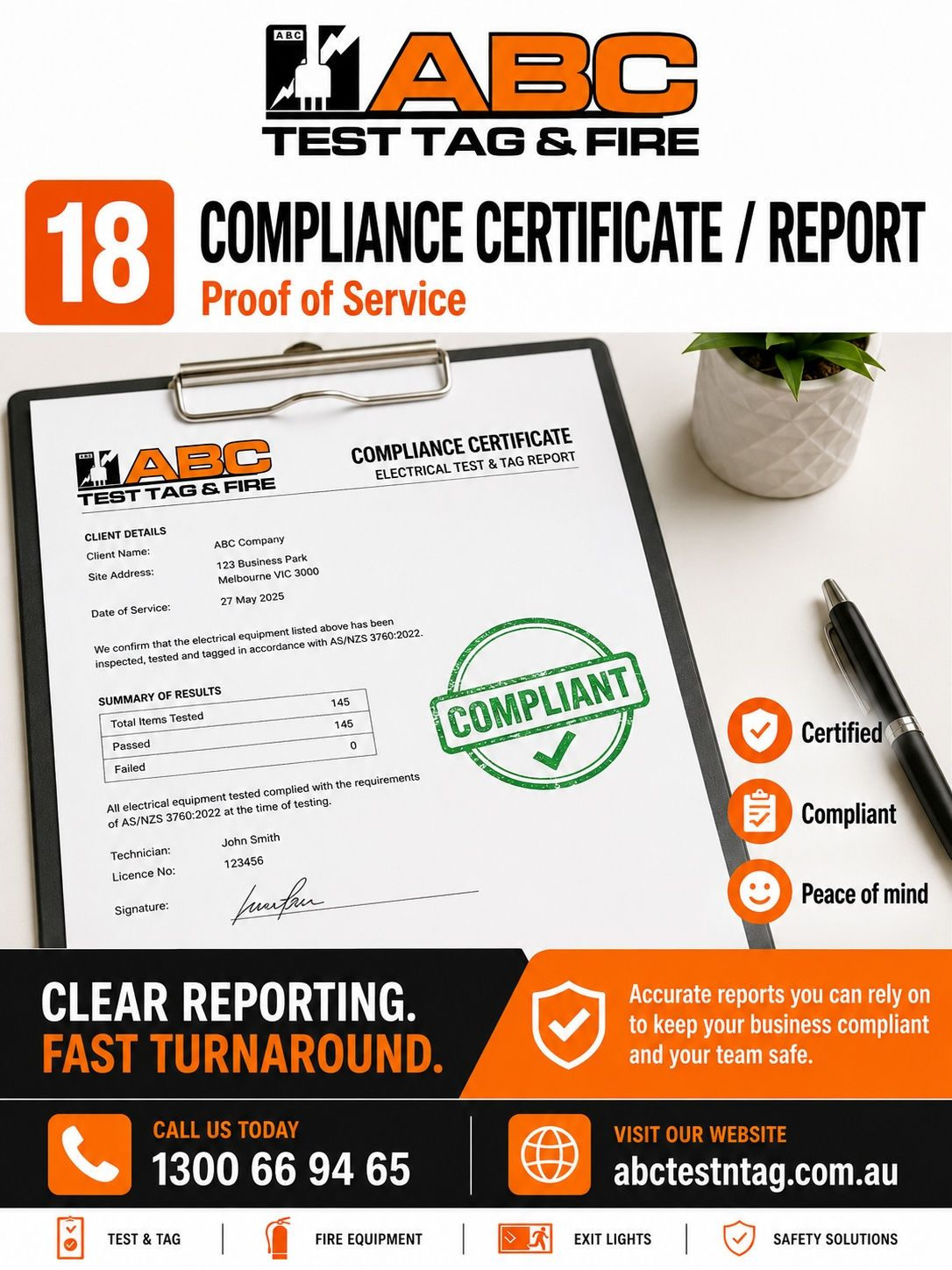
- Digital compliance certificates
- Next scheduled service date
The QR code does not replace the physical tag or the underlying record. It strengthens traceability by making the asset history easier to retrieve at the point of use.
A tag without supporting records is weak evidence because it may not demonstrate what was tested, which test method was used, whether an item previously failed or whether the tag belongs to the equipment being inspected.
Sample Audit-Ready Record Table
| Asset ID | Equipment and location | Visual result | Electrical/RCD result | Status | Test date | Next due | Technician |
|---|---|---|---|---|---|---|---|
| QR-1048 | 240V drill, workshop | Pass | Earth 0.18Ω; insulation 200MΩ | Pass | 08/09/2026 | 08/12/2026 | Competent tester ID 214 |
| QR-1052 | 3-phase grinder, factory | Pass | Test readings recorded | Pass | 08/09/2026 | 08/03/2027 | Competent tester ID 214 |
| RCD-021 | Fixed RCD, switchboard 2 | Pass | Trip time recorded; pass | Pass | 08/09/2026 | Per risk schedule | Competent tester ID 214 |
| QR-1061 | Extension lead, warehouse | Fail | Damaged sheath | Withdrawn | 08/09/2026 | Retest after repair | Competent tester ID 214 |
The record should also link to the relevant digital certificate, service report, fault record and repair documentation.
Practical Workplace Electrical Records Checklist
Before an audit or scheduled inspection, confirm that your business has:
- A current asset register
- QR-coded or uniquely identifiable asset tags
- Visual inspection results
- Electrical test readings where applicable
- RCD test results
- Pass/fail status for every item
- Out-of-service and failed-equipment records
- Repair, replacement and retest history
- Test dates and next due dates
- Technician name, business and competency information
- Digital compliance certificates
- Backups and controlled access to electronic records
- A documented testing interval based on workplace risk
- Records retained for the period required by applicable obligations and organisational policy
ABC Test Tag & Fire provides electrical test and tag services in Brisbane, including visual and electrical testing of 240V, 3-phase and low-voltage equipment, RCD testing, QR-coded asset tags and digital compliance certificates.

How Can Businesses Coordinate Electrical, Fire and Emergency-Lighting Compliance?
Recordkeeping becomes more efficient when related safety services are coordinated during one planned compliance visit.
ABC Test Tag & Fire also provides:
- Six-monthly fire extinguisher and fire blanket servicing under AS1851:2012
- Fire equipment sales, including extinguishers and blankets
- Annual emergency lighting and exit-sign testing under AS/NZS 2293
- Exit-light sales and replacement support
- Digital certificates and service reports

Coordinating electrical testing, RCD testing, fire equipment servicing and emergency-lighting inspections can reduce administrative duplication and help managers maintain a single compliance calendar.
ABC Test Tag & Fire is locally owned, fully insured and services Brisbane, Ipswich, the Gold Coast and surrounding suburbs. Businesses can save up to 20–40% by bundling services: the more services you book, the more you save. Eligible customers may also earn QANTAS Business Rewards points, subject to applicable terms and conditions.
Frequently Asked Questions
Is AS/NZS 3760:2022 a Queensland law?
No. It is a technical standard. Queensland legal duties arise primarily from legislation such as the Electrical Safety Act 2002, Electrical Safety Regulation 2013 and WHS requirements. AS/NZS 3760:2022 provides a recognised framework for managing in-service electrical equipment and RCD safety.
Is a test tag enough to prove compliance?
No. A tag provides limited information. A stronger compliance position includes an asset register, inspection results, electrical readings, RCD results, failed-equipment actions, repair history, technician details and digital certificates.
How long should workplace electrical records be kept?
Retention requirements can depend on the applicable regulation, workplace policy, contract and incident circumstances. A conservative business practice is to retain records for at least the life of the equipment and commonly seven years, while confirming current obligations for your workplace.
Does every office appliance need the same testing frequency?
No. Testing intervals depend on the type of work, equipment, environment, risk assessment and applicable Queensland requirements. Office, service, construction, warehouse and factory workplaces should not automatically be placed on the same schedule.
Can digital certificates replace paper records?
Digital records can provide efficient, searchable and auditable evidence when they are accurate, secure, backed up and retrievable. They should remain linked to the physical asset and QR-coded tag.
Book Electrical Test and Tag in Brisbane
A compliant recordkeeping system should make every asset traceable from inspection to certificate, and from failure to repair and retest.
For electrical test and tag Brisbane services, RCD testing, QR-coded test tags, digital compliance certificates, fire equipment servicing and exit-light testing, contact ABC Test Tag & Fire on 1300 66 94 65.
Leave a Reply