For business owners and facility managers across Brisbane and Ipswich, workplace safety is not merely a checkbox; it is a rigorous regulatory requirement. When a Queensland Fire and Emergency Services (QFES) auditor or a workplace health and safety (WHS) inspector arrives at your premises, the condition and documentation of your fire extinguishers are among the first elements scrutinized.
Non-compliance with Australian Standard AS 1851:2012 (Routine service of fire protection systems and equipment) and the Building Fire Safety Regulation 2008 carries significant legal and financial risks. To ensure your site remains compliant and your personnel protected, we have outlined the ten critical components of fire extinguisher maintenance you must address before your next audit.
1. What Is the Required Frequency for Extinguisher Inspections?
The primary regulatory requirement for portable fire extinguishers in Queensland is a six-monthly routine service. Under Section 10 of AS 1851:2012, fire extinguishers must undergo a systematic inspection every six months to ensure they remain functional and accessible.
This is not a suggestion; it is a mandate. A common failure in workplace audits is a "lapsed" service tag, where the last recorded inspection was eight or twelve months prior. Maintaining a strict six-monthly schedule demonstrates a commitment to safety and provides a continuous chain of compliance evidence for your fire extinguisher test and tag obligations.
2. Why Is the Five-Year Hydrostatic Test Non-Negotiable?
While six-monthly visual inspections are essential, the structural integrity of the extinguisher cylinder itself must be verified through hydrostatic pressure testing every five years. This involves emptying the unit and subjecting the cylinder to high-pressure water testing at an authorized station.
Auditors specifically look for the "Last Pressure Test" date stamped on the extinguisher or recorded on the service tag. If a unit exceeds this five-year threshold without testing or replacement, it is immediately deemed non-compliant. For many Brisbane businesses, it is often more cost-effective to replace the unit entirely every five years, ensuring you have the latest technology and a fresh manufacturer’s warranty.
3. How Critical Is Location and Accessibility?
An extinguisher is useless if it is inaccessible during an emergency. Auditors will verify that:
- Extinguishers are located in their designated positions.
- The path to the extinguisher is unobstructed (no stock, furniture, or debris blocking the way).
- Units are mounted at the correct height (typically between 100mm and 1200mm from the floor).
A common audit "fail" in warehouses and retail shops is placing stock in front of extinguishers. Regulatory requirements dictate that fire safety equipment must be "readily accessible" at all times.
4. Are Your Signage Standards Compliant?
Visibility is a core component of fire safety compliance in Brisbane. Each extinguisher must have an identification sign (ID sign) mounted directly above it. These signs must be clearly visible from a distance and use the correct Australian Standard symbols and colors to identify the type of fire the extinguisher is designed to combat (e.g., A:B(E) for dry chemical or CO2 for electrical risks).
5. What Are the Indicators of Physical Damage?
During an audit, the physical condition of the unit is closely examined. Technicians and auditors look for:
- Corrosion: Any signs of rust on the cylinder, especially at the base.
- Dents or Scratches: Structural damage that could compromise the pressure vessel.
- Hose Integrity: Cracks, blockages, or brittle material in the discharge hose.
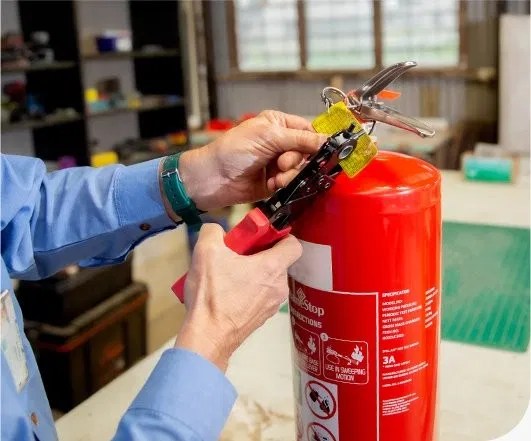
- Anti-Tamper Seals: The yellow or plastic seal must be intact, indicating the safety pin has not been removed.
If an anti-tamper seal is broken, the unit is flagged as "defective" because there is no guarantee it contains its full charge.
6. How Is Pressure and Weight Monitored?
Most modern extinguishers utilize a pressure gauge. The needle must remain firmly within the "green" operable zone. However, for CO2 extinguishers, which do not have gauges, compliance is determined by weight. A technician will weigh the unit and compare it to the "full weight" stamped on the cylinder head. A loss of 10% of the contents requires an immediate recharge or replacement.
7. Who Is a "Competent Person" for Testing?
Legislation requires that fire safety equipment be serviced by a "competent person." In Queensland, this typically refers to technicians who possess the relevant accreditation and training in AS 1851:2012. Utilizing an uncertified individual to "tick the box" is a high-risk strategy that will not withstand the scrutiny of a formal audit or an insurance investigation following a fire event.
ABC Test Tag & Fire provides fully insured, expert technicians who specialize in test and tag services across Brisbane and Ipswich, ensuring your documentation is legally robust.
8. Why Is Digital Reporting the Modern Standard?
Paper logbooks are prone to damage, loss, and illegibility. Modern auditors prefer: and often demand: digital compliance records. Our systematic process includes providing digital compliance certificates and QR-coded tags.
These digital records allow you to:
- Instantly retrieve service history during an audit.
- Track asset locations across multiple sites.
- Provide a clear audit trail for insurance providers.
- Receive automatic reminders for your next 6-monthly service.
9. Can You Bundle Fire and Electrical Testing for Savings?
A significant advantage for businesses in the Brisbane and Ipswich regions is the ability to bundle fire extinguisher testing with electrical test and tag services.
"By integrating fire safety and electrical compliance into a single service visit, businesses can achieve cost efficiencies of 20% to 40%."
Bundling reduces the "site visit" fees and minimizes workplace disruption. It also ensures that all your primary safety obligations: fire extinguishers, exit lights, and electrical appliances: are synchronized on the same compliance schedule. For detailed pricing, view our Brisbane test and tag prices guide.
10. How Can Safety Spend Benefit Your Bottom Line?
Compliance is an overhead, but it shouldn't be a sunk cost. ABC Test Tag & Fire is a proud partner of the Qantas Business Rewards program. This means that every dollar you spend on essential safety services: from fire extinguisher testing to RCD testing: earns your business Qantas Points.
These points can be redeemed for flights, hotels, or car hire, effectively turning your mandatory safety budget into a travel asset. You can learn more about earning Qantas Points here.
Conclusion: Mitigation Through Professional Oversight
The goal of fire extinguisher testing is not merely to satisfy an auditor; it is to ensure that when a fire occurs, your equipment functions exactly as designed. A systematic approach to maintenance, anchored in AS 1851:2012, is the only way to mitigate risk and ensure the safety of your occupants.
Whether you operate a retail shop in the Brisbane CBD, a warehouse in Ipswich, or a construction site in Eight Mile Plains, proactive compliance is your best defense.
Is your workplace audit-ready?
Don't wait for an inspector to find a fault. Contact ABC Test Tag & Fire today for a comprehensive, hassle-free safety assessment that saves you money and secures your business.